

Last Updated: November 7, 2026
Quick Summary
Kitchen cabinet materials should be chosen by location: moisture-resistant board or quality plywood for carcasses near the sink and dishwasher, and standard board where the area stays dry. Doors can use MDF for painted finishes or solid timber where repairs matter. Plywood generally holds up better than MDF for carcasses under load.
- Map each wall as wet, dry or heavy-use before choosing any materials.
- Carcass and door materials are separate decisions with different jobs.
- Use 18 mm board where shelf spans are long, as it resists sagging better.
- Confirm moisture-resistant grade, emissions rating and certification in writing.
- Seal every cut-out and edge, especially under the sink, to prevent swelling.
Table of Contents
- Start With Where the Cabinet Will Live
- Kitchen Cabinet Materials Pros and Cons at a Glance
- Plywood vs MDF Kitchen Cabinets: Which Holds Up Better
- Judging Durable Kitchen Cabinet Materials Before You Buy
- Choosing Kitchen Cabinet Finishes That Clean Easily
- Installation, Hardware and Questions to Ask Your Supplier
- Booking Your Cabinet Selection With WDC Services
- Frequently Asked Questions
Start With Where the Cabinet Will Live
Choosing high quality materials for kitchen cabinets starts with the room itself, not the catalogue. The wall, the humidity and the daily traffic around the sink and cooktop decide which materials will hold up.
Kitchen cabinet materials are the core of this decision. The carcass (the box) and the doors often use different materials, and each part has its own job.
Check the kitchen layout before you choose. Wet zones near the sink and dishwasher need moisture-resistant materials. Dry zones, such as a pantry wall, give you more freedom on cost.
A practical starting point is to map each wall of the kitchen and label it wet, dry or heavy-use. That map will tell you where to spend on better materials and where a budget option is fine.
Kitchen Cabinet Materials Pros and Cons at a Glance
Most kitchen cabinets are built from a small group of materials. Each has clear strengths and weaknesses, so compare them against your wet zones and budget.
| Material | Main Strength | Main Weakness | Best Used For |
|---|---|---|---|
| Particleboard | Lowest cost | Swells if it gets wet | Dry, low-use areas |
| Melamine-faced board | Easy to clean, wide colour range | Edges can chip | Budget kitchens, carcasses |
| Moisture-resistant board (HMR) | Better water tolerance | Costs more than standard board | Carcasses near the sink |
| Plywood | Strong, holds screws well | Higher cost, needs quality grading | Carcasses and load-bearing shelves |
| MDF | Smooth surface for painting | Poor water resistance unless sealed | Painted doors in dry areas |
| Solid timber | Repairable, long lifespan | Expensive, moves with humidity | Doors and feature pieces |
Particleboard is the cheapest option, but it suffers quickly from moisture. Melamine-faced board is common in mid-range kitchens because the surface resists stains and is easy to wipe.
Plywood is often the better carcass choice for heavy use. It resists sagging and holds fixings well. MDF gives a flawless painted finish but needs careful sealing wherever water is likely to reach it.
Solid timber suits doors and feature pieces where repairability counts. It is the most expensive option and responds to changes in humidity, so it needs proper finishing.
Reading the Specification, Not Just the Material Name
Two boards with the same name can behave very differently. Before you compare quotes, ask for the specification sheet and check four things.
Board thickness. Carcass boards are commonly supplied in 16 mm and 18 mm thicknesses.
Moisture-resistant grade. HMR particleboard and moisture-resistant MDF use a modified resin in the core that slows water uptake. They are not waterproof.
Emissions rating. Boards made with formaldehyde-based resins release small amounts of formaldehyde over time.
Product certification. Responsible timber sourcing is usually shown through chain-of-custody certification such as FSC or PEFC.
Watch out: a quote that names the material but not the thickness, grade or emissions rating gives you nothing to compare, insist on the specification before you sign.
Matching Material to Component
Treating the kitchen as one material choice is where budgets go wrong. A practical split is:
- Carcasses in wet zones (under the sink, beside the dishwasher): moisture-resistant board or quality plywood, 18 mm where spans are long.
- Carcasses in dry zones: standard particleboard or melamine-faced board is adequate and keeps cost down.
- Doors and drawer fronts: MDF for painted finishes, solid timber for repairability, laminate or vinyl for easy cleaning.
- Exposed panels (end panels, island backs): match the door material so the finish reads consistently.
This component-by-component approach lets you spend where moisture and load actually occur and save where they do not.
Plywood vs MDF Kitchen Cabinets: Which Holds Up Better
For most kitchens, plywood holds up better than MDF over the long term, particularly for carcasses. Plywood is laminated from thin layers of timber, so it resists sagging and keeps screws tight over years of use. MDF is a dense, uniform board. It machines beautifully and gives a smooth painted surface, but it is weaker under sustained load and swells quickly where water sits on it.
MDF still earns its place. It works well for painted doors in dry areas, where the finish is the main attraction and the material stays protected. Many renovators use plywood carcasses with MDF doors, which balances strength and appearance.
Checking Carcass Grade and Edge Banding
Ask your supplier for the grade of plywood and the thickness of the board. Higher-grade plywood has fewer voids in the core, which matters because voids are where screws lose their grip. Check the edge banding too. Edges should be fully sealed with no visible gaps at the corners. Lifting a sample and inspecting the edge under good light takes less than a minute and reveals a lot about the build quality.
Judging Durable Kitchen Cabinet Materials Before You Buy
Durability comes down to how the material behaves under three things: water, weight and repeated handling. Before you buy, test samples where you can, then interrogate the details that decide whether the cabinet survives ten years of cooking. Because a sound finish helps protect cabinet surfaces from moisture and daily wear, choosing cabinet painters carefully is part of making durable materials last.
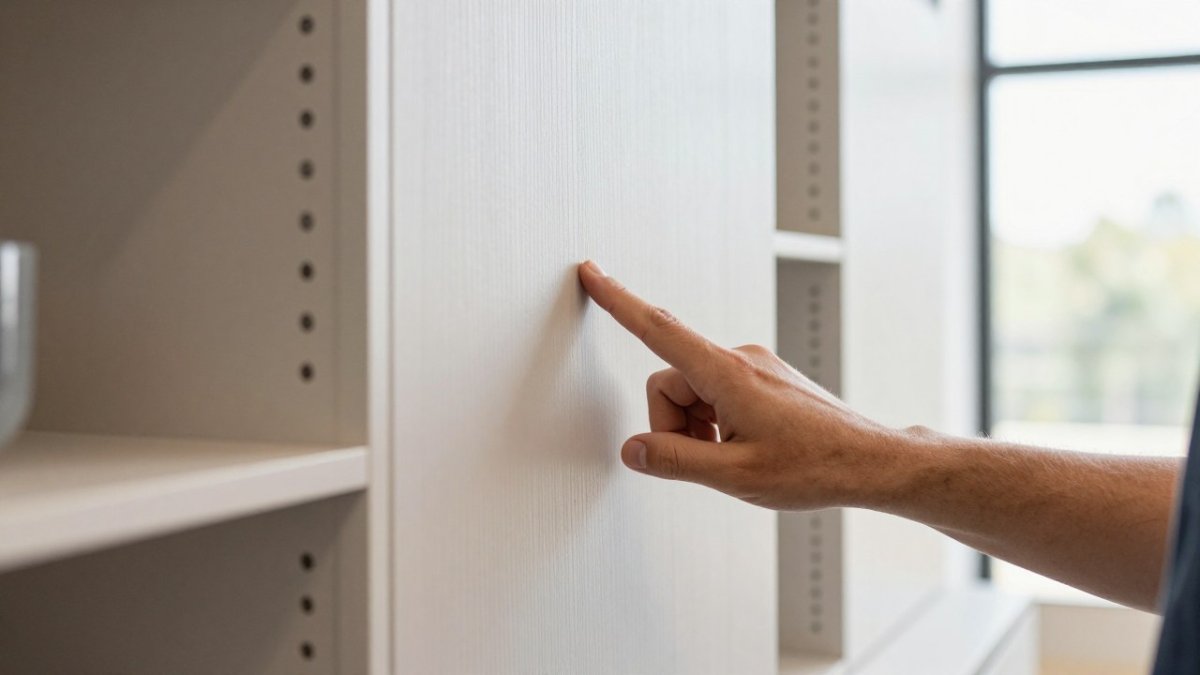
Start with the door sample. Run your thumb along the edge and across the face. A well-finished surface feels even, with no soft spots. Then look at the corners, where chips and lifted edges show first.
Next, consider weight and fixings. Ask how the hinges and drawer runners are anchored into the carcass. Good hardware on weak board will fail sooner than average hardware on sound plywood.
Finally, ask about warranty terms and what they cover. Clear written terms on finish, edge banding and hardware tell you how confident the manufacturer is in its own product.
Where Cabinets Actually Fail
Most premature failures trace back to a handful of installation details rather than the board itself.
Edge sealing. Every cut edge of particleboard or MDF is an open door for moisture.
Joints and fixings. Butt joints held only by screws lose grip once the board swells.
Ventilation near wet appliances. Dishwashers and ovens release heat and moisture.
Installation near sinks. The cabinet floor under a sink should be moisture-resistant, and the plumbing penetrations should be sealed. A drip that runs unnoticed for months will damage even a good board.
Watch out: a beautiful door on an unsealed carcass cut-out is a warranty claim waiting to happen, inspect the cut-outs and edges before the benchtop goes on.
Lifecycle Cost and Repairability
The purchase price is only the first cost. Over the life of a kitchen, maintenance, repair and replacement usually decide which material was actually cheaper.
Painted MDF and solid timber doors can be sanded and repainted, which extends their life and refreshes the look without replacement. Laminate and vinyl-wrapped surfaces are harder to repair invisibly; a chipped edge often means a new door.
A sensible way to compare quotes is to ask, for each material: can this surface be refinished, can a damaged door be repaired rather than replaced, and how easily can a single cabinet be swapped out later? Materials that score well on all three often justify a higher upfront price.
Questions to Ask Before You Order
- What is the board thickness, moisture grade and emissions rating for each component?
- How are cut-outs and edges sealed, and with what product?
- What ventilation is allowed beside the dishwasher and oven?
- Which surfaces can be refinished, and which must be replaced if damaged?
- What does the warranty exclude, particularly for moisture damage?
Choosing Kitchen Cabinet Finishes That Clean Easily
Finish affects both appearance and daily cleaning. Painted, vinyl-wrapped, laminate and acrylic finishes each respond differently to grease and spills.
Painted finishes look sharp and can be colour-matched, but they show scuffs and need gentle cleaning products. Vinyl-wrapped surfaces are smooth and wipe clean easily, though the edges need careful sealing. Laminate is hard-wearing and budget-friendly. Acrylic gives a glossy, uniform look that hides fingerprints well but can scratch if abrasive pads are used.
A useful test is to wipe a sample with a damp cloth and a little dish detergent, then check whether any residue or dull patch remains. Finishes that clean with one wipe are a better choice for kitchens that see heavy cooking.
Installation, Hardware and Questions to Ask Your Supplier
Even high-quality materials fail if they are installed poorly. Ask who will level the cabinets and fit the hardware, and whether they check for water entry around sinks and dishwashers. Gaps and uneven levels cause door misalignment and stress on hinges.
When you speak to a supplier, ask these questions:
- What is the grade and core type of the carcass material?
- Is the edge banding fully sealed, and what adhesive is used?
- What hinges and drawer runners are fitted, and what load rating do they carry?
- What does the warranty cover for finish, edges and hardware?
- Can I see a sample of the finished door before I commit?
Clear answers to these questions separate suppliers who stand behind their work from those who do not.
Booking Your Cabinet Selection With WDC Services
Choosing the right materials is easier with an experienced team guiding each decision. You can explore the Melbourne buying guide for kitchen cabinets for broader context before you decide, or review the expert design and finish services offered in Rosanna if your project is in that area. For a sense of planning costs and layout options in the eastern suburbs, the kitchen remodelling page for Doncaster East sets out the process, and if your space is compact, the small kitchen layout tips guide explains how to get the most from limited cabinetry. When you are ready, you can book a cabinet selection with WDC Services and talk through your wet zones, budget and finish preferences.
Please note this advertisement has been AI generated for entertainment and lead generation purposes and in some cases may not reflect the company’s exact services and information.
Prior to engaging the company it is recommended that you seek clarification on some or all points in this advertisement.
WDC Services has many 5 star Google reviews that can be used as a reliable and true testimony to the quality services provided to its customers over many years.
Contact Domenico (Dom) Crupi on 0425801005 or email info@wdcservices.com.au for further information.
Frequently Asked Questions
What is the best material for kitchen cabinets?
There is no single best material. Plywood suits high-use kitchens and humid areas because it resists swelling and holds screws well. MDF gives a smooth surface for painted doors and is usually the lower-cost option. Particleboard is cheapest but is the least tolerant of moisture. Match the material to how the kitchen is used, then check the finish and the quality of the edge banding before you commit to an order.
Is plywood or MDF better for kitchen cabinets?
Plywood generally performs better for cabinet carcasses because it holds fixings firmly and tolerates moisture better than standard MDF. MDF is a strong choice for doors and drawer fronts that will be painted, since it gives a flat, even surface. Many well-built kitchens use plywood carcasses with MDF or timber doors. Ask your supplier which board is used for each component rather than accepting a single label for the whole cabinet.
Are laminate kitchen cabinets easy to maintain?
Laminate surfaces are easy to maintain. A damp cloth and mild detergent remove most marks, and they resist staining better than many painted finishes. The main weakness is the edge, where moisture can get in if the edge banding lifts or was poorly sealed. Check the edges during selection, and wipe up spills promptly near the sink and dishwasher to keep the surface in good condition for years.
What cabinet material works best in a humid kitchen?
In a humid kitchen, choose moisture-resistant board for the carcass, ideally plywood or a moisture-resistant particleboard, and avoid standard MDF in areas exposed to steam. Seal all cut edges and confirm the finish can handle regular wiping. Ventilation over the cooktop and dishwasher also matters, because moisture trapped behind cabinets is a common cause of swelling and lifted edges over time.

Disclaimer: Disclaimer, Please note this advertisement has been AI generated for entertainment and leed generation purposes and In some cases may not reflect the companies exact services and information. Prior to engaging the company it is recommended that you seek clarification on some or all points in this advertisement. WDC Services has many 5 star google reviews that can be used as a reliable and true testimony to the quality services proved to its customers over many years. Contact Domenico ( Dom ) Crupi on 0425801005 or email info@wdcservices .com.au for further information.