
Last Updated: October 23, 2026
Quick Summary
Choose kitchen cabinets in Melbourne by auditing how you cook and live first, then matching door style, carcass material, edging and hardware to your routine. Confirm appliance dimensions and site-measure before signing, and compare quotes on scope, allowances and exclusions rather than the bottom line.
- Shaker doors suit period and family homes, flat-front suits modern and small kitchens, and handleless works where space is tight.
- Standard carcass board is commonly around 16 mm, with 18 mm in sturdier builds.
- Check that edging seals all exposed edges, especially around the sink and dishwasher.
- Drawer runner load ratings are commonly around 25-30 kg for standard domestic use.
- Ordering cabinets before appliances are locked in is the most common cause of rework.
Table of Contents
- Start With How You Cook and Live
- Kitchen Cabinet Door Styles That Suit Your Home
- Kitchen Cabinet Materials: What Lasts in Melbourne Homes
- Custom, Semi-Custom or Flat-Pack: Matching the Build to the Room
- Small Kitchen Storage Solutions That Earn Their Space
- Your Kitchen Cabinet Planning Checklist Before You Sign
- Comparing Quotes and Sequencing the Renovation
- Conclusion
- Frequently Asked Questions
Start With How You Cook and Live
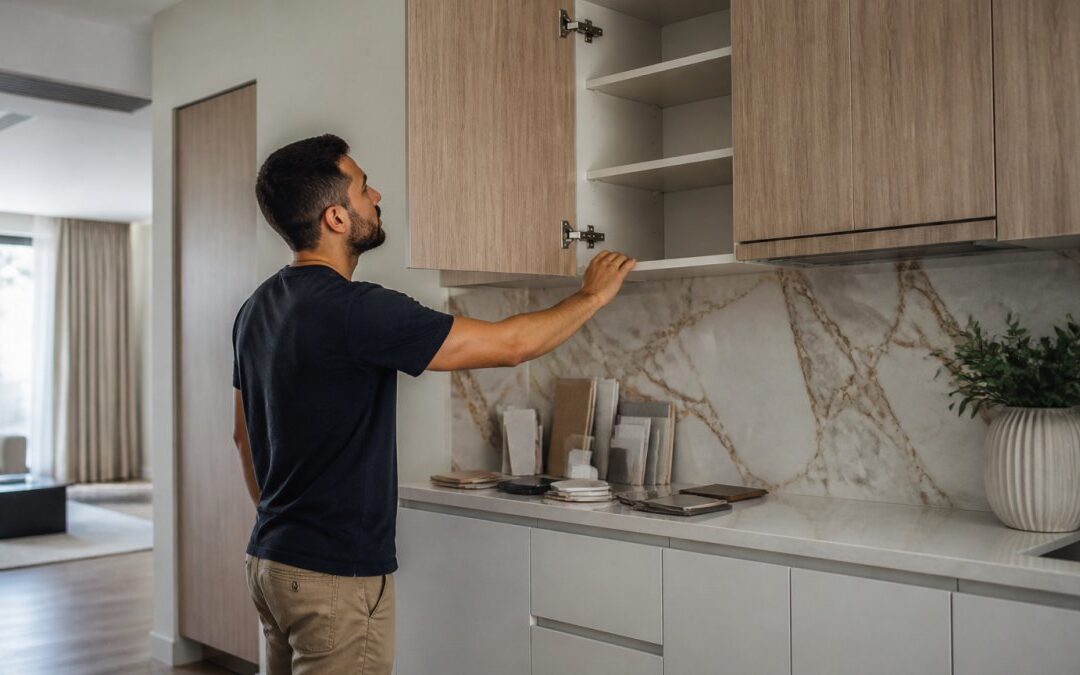
Most kitchen renovation regrets start with a door sample, not a layout. This guide from WDC Services covers how to choose kitchen cabinets Melbourne homeowners actually keep happy, starting with your daily routine. Kitchen cabinets are the fixed joinery holding your cooking, storage and cleaning zones together, so they should follow how you live.
Audit Your Current Kitchen’s Failures
Walk into your kitchen and list what fails you now.
- Drawers that jam or don’t pull out fully
- A pantry you have to empty to reach the back
- Bench space too small for a chopping board
Keep that list. It becomes your test for every cabinet you consider.
Map the Workflow Before the Look
Think about your busiest cooking session: where you stand and what you reach for first. Sketch the path from fridge to sink to cooktop, then mark where you store pots, plates and dry goods. In a tight kitchen, a galley or straight-line layout often works harder than an open plan with wasted corners.
Kitchen Cabinet Door Styles That Suit Your Home
Shaker doors remain the safest choice for most homes, flat-front doors suit modern and small kitchens, and handleless cabinets work best where space is tight.
Here’s how the main options compare in practice:
| Door style | Best for | Watch out for |
|---|---|---|
| Shaker | Period and family homes | Grooves collect kitchen grime |
| Flat-front | Modern, small kitchens | Fingerprints show on gloss |
| Handleless | Tight spaces, clean lines | Needs quality push-latch hardware |
| Profiled timber | Traditional character | Higher maintenance over time |
For a deeper look at styles and materials, our guide to kitchen cabinet styles and materials covers the options in more detail.
Kitchen Cabinet Materials: What Lasts in Melbourne Homes
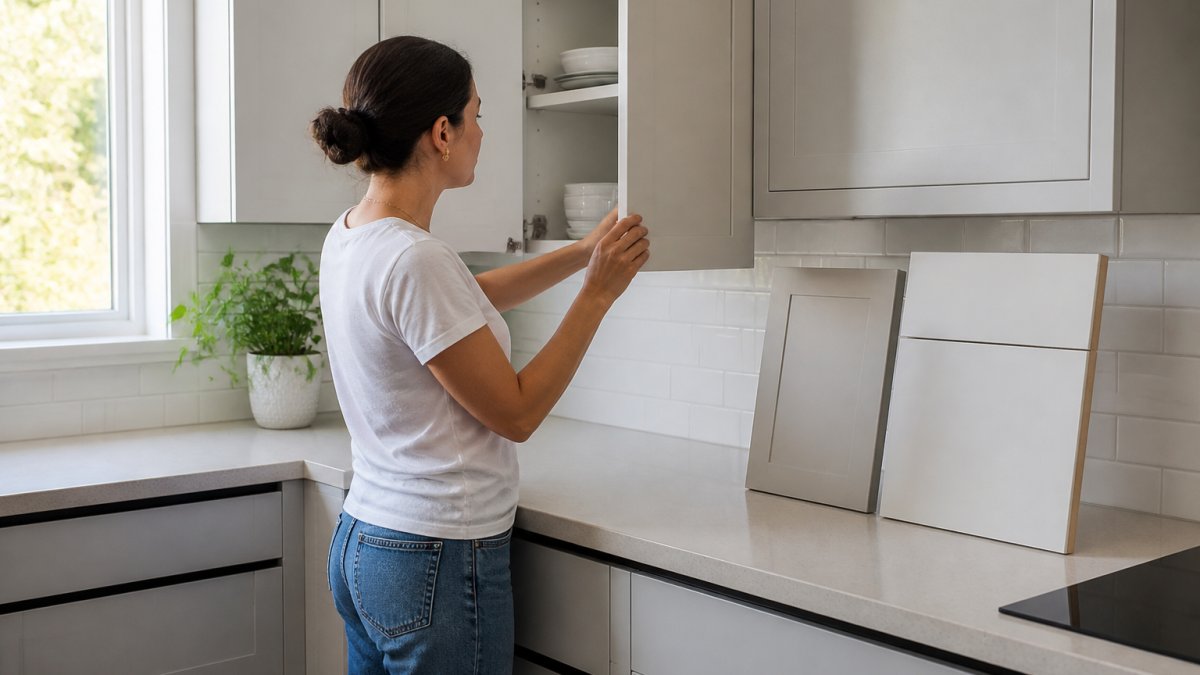
Moisture and heat are the real tests for kitchen cabinet materials in Melbourne homes. Particleboard is the common carcass material, MDF suits painted door fronts, timber or veneer gives warmth but needs more care, and vinyl wrap offers a durable, wipe-clean finish. But the door skin is only the visible layer, what determines whether cabinets survive a decade of steam, spills and daily slamming sits behind the front, in the carcass, edging and hardware.
Read the Carcass, Not Just the Door
The carcass is the box that holds everything. Ask what it is made of and how thick it is.
- Particleboard is the standard carcass in most Australian kitchens. It is stable and affordable, but relies entirely on edge sealing to keep moisture out.
- MDF machines cleanly and takes paint well, which is why it dominates painted door fronts. It swells if water reaches raw edges, so sealed edges matter even more.
- Plywood is more moisture-tolerant and holds screws better at edges, which is why it appears in premium and wet-area joinery.
Thickness is a quick proxy for rigidity: standard carcass board is commonly around 16 mm, with 18 mm in sturdier builds. Thicker board resists sagging on long shelves and holds hinges more securely.
Edging Is the Moisture Barrier
Every cut edge of board is an exposed core. Edging tape or ABS banding seals that core against water from benchtop spills, sink splashes and steam.
Check three things:
- Is the edging applied to all exposed edges, including shelf fronts and the inside of the carcass?
- Is it thick enough to protect the corner, or is it a thin tape that peels at the first knock?
- Are the edges sealed, not raw board, especially around the sink and dishwasher?
A premium door on an unsealed carcass will fail from the inside out, the most common hidden shortcut in budget joinery.
Hardware Does the Daily Work
Hinges and drawer runners take more load and movement than any other cabinet part, and are the easiest place to cut cost invisibly.
- Hinges: Look for a branded, adjustable hinge with soft-close. Adjustability matters because doors move over time; a hinge with no adjustment range cannot be corrected when a door drops.
- Drawer runners: Ask whether they are undermount (hidden, smoother, easier to clean) or side-mount (visible, cheaper, less smooth). Check the load rating, commonly around 25-30 kg for standard domestic use, with heavier-duty options for pot drawers.
- Drawer boxes: Metal-sided boxes resist moisture better than particleboard, particularly around the sink and dishwasher.
Construction Quality You Can Check in the Showroom
You can judge build quality in minutes:
- Open and close a drawer: it should glide, not rattle
- Look for soft-close hinges with a brand name on them
- Check that shelf edges are sealed, not raw board
Ask to see a drawer pulled fully out and loaded. A drawer that sags under weight in the showroom will sag at home within a year.
Matching Material to the Room
Material choice should follow the conditions, not just the look.
For a deeper look at styles and materials, our guide to kitchen cabinet styles and materials covers the options in more detail.
Custom, Semi-Custom or Flat-Pack: Matching the Build to the Room
Custom cabinets are built to your exact room, semi-custom cabinets adapt standard sizes, and flat-pack cabinets arrive in boxes for assembly.
Flat-pack suits simple, standard layouts and tight budgets. It struggles with irregular walls and unusual corners.
If you’re leaning toward bespoke work, our guide to custom kitchen cabinetry explains what the process involves before you commit.
Small Kitchen Storage Solutions That Earn Their Space
Good storage adds usable capacity without adding floor space. Pull-out pantries, deep drawer inserts and corner carousels turn dead zones into working storage, and the best small kitchen storage solutions solve a specific problem from your audit. Start with these:
- A pull-out pantry for narrow gaps beside the fridge
- Deep drawers instead of cupboards for pots and pans
- Drawer inserts to stop cutlery and utensils sliding
For a fuller breakdown, read our article on small kitchen storage solutions.
Storage works best when it matches your habits. A pull-out pantry you use daily beats a walk-in cupboard you fill and forget.
Your Kitchen Cabinet Planning Checklist Before You Sign
Before you sign anything, confirm the layout, measurements and appliance plan on paper. Most cabinet problems trace back to a rushed measure or an appliance that arrived a different size than planned. Run this checklist:
- Final layout drawn with door swing directions
- Appliance models chosen and dimensions confirmed
- Sink, tapware and cooktop positions locked in
Measure Twice: Appliances, Services and Clearances
Cabinets are built around appliances, not the other way around. Confirm the fridge, oven and dishwasher models first, then build the joinery to suit, checking that doors and drawers open without hitting each other or a wall.
Our guide to choosing kitchen appliances helps you match layouts, compare running costs and plan dimensions before the cabinet order is placed.
Ordering cabinets before appliances are locked in is the most common cause of rework. A fridge that’s a few centimetres wider than the gap means cutting into finished joinery or returning the appliance.
Comparing Quotes and Sequencing the Renovation
Compare quotes on scope, not just the bottom line. Two quotes can look similar until you check what each includes: demolition, electrical work, waterproofing, tiling, benchtop templates and waste removal. Cabinet quotes are rarely written to a common standard, one may price the carcass only, another may include installation, hardware and waste removal, so put every quote through the same like-for-like checklist before you look at the total.
The Like-for-Like Quote Checklist
Ask each supplier to confirm, in writing, whether the following are included or excluded:
- Carcass and door fronts, both priced, or door fronts only?
- Hardware, hinges, runners, handles and push-latches included, and at what specification?
- Installation, who installs, and is the cost fixed or an allowance?
A quote that is silent on an item is usually excluding it. Silence is not inclusion.
Allowances: Where Quotes Drift
An allowance is a placeholder amount for something not yet selected, benchtops, splashbacks, tapware or appliances. Two quotes can look close until you compare allowances. Ask each supplier:
- What allowance has been used for each item?
- What happens if the selected product costs more, who pays the difference, and when?
- Is the allowance realistic for the finish level shown in the display?
A low headline price built on tight allowances often grows during the build. Comparing allowances line by line is how you spot the real cost before you sign.
Exclusions and Variations
Read the exclusions section as carefully as the inclusions. Common exclusions:
- Making good after demolition
- Relocating services
- Structural changes or wall removal
Ask how variations are priced and approved, and whether there is a written process before extra work proceeds. A clear variation process protects both sides.
Warranties and Who Honours Them
Cabinet warranties are often split between carcass, hardware and door finish. Ask:
- What does each warranty cover?
- Who honours it, the manufacturer, the installer or both?
- What voids it, moisture damage, incorrect cleaning, DIY alterations?
Get the warranty terms in writing before signing, not after.
Sequencing the Work
Once the quote is settled, sequence the work so trades do not collide. A typical order:
- Design and selections
- Site measure and appliance confirmation
- Demolition
- Electrical and plumbing rough-in
- Cabinetry install
- Benchtop template and fit
- Splashback
- Final trades and handover
Our guide to understanding your builder’s quote explains how to compare scope, allowances and exclusions so you can spot real value.
Ask for the schedule in writing with trade dates. A clear sequence is the best protection against a stalled renovation.
Do not sign a cabinet quote that has not been site-measured. Quotes based on plans alone often carry allowances that grow once walls, floors and services are checked on site.
Conclusion
Choosing kitchen cabinets is a decision-led process, not a shopping trip.
Get started with WDC Services and choose cabinets that fit your home, your routine and your budget.
Disclaimer
Please note this advertisement has been AI generated for entertainment and leed generation purposes and In some cases may not reflect the companies exact services and information.
Frequently Asked Questions
What should I consider when choosing kitchen cabinets?
Work through four things in order: how you cook and move through the room, the door style that suits the house, the material and construction quality behind the door front, and the storage that fits your pots, appliances and pantry goods. Then check the quote covers delivery, installation, hardware and making good. Getting the workflow and measurements right first saves expensive changes later, because cabinet carcasses are built to fixed dimensions once ordered.
Which kitchen cabinet materials are durable and easy to maintain?
Moisture-resistant particleboard and MDF with quality edge banding handle daily kitchen use well and wipe clean easily. Timber veneer and solid timber fronts look warmer but need more careful cleaning around the sink and range. Ask what the carcass, door front and edge banding are each made from, because a durable door on a weak carcass still fails. Also ask about low-emission board options if indoor air quality matters to you.
What is the difference between custom and standard kitchen cabinets?
Custom cabinets are built to your room’s exact dimensions, so awkward corners, bulkheads and appliance gaps get filled properly. Semi-custom uses standard carcasses with some size and front options. Flat-pack arrives in boxes for assembly and suits straight runs and simple layouts. In older homes with uneven walls and non-standard spaces, custom or semi-custom usually delivers a better fit and fewer filler panels, while flat-pack can work well in a simple galley or straight-line layout.
How can I make kitchen cabinets work in a small kitchen?
Go tall rather than wide: full-height pantry cabinets, drawers instead of cupboards below the bench, and pull-out systems in corner dead zones. Choose handleless or slim pull handles so doors open without stealing walkway space, and keep the benchtop clear by housing appliances in dedicated cabinets. Measure your tallest items before specifying internal heights. A cabinet maker who plans storage around your actual cooking habits will fit more usable space into the same footprint.

Disclaimer: Disclaimer, Please note this advertisement has been AI generated for entertainment and leed generation purposes and In some cases may not reflect the companies exact services and information. Prior to engaging the company it is recommended that you seek clarification on some or all points in this advertisement. WDC Services has many 5 star google reviews that can be used as a reliable and true testimony to the quality services proved to its customers over many years. Contact Domenico ( Dom ) Crupi on 0425801005 or email info@wdcservices .com.au for further information.