
Table of Contents
- Why Laundry Room Ventilation Requirements Matter
- Understanding Laundry Room Ventilation Requirements
- Moisture, Humidity, and Condensation: The Core Problem
- Choosing the Right Laundry Exhaust Fan
- Vented vs Condenser Clothes Dryer: Which Needs Ventilation
- Fire Safety and Dryer Vent Maintenance
- Common Ventilation Mistakes and How to Avoid Them
- Conclusion
- Frequently Asked Questions
Last Updated: October 19, 2026
Why Laundry Room Ventilation Requirements Matter
Moisture builds up fast in laundry rooms. A single wash cycle releases litres of water into the air, and without proper ventilation it stays trapped, settling on walls until mold and mildew take hold.
Laundry room ventilation requirements protect your health, prevent structural damage, and reduce energy waste.
Understanding Laundry Room Ventilation Requirements
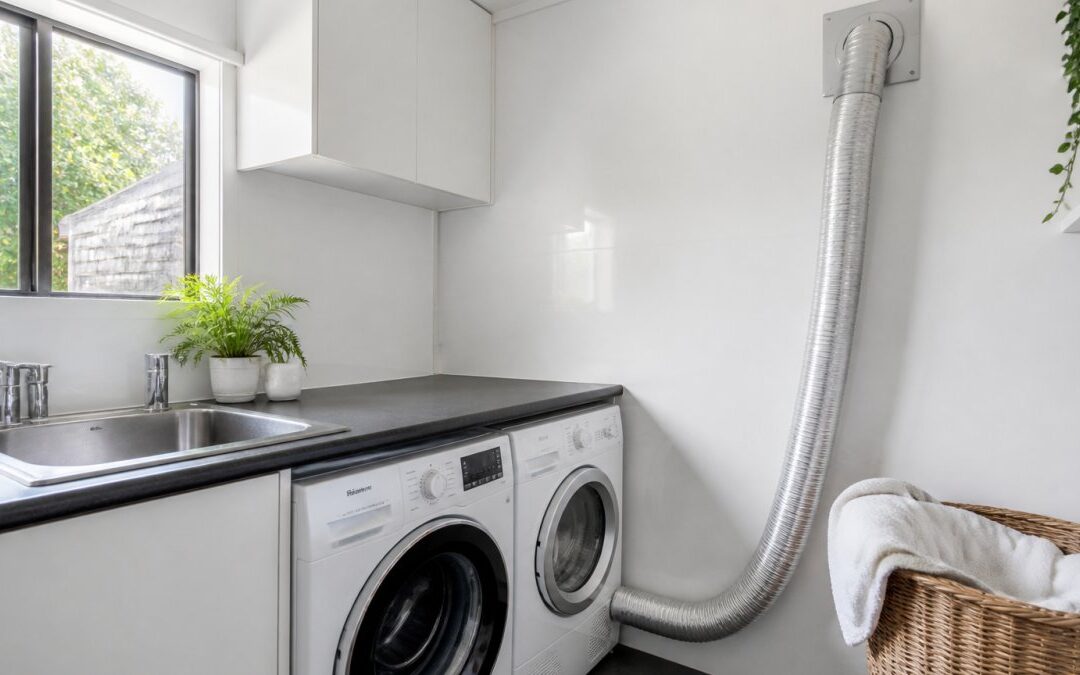
Laundry room ventilation requirements vary by setup. A vented dryer needs an exhaust duct pushing hot, moist air outside; a condenser dryer still needs an exhaust fan to remove humidity from the room.
Key points:
- Vented dryers push air outside through a duct
- Condenser dryers release moisture into the room
- Exhaust fans remove humidity from the space
- Proper ductwork prevents backflow and blockages
Think of your laundry room like a bathroom: an exhaust fan removes the steam. The difference is volume, a single dryer cycle can release more moisture than a 20-minute shower.
Moisture, Humidity, and Condensation: The Core Problem
When water vapour cools it becomes liquid, settles on surfaces, and over months causes serious damage.
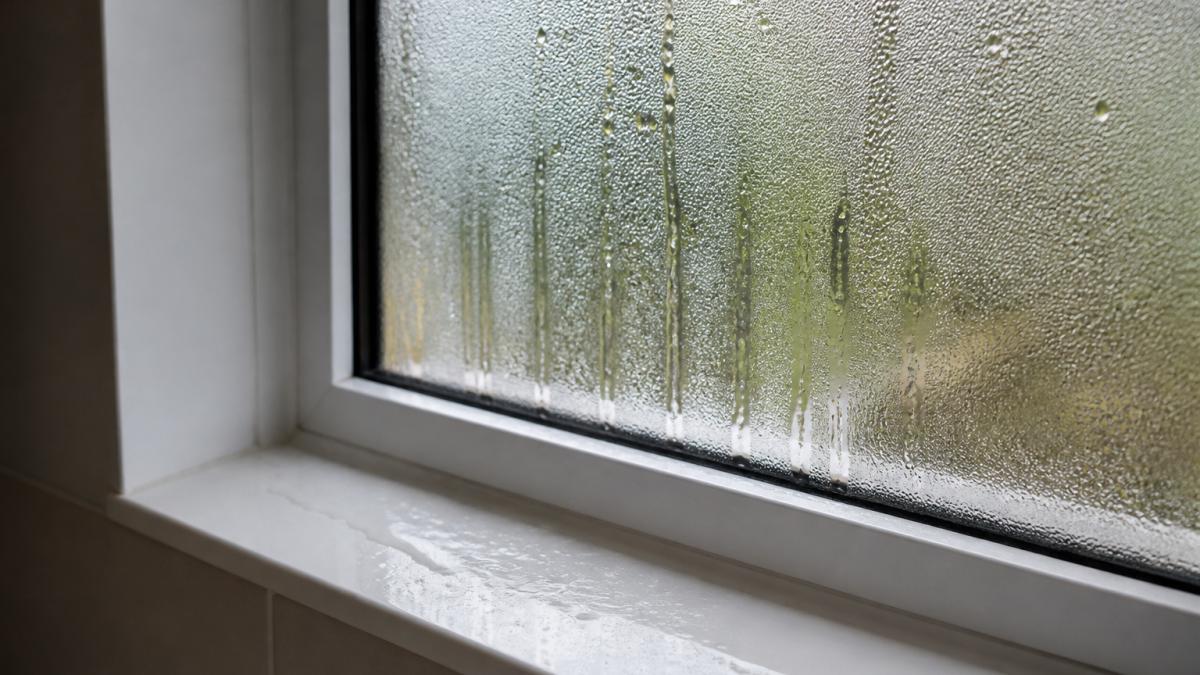
What happens without proper ventilation:
- Condensation forms on windows and mirrors
- Paint begins to peel and bubble
- Drywall absorbs moisture and weakens
- Mold spores find ideal growing conditions
A condenser dryer is particularly problematic: it releases several litres of water vapour directly into the room per cycle. Without an exhaust fan running, that moisture has nowhere to go.
The solution: an exhaust fan rated for your room size pulls humid air out through ductwork while fresh air flows in.
Choosing the Right Laundry Exhaust Fan
A fan that’s too small won’t remove moisture fast enough; an oversized one wastes energy and creates drafts. The difference comes down to three numbers: room volume, air-change rate, and duct pressure loss.
Step 1: Calculate room volume
Measure the laundry in metres and multiply length × width × height. A 2.4 m × 2.0 m room with a 2.4 m ceiling has a volume of 11.52 m³.
Step 2: Apply an air-change rate
Ventilation capacity is expressed as air changes per hour (ACH), how many times the full room volume is replaced in an hour. Bathroom-style moisture removal typically targets 6-10 ACH; a laundry with a condenser dryer releasing moisture indoors often needs the higher end. Using 8 ACH:
- 11.52 m³ × 8 = 92.16 m³ per hour
- Divide by 60 to get cubic metres per minute: about 1.54 m³/min
- Convert to litres per second (the unit most Australian fan spec sheets use): about 25.6 L/s
That is the minimum extract rate at the fan. Most practitioners round up by 20-30% to allow for duct losses, so a fan rated around 30-35 L/s is a sensible starting point for that room.
Fan packaging in Australia often lists extract capacity in litres per second (L/s) or cubic metres per hour (m³/h). To compare apples with apples: 1 m³/h ≈ 0.278 L/s, and 1 L/s ≈ 3.6 m³/h. A fan sold as “100 m³/h” is roughly 28 L/s.
Step 3: Subtract duct pressure losses
A fan’s rated capacity is measured with no duct attached. Every metre of duct, bend, and grille reduces actual airflow: a short, straight, rigid run of 1-2 m with one bend costs roughly 10-20% of rated capacity, while a long flexible run with multiple bends can lose 40% or more. If your duct route is long or bendy, upsize the fan or duct diameter.
Step 4: Match the fan to the moisture source
- Vented dryer ducted outdoors: the dryer does most of the moisture removal; the room fan mainly handles residual humidity and washer moisture. A mid-range fan sized to the room volume is usually adequate.
- Condenser or heat-pump dryer: moisture is released into the room, so the fan is doing the heavy lifting. Size to the higher end of the ACH band and consider a humidity sensor or timer control so the fan runs until moisture drops, not just for a fixed period.
- Gas appliances in the room: a gas dryer or gas hot water unit consumes oxygen and produces combustion by-products. Ventilation must be adequate for both moisture and combustion air, this is a safety matter, not a comfort one. Confirm requirements with a licensed gasfitter and your local building authority before specifying.
Step 5: Verify what actually applies to your property
Ventilation requirements are set through the National Construction Code (NCC) and applied by state and territory building regulators. The NCC is performance-based, so deemed-to-satisfy provisions give one path but an alternative solution can be engineered. In practice:
- Check whether your project needs development or building approval, a like-for-like fan replacement often doesn’t, but a new duct penetration through an external wall usually does.
- Ask your local council or private certifier which NCC edition applies to your project and whether any state variation overrides the default provisions.
- For rental properties, check the state or territory residential tenancy legislation, some jurisdictions impose specific ventilation and mould-related obligations on landlords that go beyond the NCC.
Step 6: Practical selection criteria
- Noise: look for a fan in the 25-35 dB(A) range at low speed for a room adjacent to living areas; cheaper units often exceed 45 dB(A).
- Control: a run-on timer (10-30 minutes after the dryer stops) or a humidity sensor prevents moisture re-settling once the appliance switches off.
- Backdraft shutter: essential on external walls to stop wind-driven rain and cold air entering when the fan is off.
- IP rating and location: fans installed in a shower or bath zone need an appropriate IP rating and must be installed by a licensed electrician.
Undersizing is a common mistake that brings moisture problems back.
Installation matters too:
- Mount the fan directly above the dryer if possible
- Use rigid ductwork, not flexible ducting (it traps lint and moisture)
- Ensure the duct slopes downward slightly to prevent water pooling
- Seal all duct joints with mastic, not tape (tape fails over time)
Vented vs Condenser Clothes Dryer: Which Needs Ventilation
All three common dryer types produce moisture, but how they handle it, and the room ventilation each still needs, differs completely.
Vented dryers
A vented dryer draws room air in, heats it, tumbles it through the load, and pushes the hot, moisture-laden air out through a duct to the exterior, the most direct approach, provided the duct terminates outside the building envelope.
- Room ventilation still required: yes, but mainly for washer moisture and residual humidity. A room-sized exhaust fan is usually sufficient.
- Duct requirements: rigid metal ducting, as short and straight as possible, terminated outside with a flapper that opens freely. Flexible foil or plastic ducting traps lint and is a fire risk.
- Main risk: a blocked or kinked duct. Lint accumulates, airflow drops, heat builds, and drying times lengthen. In serious cases this becomes a fire hazard.
Condenser dryers
A condenser dryer does not exhaust air outdoors. It passes the moist exhaust air over a cooled heat exchanger, condensing the water vapour into liquid that collects in a tank or drains through a hose.
- Room ventilation still required: yes. Some moisture still enters the room, and the machine adds heat. An exhaust fan sized to the room volume handles this.
- Placement flexibility: no external duct needed, so the dryer can sit away from an external wall, useful in apartments and internal laundries.
- Main risk: if the room is not ventilated, humidity and heat accumulate, slowing drying and encouraging condensation on cool surfaces.
Heat-pump dryers
A heat-pump dryer uses a refrigerant cycle instead of a resistive element to heat the air and condense moisture out of it. It recycles heat rather than venting it, so it is significantly more energy-efficient, but slower, and it still releases some heat and moisture into the room.
- Room ventilation still required: yes, though the load is lower than a conventional condenser. A modest exhaust fan is usually adequate.
- Main risk: the condenser coils and lint filter need regular cleaning. A clogged heat-pump dryer loses efficiency quickly and can overheat.
Side-by-side comparison
| Feature | Vented | Condenser | Heat-pump |
|---|---|---|---|
| Exhausts air outdoors | Yes, via duct | No | No |
| Moisture released into room | Minimal (duct carries it out) | Moderate | Low to moderate |
| Room exhaust fan needed | Yes, for residual humidity | Yes, sized to room | Yes, modest |
| Placement flexibility | Limited, needs external wall route | High | High |
| Relative energy use | Higher | Higher | Lower |
| Drying speed | Fastest | Slower | Slowest |
| Key maintenance | Clear duct and lint trap | Empty water tank, clean condenser | Clean filters and condenser coils |
What this means for your ventilation plan
Many people think condenser and heat-pump dryers eliminate the need for ventilation. They don’t, laundry room ventilation requirements still apply. A condenser or heat-pump dryer is simply more forgiving, releasing less moisture so a standard exhaust fan usually handles it.
If you’re renovating and have a choice, a vented dryer with rigid ductwork is the most straightforward solution for moisture removal; a heat-pump dryer suits energy efficiency over speed where an external duct route is impractical.
No dryer type removes the need for room ventilation. Vented dryers need a duct plus a room fan; condenser and heat-pump dryers need a room fan sized to the moisture load they release. Match the fan to the dryer type, not just the room size.
Fire Safety and Dryer Vent Maintenance
Lint is a fire hazard. It accumulates inside dryer ducts and exhaust vents, slowing airflow and building heat until it can ignite.
Maintenance checklist:
- Clean the lint trap after every load
- Inspect the exhaust duct quarterly
- Remove lint from the duct opening outside
- Replace flexible ducting with rigid ducting (lint sticks to flexible ducts)
A blocked vent also reduces dryer efficiency: clothes take longer to dry, energy bills rise, and the dryer wears out faster.
When you plan a laundry renovation with WDC Services, we install venting systems designed for easy maintenance.
Common Ventilation Mistakes and How to Avoid Them
Most ventilation problems stem from poor installation or maintenance. The most common mistakes:
Mistake 1: Using flexible ducting
Flexible ducting traps lint and moisture. It sags over time, creating pockets where water pools. Use rigid metal ducting instead. It’s easier to clean and lasts longer.
Mistake 2: Ducting runs too long or with too many bends
Every bend reduces airflow and every extra metre of duct adds friction.
Mistake 4: Blocking the exhaust fan intake
If furniture or storage blocks the fan intake, airflow drops.
Mistake 5: Neglecting maintenance
A clean vent works better and lasts longer. Check it quarterly, a five-minute inspection prevents expensive repairs later.
Conclusion
Laundry room ventilation isn’t complicated. It’s essential. Proper ventilation removes moisture, prevents mold, protects your home, and keeps your appliances running efficiently.
When you’re planning a laundry renovation, ventilation should be part of the conversation from day one.
Disclaimer
Prior to engaging the company it is recommended that you seek clarification on some or all points in this advertisement.
Contact Domenico (Dom) Crupi on 0425801005 or email info@wdcservices.com.au for further information.
Frequently Asked Questions
Does a laundry room need ventilation?
Yes. Washing machines and dryers release significant moisture into the air. Without proper ventilation, this moisture accumulates as condensation on walls and windows, creating conditions for mould growth and damaging building materials. Ventilation also removes odours and improves indoor air quality. A laundry room with a window may provide some natural airflow, but mechanical ventilation through an exhaust fan is the most reliable solution.
What are the signs of poor laundry room ventilation?
Watch for condensation on windows and mirrors that lingers after laundry sessions, musty odours, visible mould or mildew on walls or ceilings, peeling paint or wallpaper, and damp-feeling air. These symptoms indicate moisture is not being removed effectively. Poor ventilation also increases drying times for clothes and can cause damage to adjacent rooms if moisture seeps through walls or under doors.
How can you reduce moisture in a laundry room?
Install a properly sized laundry exhaust fan and use it during and for 20-30 minutes after each wash or dry cycle. Ensure the duct vents moisture outside, not into roof cavities or other spaces. Keep the laundry door closed during operation to contain moisture. If using a vented dryer, ensure the vent is clear of lint blockages. Consider a dehumidifier as a supplementary measure in very humid climates, but mechanical ventilation is the primary control method.
What is the difference between vented and condenser clothes dryers in terms of ventilation?
Vented dryers expel hot, moist air directly outside through a duct, requiring dedicated ventilation infrastructure. Condenser dryers cool and condense moisture internally, collecting water in a tank or draining to a floor waste, so they don’t need external ducting. However, condenser dryers are less energy-efficient and take longer to dry clothes. Both types benefit from good laundry room ventilation to manage ambient humidity, though only vented dryers require a dedicated exhaust duct.
Disclaimer: Disclaimer, Please note this advertisement has been AI generated for entertainment and leed generation purposes and In some cases may not reflect the companies exact services and information. Prior to engaging the company it is recommended that you seek clarification on some or all points in this advertisement. WDC Services has many 5 star google reviews that can be used as a reliable and true testimony to the quality services proved to its customers over many years. Contact Domenico ( Dom ) Crupi on 0425801005 or email info@wdcservices .com.au for further information.