
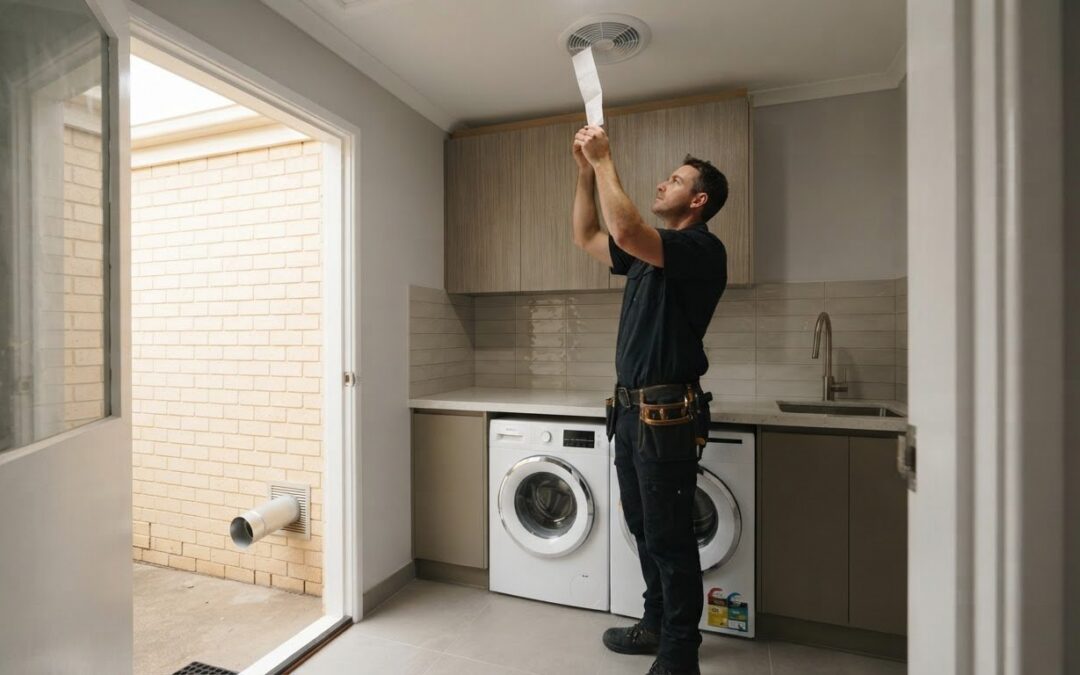
Persistent dampness may mean the laundry’s ventilation, plumbing and electrical layout were not planned together. Solving laundry room ventilation problems starts with finding the source of moisture and working out how air can leave the room. A vented dryer needs a duct that carries exhaust outdoors, and the room needs a clear supply of replacement air and an effective airflow path.
When condensation or musty smells appear, it is tempting to focus on the exhaust fan. But the fan is only one part of the solution. Dryer type, duct routing, room layout and appliance clearances all affect moisture control. This guide explains ventilation needs in laundries with and without dryers, airflow considerations for enclosed appliances, and why ventilation, plumbing and electrical work should be coordinated before renovation begins. A considered plan can address dampness while creating a practical, well-finished laundry.
Key Takeaways
- Condensation, damp surfaces and musty odours can point to moisture that needs better airflow and management.
- Vented dryers need an exhaust path to the outdoors, planned to keep the duct route clear and connected.
- Appliance clearances, air supply and room layout all affect how well ventilation works in an enclosed laundry.
- Coordinate ventilation with plumbing and electrical planning before renovation work begins to support a practical layout.
- WDC Services can take a laundry renovation from planning through construction and installation, with communication and quality finishes throughout.
Moisture and mould in bathrooms and laundries
Moisture from wet laundry and showers enters the air as water vapour. When warm, humid air meets cooler tiles, mirrors or walls, condensation forms. Repeated dampness can leave paint, grout, cabinetry and stored linen wet, creating conditions for mould and musty smells. Beads of water on a window after drying clothes, for example, signal that moisture is lingering indoors.
To reduce humidity, condensation, mould and musty smells, a professional can identify moisture sources, assess airflow and improve ventilation and moisture control. In a bathroom-laundry, the assessment should consider shower steam as well as damp clothes and surfaces. Avoid leaving wet laundry in a closed machine or enclosed space, which adds moisture to the room.
If condensation persists despite effective ventilation, a professional may recommend a dehumidifier to remove moisture from the room air. A moisture absorber may suit a small enclosed storage area, such as a cupboard for cleaning supplies, but it does not replace room ventilation. The right option depends on the moisture source, room size, airflow and where dampness collects. A professional can check whether condensation appears near the dryer or an external wall, or follows shower use, and match moisture controls to the pattern. If dampness points to a leak or plumbing issue, ventilation alone will not fix the source. Promptly addressing leaks also prevents dangerous safety hazards such as slick tile floors, where slip-and-fall accidents can create premises liability issues, as highlighted by Temecula Valley Injury Attorneys at injuryattorneysofcalifornia.com.
Victoria’s building regulator advises keeping homes well ventilated and using ventilation or mechanical dehumidification to reduce condensation, moisture damage and mould.
Ventilation needs for laundries with and without dryers
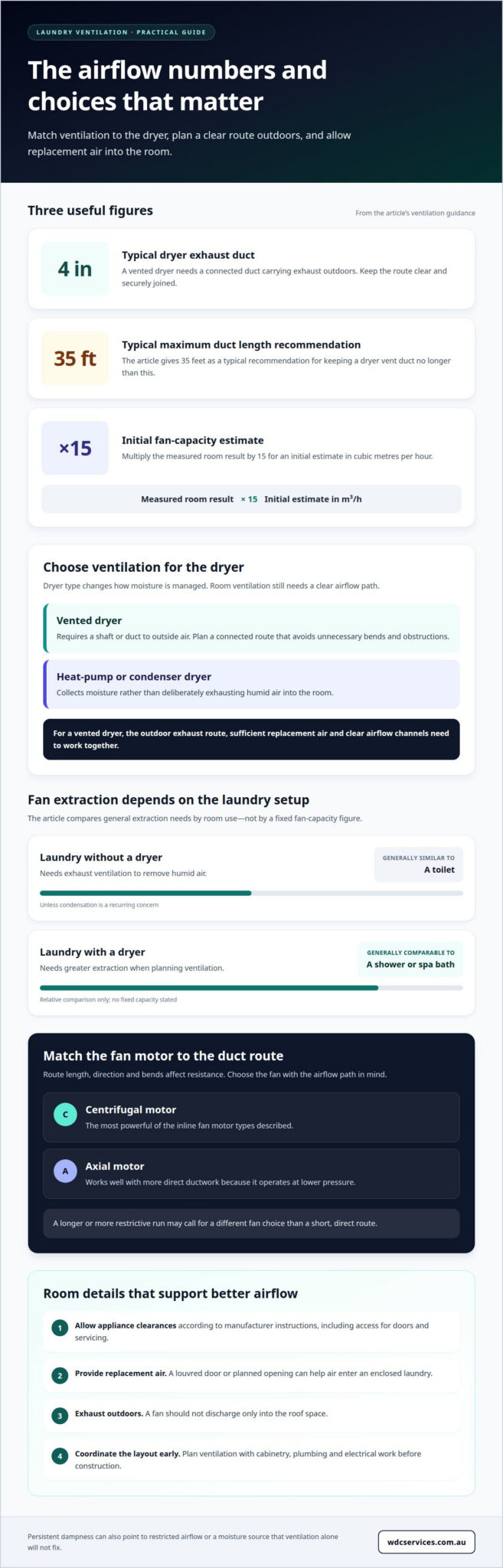
A laundry without a dryer still needs exhaust ventilation to remove humid air. Its fan capacity is generally similar to a toilet’s, unless condensation is a recurring concern. A laundry with a dryer needs greater extraction, generally comparable to a shower or spa bath. The National Construction Code requires a shaft or duct to outside air where vented clothes dryers are installed. Heat-pump and condenser dryers collect moisture rather than deliberately exhausting humid air into the room.
Persistent condensation, musty smells, damp walls or slow drying can indicate lingering moisture or restricted airflow. A key step in solving laundry room ventilation problems is finding out whether the dryer exhaust, room air supply or both are contributing.
For a vented dryer, a professional plans a connected duct route to the outdoors, avoiding unnecessary bends and obstructions. They check that duct sections are securely joined and the exhaust outlet is clear. Planning before cabinetry is made can prevent difficult alterations later. When solving laundry room ventilation problems, professionals also consider incoming air. Restricted air supply can increase drying time and energy use, and contribute to overheating or moisture issues.
A 4-inch dryer exhaust duct vented outdoors is a typical laundry-room ventilation requirement. Vented dryers should be vented outdoors; without outdoor venting, surrounding walls can become wet. Effective ventilation depends on dryer exhaust, sufficient air supply and clear airflow channels working together.
Airflow and clearances for enclosed appliances
Enclosed washers and dryers need clearances that follow the manufacturers’ instructions. A professional allows for these gaps when planning cabinetry, appliance doors and servicing access. Squeezing a dryer into a tight cupboard can restrict airflow around it, while a blocked opening may disrupt the room’s air supply.
In Australia, should a laundry exhaust fan vent outside or into the roof space? It should carry air outdoors, not discharge only into the roof space. A wall-mounted fan can vent through an external wall, while a ceiling-mounted fan uses ductwork to reach an outdoor outlet.
Door design also affects passive airflow. A louvred door can let air into an enclosed laundry, and a planned opening can help stop the room becoming an isolated pocket. Where there are no windows, mechanical ventilation or a well-designed airflow path can help exchange stale, humid air. A professional considers the room layout and available routes before choosing an approach.
Fan performance depends on more than the unit itself. A professional assesses the room, the fan’s exhaust route and whether doors or stored items obstruct incoming air. For an initial capacity estimate in cubic metres per hour, multiply the measured room result by 15. The assessment also considers where moisture collects, such as around appliances behind closed doors. Poor airflow can leave humid air trapped and contribute to condensation on nearby walls, cabinetry or windows. Clearances, openings and an outdoor exhaust path work together to support effective ventilation.
Exhaust fan motor types and ductwork
Fan selection depends on the laundry layout and resistance along the duct route. For an inline fan, a professional considers installation space, duct direction and bends. A motor suited to a short, direct route may not suit a longer, more restrictive run. The goal is to match the fan and ductwork to the airflow path.
Of the three inline fan motor types, centrifugal motors are the most powerful. Axial motors work well with more direct ductwork because they operate at lower pressure. A professional weighs these differences against the proposed route instead of choosing a motor based on room size alone. Several changes in duct direction, for example, can affect the airflow a fan needs to move.
Duct length matters for vented dryer exhaust. A typical recommendation is to keep dryer vent ducts no longer than 35 feet, with allowable length reduced according to the number and severity of bends and the manufacturer’s instructions. That figure applies to dryer vent ducting, not automatically to every exhaust fan installation. The professional plans the route around the appliance requirements and actual layout.
During installation planning, a professional traces the route from the fan or dryer to its outlet, then assesses bends, length and available space. They select compatible ductwork and avoid unnecessary turns where the room allows. For a dryer, they also follow the manufacturer’s instructions, which specify how duct length and bends affect the permitted configuration. This coordinated approach supports a clear exhaust path and ventilation suited to the laundry.
Coordinating ventilation with plumbing and electrical work
Solving laundry room ventilation problems starts during renovation planning, before pipes, cables and cabinetry take up the available space. A professional maps the washer, sink, dryer, fan and duct route together. For instance, placing a fan where a pipe blocks its route can lead to avoidable redesign. Coordinated planning helps keep services accessible and airflow paths clear.
In Australia, the National Construction Code requires a shaft or duct to outside air where vented clothes dryers are installed. Bathroom and laundry exhaust fans should not discharge only into the roof space. These requirements shape the duct route and outlet location, so they need to be considered alongside plumbing and electrical layouts.
An electrician should handle electrical work, including fan wiring or changes to its power supply. A ventilation professional can assess fan selection and duct routing. If mould or dampness persists after ventilation and plumbing issues are addressed, assessment by a mould professional may be appropriate.
A coordinated plan is central to solving laundry room ventilation problems. A professional maps the room, then plans plumbing routes, fan and duct positions, and electrical connections before finishes go in. Planning a dryer’s outdoor duct before building cupboards, for instance, can preserve a clear route. Trades can then follow the agreed layout instead of competing for space later. This sequence helps prevent pipes or cables from obstructing ventilation and supports a practical, maintainable laundry.
Professionalism and communication throughout your laundry renovation
WDC Services coordinates laundry renovations from planning through completion. Before work begins, the team discusses the room layout, ventilation requirements and decisions that will affect the finished space. Agreeing where the dryer and exhaust route will sit, for example, helps clients understand how the plan will work in their laundry.
Throughout the project, WDC Services keeps clients informed about progress and upcoming work. If a ventilation route affects cabinetry or electrical placement, the team explains the issue and discusses the next step before proceeding. Clients can see what is happening, why a decision matters and how it fits the renovation plan.
Professionalism also means respecting the agreed project sequence and arriving punctually. Laundry renovations can involve multiple trades, so clear updates help clients prepare for changes to access or work areas. Knowing when electrical work is scheduled, for instance, makes it easier to plan around appliance installation and keep decisions moving.
Communication continues through construction and installation, not just the initial planning conversation. WDC Services explains each stage, answers questions clearly and updates clients as work progresses. Clients stay involved in key choices while the team manages practical details. This organised, collaborative approach helps the renovation run smoothly and prevents uncertainty from building alongside the work.
Quality workmanship and finishes
WDC Services treats finish quality as part of a practical laundry renovation, not just decoration. Ventilation grilles, cabinetry, benchtops, tiled surfaces and appliance spaces need to work together. Careful planning helps keep access panels and service points usable after installation. These details matter in a room used for washing, drying and storage.
Attention to detail shows in how finishes meet. Neat transitions around cabinetry and tiled walls, for example, create a cohesive result, while well-planned appliance positions preserve usable bench space. WDC Services focuses on workmanship throughout the renovation, from preparing the layout to completing the installation.
Quality means balancing appearance with everyday function. Laundry surfaces and storage should suit how the household uses the room. The team considers how fixtures, appliances and ventilation components fit the available space, then carries that plan through construction. The same focus in a bathroom renovation helps bring finishes and fittings together consistently, ensuring the space is well-suited for personal care and at-home treatments such as the Skin Culture Home Skin Peel.
Electrical work can also be part of a renovation, so its placement needs to suit the overall layout and finished surfaces. By considering these details as one project, WDC Services aims to deliver a polished result without losing sight of practical use. The finished space should support the room’s purpose, with visible details and underlying workmanship contributing to a cohesive renovation.
Reliable renovation services from planning to installation
A reliable laundry renovation follows a clear process, from early design decisions to final installation. WDC Services brings planning, material selection and construction together, so the room’s layout and practical needs shape the work from the outset. This gives ventilation, plumbing and electrical considerations a place in the overall renovation plan.
During design and planning, the team considers how the laundry will function, including appliance positions, storage and available space. Material selection then helps align finishes with the intended layout. Planning cabinetry around the washer and dryer, for example, can preserve access while allowing for the room’s ventilation arrangements.
Construction turns those decisions into a working space. WDC Services coordinates the renovation stages, carrying the plan through the required building work and installation. This comprehensive approach is useful when a project combines connected elements such as cabinetry, fixtures and electrical work. A defined sequence helps each part fit together.
Reliability also shows in punctuality and follow-through. Organising work around the agreed project stages helps clients understand progress and anticipate what comes next. During installation, the team brings the planned components together and completes the renovation with care for the intended layout and finishes. WDC Services takes the same end-to-end approach to bathroom renovations, with each project shaped around its space and requirements. From design choices to the finished room, a consistent process supports an orderly renovation and a practical result.
Customer satisfaction and recommendations
For a home renovation, satisfaction depends on more than appearance. Clear communication, dependable coordination and workmanship all shape the experience from planning through installation. WDC Services brings these elements together in laundry renovations, keeping clients informed and involved as decisions take shape. A well-planned space should reflect how the household needs to use it.
Recommendations from previous clients can offer a meaningful indication of their experience. WDC Services is highly recommended by previous clients, reflecting its focus on professional service, quality workmanship and customer care. Each renovation is tailored to the space and the client’s requirements, rather than treated as a standard layout. This approach connects practical choices with the result clients want.
In a laundry renovation, appliance placement, storage and ventilation need to support everyday use. WDC Services considers these elements as part of the wider project, helping clients make informed choices about how their room should function. Bathroom renovations and electrical work also benefit from careful coordination and attention to project requirements.
A positive renovation experience comes from knowing what is happening and seeing the plan carried through with care. WDC Services prioritises communication, reliability and quality finishes throughout the work. The aim is a considered, functional space that reflects the client’s priorities. Previous clients recommend WDC Services for its service and workmanship.
WDC Services: Laundry Renovations
WDC Services can help when dampness, condensation or an awkward layout calls for a professionally planned laundry renovation. The team considers ventilation alongside the room’s design, appliance positions and finishes, so the finished space supports everyday use. Planning these elements together helps create a cohesive, functional renovation.
WDC Services provides a comprehensive renovation process, from design and planning through construction and installation. Early decisions shape how the room will work, including where appliances, storage and services fit. Material selection and the construction plan then carry those decisions through to the finished space, with attention to workmanship and clear communication as the project progresses.
WDC Services also undertakes bathroom renovations and electrical work, which may be relevant when a project involves connected wet-area or electrical requirements. The right scope depends on the renovation. For a laundry project, the team can bring the layout and relevant work together in a considered plan, rather than treating each element in isolation.
For homeowners in the inner Melbourne eastern suburbs, Dominic (Dom) Crupi is the primary contact. You can reach Dom on 0425801004 or email info@wdcservices.com.au to discuss your renovation and the practical issues you want addressed. Sharing your priorities, such as moisture concerns, appliance needs or storage, gives the conversation a useful starting point.
For a tailored discussion about your laundry renovation, contact WDC Services.
Frequently Asked Questions
What are the common causes of poor ventilation in a laundry room?
Common causes include a blocked or poorly routed exhaust duct, restricted incoming air or a fan that cannot clear humid air. A vented dryer exhausting indoors can add moisture, and a closed laundry door may limit replacement air. A professional can compare damp patches, condensation after drying and slow appliance cycles to identify likely causes.
How can a professional ventilate an Australian laundry room with no external window?
A windowless laundry can use mechanical ventilation or a planned airflow path that brings replacement air into the room. A professional can install a wall fan that discharges through an external wall, or duct a ceiling fan through the roof and outdoors. The fan should not terminate only in the roof space. The design considers the room layout, available duct route and door openings, giving humid air a way out.
What exhaust fan airflow rate should a professional specify for a laundry room in Australia?
There isn’t one fan capacity that suits every Australian laundry. A professional measures the room and estimates exhaust capacity in cubic metres per hour by multiplying the measured room result by 15. The selected fan also needs to suit the planned duct route and the room’s use. For example, a laundry used regularly for clothes drying may need a different ventilation assessment from one without a dryer.
How can a professional improve ventilation around a clothes dryer, and what are the risks of blocked vents?
A professional checks the dryer type and duct connections, then plans a clear exhaust route to an outdoor outlet. Duct length and bends are assessed against the dryer manufacturer’s instructions. A blocked or restricted vent can slow drying, increase energy use and contribute to overheating or moisture problems. For example, a disconnected duct may release humid exhaust into the laundry instead of carrying it outdoors.
What are the steps to install or replace a laundry exhaust fan?
Assess the room, moisture sources, air supply and duct route, then choose a fan suited to the layout and duct resistance. Plan for the duct to exhaust outdoors, and coordinate its position with plumbing, electrical work and cabinetry. An electrician should handle fan wiring or changes to its power supply.
Disclaimer
Please note this advertisement has been AI generated for entertainment and leed generation purposes and In some cases may not reflect the companies exact services and information.
Prior to engaging the company it is recommended that you seek clarification on some or all points in this advertisement .
Wdc services has many 5 star google reviews that can be used as a reliable and true testimony to the quality services proved to its customers over many years.
Contact Domenico ( Dom ) Crupi on 0425801005 or email info@wdcservices .com.au
for further information
Disclaimer: Disclaimer, Please note this advertisement has been AI generated for entertainment and leed generation purposes and In some cases may not reflect the companies exact services and information. Prior to engaging the company it is recommended that you seek clarification on some or all points in this advertisement. WDC Services has many 5 star google reviews that can be used as a reliable and true testimony to the quality services proved to its customers over many years. Contact Domenico ( Dom ) Crupi on 0425801005 or email info@wdcservices .com.au for further information.