

Last Updated: November 13, 2026
Quick Summary
Low-sheen, super-matte and textured finishes do the most to limit visible fingerprints on kitchen cabinets, because they scatter light instead of reflecting it. Very dark, smooth, glossy doors show marks most clearly. No fingerprint resistant cabinet finishes stop marks completely, so some wiping is still needed.
- Very dark, smooth, reflective cabinet surfaces are especially prone to showing fingerprints.
- Matte and low-sheen surfaces scatter light, giving the eye less contrast to pick up marks.
- Gloss finishes show fingerprints highly and need frequent wiping.
- Anti-fingerprint laminate reduces visible marks but does not make doors immune.
- Clean matte cabinets with a soft damp microfibre cloth and dry straight away.
Table of Contents
- Why Some Cabinet Finishes Show Fingerprints More Than Others
- Kitchen Cabinet Finish Comparison: Matte, Low-Sheen, Textured and Laminate
- Anti-Fingerprint Kitchen Laminate: What It Does and Does Not Do
- Dark Versus Light Cabinet Colours in Everyday Use
- How to Clean Matte Kitchen Cabinets Without Leaving Marks
- Durability, Repairs and Total Cost Over Time
- Choosing a Finish for Your Melbourne Kitchen Renovation
- Frequently Asked Questions
Why Some Cabinet Finishes Show Fingerprints More Than Others
Choosing fingerprint resistant cabinet finishes is a practical decision for Australian homes, where cabinet doors get touched many times a day. At WDC Services, we see the same question come up on almost every kitchen renovation: why do some doors look spotless while others show every mark? The answer comes down to sheen, colour and texture.
Fingerprints show most on surfaces that reflect light. A very dark, smooth, reflective door acts like a mirror, so oils from the skin stand out clearly. According to Heartland Cabinetry, very dark, smooth, reflective cabinet surfaces are especially prone to showing fingerprints Heartland Cabinetry guide on cabinet finishes that hide fingerprints.
Lower sheen helps because it scatters light rather than bouncing it back. A matte or textured surface gives the eye less contrast to pick up a mark. That is the core idea behind most anti-fingerprint finishes, though no finish stops marks completely.
Kitchen Cabinet Finish Comparison: Matte, Low-Sheen, Textured and Laminate
Most finishes fall into four broad groups: matte, low-sheen painted, textured or woodgrain, and laminate. Each handles touch marks differently, and the right choice depends on colour and how the kitchen is used.
| Finish type | Fingerprint visibility | Care needs | Best for |
|---|---|---|---|
| Super-matte | Low | Wipe with a soft damp cloth | Busy family kitchens |
| Low-sheen painted | Low to moderate | Mild detergent, no abrasives | Classic and modern looks |
| Textured or woodgrain | Low | Dust and wipe along the grain | Warm, natural designs |
| Gloss | High | Frequent wiping | Small, bright spaces |
Matte finishes are not automatically fingerprint-proof. MTN Kitchen & Joinery notes that dark matte cabinets can still show marks, and the result depends on colour and the exact surface treatment MTN Kitchen & Joinery article on matte kitchen cabinets and fingerprints.
Super-Matte and Painted Surfaces
Super-matte doors are designed to shrug off everyday marks. Pricing depends on the door style and the project, so ask for a quote.
Low-sheen painted finishes are a practical alternative. They are a good middle ground if you want a painted look without the sheen of a gloss door.
Textured and Woodgrain Options
Textured surfaces break up light across the door, which makes touch marks less obvious. Textured surfaces are commonly chosen as a fingerprint-hiding option. Woodgrain finishes work on a similar principle, because the grain pattern distracts the eye from small marks. Textured doors do feel different under the hand, so visit a showroom and handle samples before you decide.
Anti-Fingerprint Kitchen Laminate: What It Does and Does Not Do
Laminate is often sold with anti-fingerprint claims, so it is worth being clear about what that means. A laminate surface with a matte or textured finish usually shows fewer marks than a glossy one. It does not make the door immune to marks, and heavy use will still leave some residue over time.
Check the product specification for the finish type and the manufacturer’s care instructions. Anti-fingerprint is a surface characteristic, not a guarantee, so treat it as a reduction in visible marks rather than a permanent fix.
Dark Versus Light Cabinet Colours in Everyday Use
Colour changes how much a finish shows, but the effect is not simply dark equals bad and light equals good. It depends on the contrast between the mark and the surface, the direction of light, and who is using the kitchen.
Why dark doors show marks. Skin oils, cooking grease and dust sit on the surface as a slightly lighter or duller patch. On a dark door the contrast is high, so the mark reads clearly. On a glossy dark door the effect is doubled because the surface also reflects the room, and any interruption to that reflection draws the eye. A matte dark door scatters light instead, which softens the contrast, but it does not remove it.
Why light doors are not automatically safe. Light doors hide fine skin oils well, but they show grease splatter near the cooktop, tea and coffee drips, and dark dust along the bottom edges. A white or cream door with a textured surface can look clean for longer than a flat one, because the texture breaks up the light and disguises small deposits.
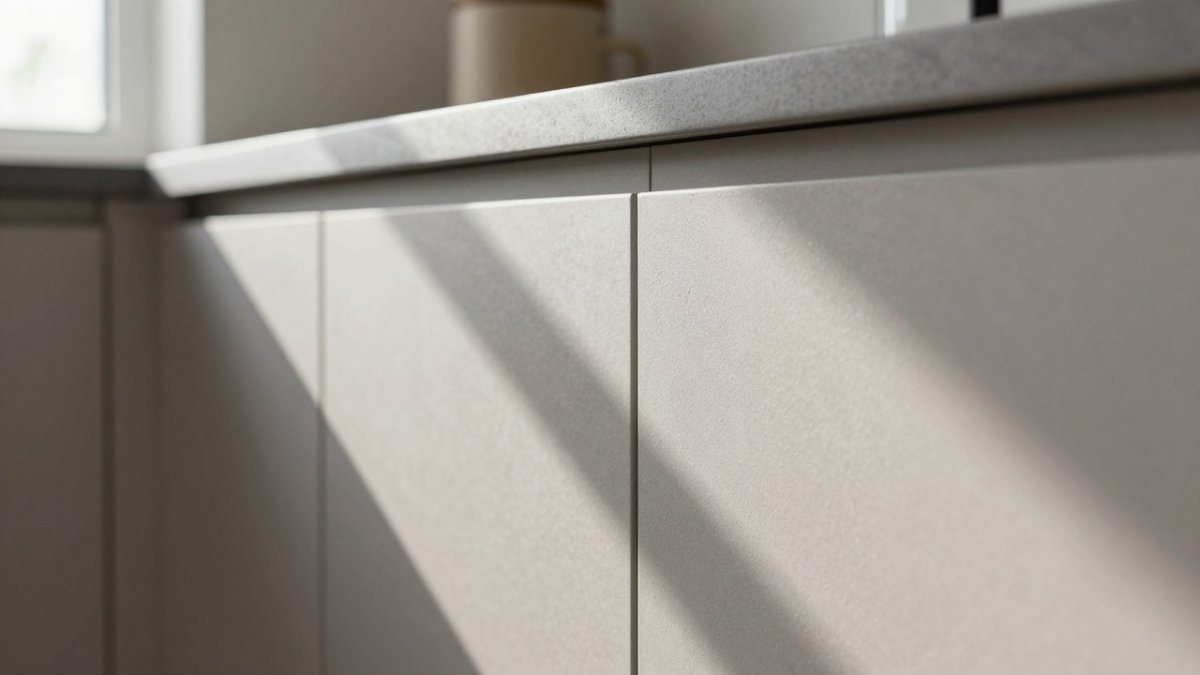
Lighting matters as much as colour. A door that looks clean under soft ambient light can show every mark under direct downlights or morning sun. This is why samples should be viewed in the actual kitchen, at the actual time of day, rather than in a showroom. A common pattern is that marks are most visible when light rakes across the door at a low angle.
Household use changes the picture. Homes with young children, pets or frequent cooking generate more airborne grease and more hand contact. In those homes, a mid-tone or textured finish often outperforms both extremes, because it hides a wider range of marks rather than excelling at hiding one type.
Practical guidance. If you want a dark colour, pair it with a low-sheen or textured finish and accept more frequent wiping. If you want a light colour, choose a texture or low sheen to manage grease near the cooktop. If you want the lowest-maintenance option, a mid-tone matte or woodgrain finish usually balances the trade-offs best. Always check samples under your own lighting before committing.
How to Clean Matte Kitchen Cabinets Without Leaving Marks
Cleaning method matters as much as the finish. Matte surfaces can look patchy if they are scrubbed hard or wiped with the wrong product, so the approach is different from gloss.
- Wipe with a soft microfibre cloth dampened with warm water.
- Add a small amount of mild dish detergent for grease, then wipe again with clean water.
- Dry straight away to prevent hard-water spots.
- Avoid abrasive pads, bleach and strong degreasers, which can dull the surface.
- Test any new cleaner on a hidden spot first.
Always follow the cabinet maker’s care instructions, since they vary between finishes.
Watch out: scrubbing a matte door with a rough cloth can leave shiny patches that look worse than the original marks.
Durability, Repairs and Total Cost Over Time
Durability depends on the material under the finish, the quality of the paint or laminate, and how the doors are used. But the more useful question for most households is repairability: when a mark or scratch appears, can it be fixed without replacing the door?
How each finish repairs. A painted door can often be touched up, but matching the sheen and colour invisibly is difficult, especially on matte and super-matte surfaces where a patch can look shinier or duller than the surrounding area. A laminate door cannot usually be spot-repaired; a deep scratch or chip may require replacing the door face or the whole door. Textured and woodgrain surfaces hide minor scratches well but can trap dirt in the grain if damaged. Gloss shows scratches and swirl marks readily and is the least forgiving to repair. Because repairs depend partly on how a surface handles light and wear, choosing a paint finish for each room with its use in mind can help keep touch-ups less conspicuous.
What wears first. Hinges, drawer runners and the edges of doors take the most wear. Edge banding on laminate doors can lift or chip over time, and painted edges can chip where doors meet. Ask your cabinet maker how edges are finished and whether replacement doors can be ordered in the same finish years later.
Cleaning effort over time. A finish that needs less frequent cleaning has a real lifecycle value, even if the upfront cost is higher. Matte and textured surfaces generally need gentler, less frequent wiping than gloss, but they can be less tolerant of harsh cleaners. Factor in the cost of cleaning products and the time spent, not just the door price.
Total cost considerations. Total cost is more than the price of the doors. Consider the cost of repainting or replacing doors in a few years, the availability of matching finishes for future repairs, and whether the finish is suitable for the humidity and heat of the kitchen. We recommend asking for a written quote that lists the finish, the door style, the edge treatment and what is included, so you can compare options on a like-for-like basis.
Questions to ask before you order. Can the finish be repaired on site? Are touch-up products available? Can matching doors be supplied later? What is the expected life of the surface under normal kitchen use? The answers will tell you more about long-term value than the showroom appearance alone.
Choosing a Finish for Your Melbourne Kitchen Renovation
Start with three questions: how dark is the colour you want, how busy is the kitchen, and how much daily cleaning are you willing to do. A low-sheen or super-matte finish suits most busy family kitchens. Dark colours need extra care, and gloss suits small spaces where you accept more wiping.
Our pick for most homes is a low-sheen or textured finish, because it balances appearance and practicality. Bring samples to your site and look at them under your own lighting before you decide. Our team at WDC Services can walk you through the options as part of a full renovation.
Discuss your finish options with WDC Services before ordering, so the doors, the splashback and the lighting all work together.
Please note this advertisement has been AI generated for entertainment and leed generation purposes and In some cases may not reflect the companies exact services and information.
Prior to engaging the company it is recommended that you seek clarification on some or all points in this advertisement .
Wdc services has many 5 star google reviews that can be used as a reliable and true testimony to the quality services proved to its customers over many years.
Contact Domenico ( Dom ) Crupi on 0425801005 or email info@wdcservices .com.au for further information
Frequently Asked Questions
Which kitchen cabinet finish shows the fewest fingerprints?
Low-sheen and matte surfaces generally show fewer fingerprints than high-gloss or very dark, smooth finishes, because the reflective surface is what makes marks stand out. Textured surfaces can also help. The result depends on colour and the exact finish, so ask your cabinet maker to show you a sample under your own kitchen lighting before you decide. Fingerprint resistance is a sensible factor to weigh, but it should not be the only one.
Are matte kitchen cabinets better at hiding fingerprints?
Matte finishes usually hide fingerprints better than gloss, since they reflect less light. However, dark matte cabinets can still show marks clearly, so a matte finish is not automatically fingerprint-proof. Light or mid-tone matte colours tend to perform best for everyday touch marks. Test a sample in your kitchen before committing to a full set of doors.
Do anti-fingerprint cabinet finishes really work?
Anti-fingerprint finishes can reduce how visible marks are, but they do not stop fingerprints from forming entirely. Treat the claim as one factor in your decision, and check how the finish performs with the cleaning products you plan to use.
How do you clean fingerprint-resistant kitchen cabinets?
Wipe the surface with a soft microfibre cloth and warm water, then dry it straight away. Avoid abrasive pads, harsh solvents and strong degreasers, which can dull matte finishes or leave a shiny patch. Check the manufacturer’s care instructions for the specific product, as recommended cleaners vary between finishes. Regular light cleaning is more effective than occasional heavy scrubbing.

Disclaimer: Disclaimer, Please note this advertisement has been AI generated for entertainment and leed generation purposes and In some cases may not reflect the companies exact services and information. Prior to engaging the company it is recommended that you seek clarification on some or all points in this advertisement. WDC Services has many 5 star google reviews that can be used as a reliable and true testimony to the quality services proved to its customers over many years. Contact Domenico ( Dom ) Crupi on 0425801005 or email info@wdcservices .com.au for further information.