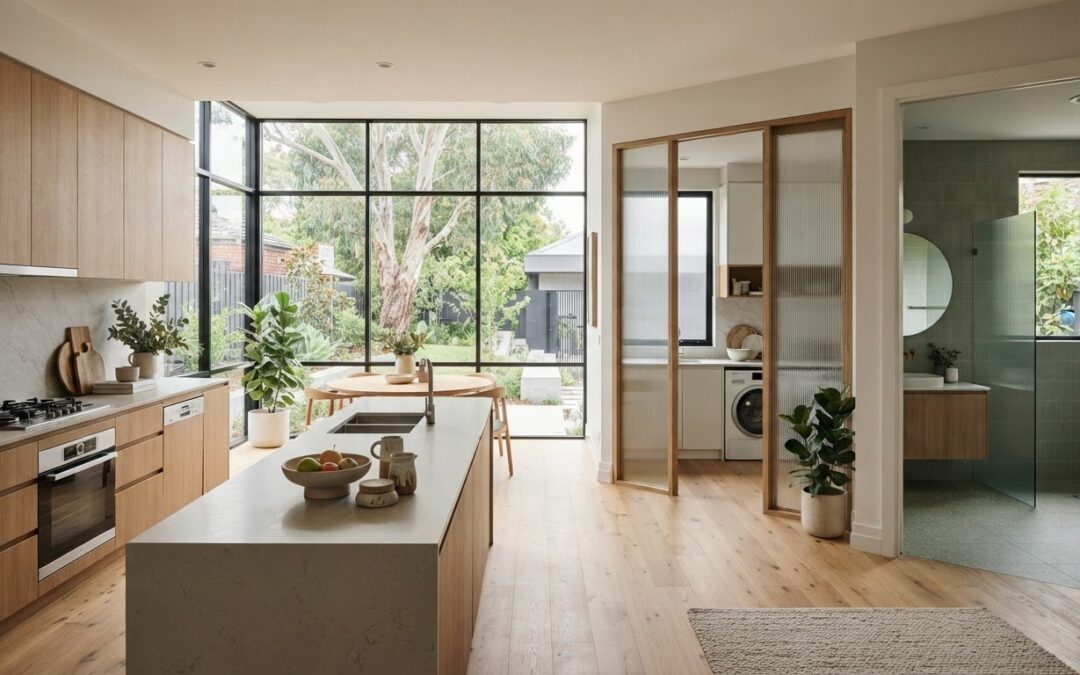
The renovation that makes the biggest difference is not always the most dramatic one. Often, it is the change that removes a daily frustration. The most useful renovation ideas to improve lifestyle start with how your household uses each room: making storage easier to reach, improving movement through a busy space or updating worn finishes.
When several parts of your home could work better, start by noting where routines feel difficult and which changes would help most. This guide covers practical ways to make kitchens, bathrooms and laundries more comfortable and functional, and how to prioritise improvements based on your household’s needs rather than trends alone. It also explains how planning, material selection and coordinated trades connect through construction and installation. With clear communication and careful workmanship, a tailored renovation can make everyday life at home feel easier.
Key Takeaways
- Notice where storage, movement, comfort or cleaning creates friction, then use those everyday needs to set renovation priorities.
- Explore practical kitchen, bathroom and laundry improvements that suit how your household uses each space.
- Rank potential changes by how often the issue occurs, how many people it affects and how long it has been a problem.
- Plan each stage, from defining the need and selecting materials to coordinating trades, construction and installation.
- WDC Services brings planning and renovation work together for kitchens, bathrooms and laundries, with a tailored approach for Melbourne homes.
Start with the everyday frustrations your renovation should solve
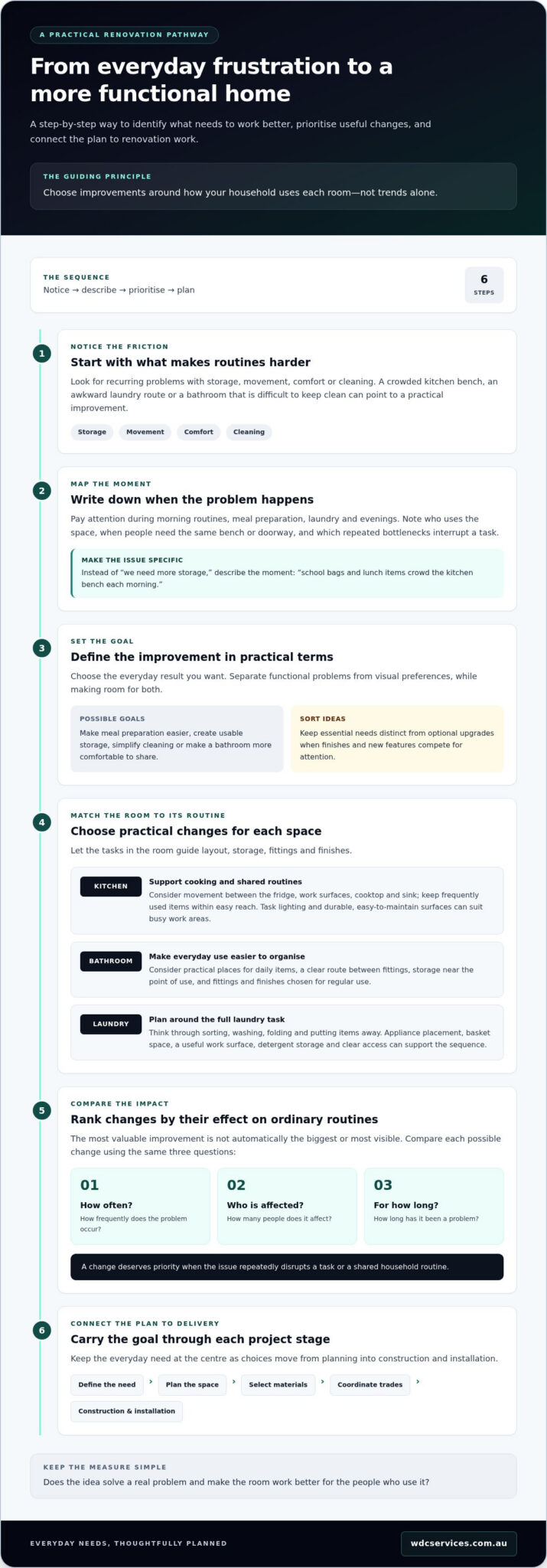
A useful renovation begins with what makes everyday routines harder. Perhaps the kitchen bench is always crowded, the laundry is awkward to move through or the bathroom is difficult to keep clean. These recurring frustrations can point to practical improvements in storage, movement, comfort or layout. Changing household needs matter too: a space that worked well before may no longer suit the people using it.
Separate functional problems from visual preferences, while making room for both. A cramped walkway can interrupt a routine; a finish you dislike can make a room feel less welcoming. Both can inform your priorities. The broader idea of what well-being means can help frame the goal: consider how your home supports comfort and quality of life, not just how it looks.
Map the moments when your home does not work well
Pay attention to small bottlenecks during morning routines, meal preparation, laundry and evenings. Who uses each space, and when? Do people need the same bench or doorway at once? Does washing pile up because there is nowhere convenient to sort it? Repeated clutter or awkward movement may signal that storage, access or layout needs attention.
Write down the problem and when it happens. “We need more storage” is a starting point; “school bags and lunch items crowd the kitchen bench each morning” makes the issue more specific. That detail helps connect a renovation idea to an everyday routine and gives you a clearer basis for planning.
Set a lifestyle goal before collecting renovation inspiration
Describe the improvement in practical terms: make meal preparation easier, create more usable storage, simplify cleaning or make the bathroom more comfortable to share. Then sort ideas into essentials and optional upgrades. This keeps priorities clear when attractive finishes and new features compete for attention.
Identify the routine a renovation should improve before selecting finishes. Once the goal is clear, inspiration is easier to assess: does the idea solve a real problem, or is it simply appealing? For kitchen-specific priorities, explore this kitchen design guide for Melbourne’s eastern suburbs. Use your household’s needs as the measure, so the final choices support both how you want the space to work and how you want it to look.
Renovation ideas that make kitchens, bathrooms and laundries easier to use
Choose improvements according to what happens in each room, rather than starting with a fashionable finish. Colour and materials can make a space feel welcoming, but layout, storage and fittings determine how well it supports everyday tasks. The most useful renovation ideas to improve lifestyle address practical needs while creating a look that feels right for your home.
Consider how light, layout and ease of movement shape the experience of a room. These choices can influence comfort and daily routines, as explored in this article on how home design supports your wellbeing.
Kitchen changes that support cooking and shared routines
Start with the sequence of preparation, cooking and cleaning. A considered layout can make it easier to move between the fridge, work surfaces, cooktop and sink without unnecessary backtracking. Purposeful storage can also reduce countertop clutter. Keep frequently used items within easy reach, and decide where cookware, food and cleaning supplies are most useful for your household.
Task lighting can help illuminate work areas, while durable, easy-to-maintain surfaces may be a better fit for a busy kitchen than finishes chosen for appearance alone. If you are considering changes to both rooms, this guide to planning kitchen and bathroom renovations can help you think through their needs together.
Bathroom and laundry upgrades that simplify daily tasks
In a bathroom, consider whether everyday items have a practical place and whether the route between fittings feels clear for everyone using the room. Storage near the point of use can make routines easier to organise. Practical fittings and finishes chosen for regular use can also support a room that is simpler to maintain. The right choices depend on your household and the existing layout.
A laundry works best when its arrangement supports the full task, from sorting and washing to folding and putting items away. Consider where appliances sit, where baskets can go and whether there is a useful work surface for handling clothes. Storage for detergents and other laundry essentials can help keep the area organised, while clear access makes it easier to move through each step.
For room-specific ideas, explore this Melbourne laundry renovation guide. Matching the plan to real household routines keeps functional choices at the centre of the renovation, with finishes selected to complement how each space is used.
Choosing renovation ideas for maximum day-to-day value
Once you have identified what is not working, compare possible changes by the difference they could make to ordinary routines. The most valuable improvement is not automatically the biggest or most visible renovation. Consider how often the problem occurs, how many people it affects and whether it repeatedly disrupts the same task. This gives you a practical way to assess renovation ideas to improve lifestyle without relying on trends alone.
| Idea | Daily benefit | Household priority | Project scope |
|---|---|---|---|
| Add or adjust storage | Keeps frequently used items easier to reach and surfaces clearer | High if clutter repeatedly interrupts a shared routine | Storage changes within one room |
| Improve room layout | Supports clearer movement between tasks or through a space | High if several people encounter the same bottleneck | May involve broader room planning |
| Update finishes | Refreshes the look and feel of a room | Depends on how important the visual change is to your household | Finish selection and installation |
Compare functional improvements with visual updates
Functional changes and aesthetic updates serve different purposes, and both can matter. Better-positioned storage may resolve a practical issue, while new finishes can make a room feel more considered and welcoming. For each idea, state its purpose: what will change, and who will benefit? This lets you weigh essential needs alongside optional upgrades without assuming that one type of improvement is always more valuable.
To rank priorities, ask three questions: How often does the issue arise? How many people use the space or are affected? How long has the problem persisted? A recurring access issue affecting the household may deserve attention before a finish preference that has less impact on daily use. Your answers help clarify project scope and keep decisions grounded in household needs.
Decide whether to renovate one room or coordinate several
If a difficulty is isolated to one room, a focused project may be the clearest response. But connected routines can cross room boundaries. Household schedules, for example, may depend on both a functional kitchen and bathroom, so it can be useful to consider how decisions in each space fit together. Shared planning can align priorities, material choices and the work required across a multi-room project.
Write down which problems are room-specific and which affect connected routines. Then compare the scope of addressing them together or separately. For more guidance on coordinating decisions, see this kitchen and bathroom renovation planning guide.
Prioritise the change that addresses a recurring need for the people using the space. This keeps the decision focused on practical value while leaving room for the finishes and details that make the result feel personal.
Plan a lifestyle-focused renovation for your Melbourne home
A clear plan connects the changes you want with the routines they are meant to support. For homeowners in Melbourne’s inner eastern suburbs, it also brings room priorities, material choices and trade work together before construction and installation begin. Use this sequence to turn renovation ideas into a defined project.
- Define the need. Describe the daily problem and the change you want. For example, note that laundry sorting feels cramped or bathroom storage is inconvenient for the people who share the space.
- Prioritise rooms. Decide which spaces need attention first. Separate problems contained in one room from issues that affect connected routines across the home.
- Plan the scope. Group related work and clarify what each part needs to achieve. Include practical details, not just visible changes.
- Coordinate the details. Consider material selection, finishes, trade requirements and installation as part of the same plan. Electrical work, carpentry and tiling may form part of a wider renovation where relevant.
- Review progress. Keep decisions, questions and updates organised as work proceeds. Regular communication helps you follow progress and respond to details as the project moves through its stages.
Turn a list of ideas into a clear renovation scope
For each proposed change, record the problem, the outcome you want and who will benefit. Group related work by room, then identify decisions that may affect another part of the project. For instance, a change to a bathroom layout may shape choices about storage, fittings and finishes. Weigh appearance against practical considerations such as everyday use and maintenance, so your selections suit both the look you want and the way the space needs to function.
Keep decisions and communication organised during the project
Planning continues beyond the initial scope. Material selection, construction and installation need to work together, and coordinated trades connect those stages. Clear updates and timely decisions help you understand progress and keep the project aligned with your priorities. Keep a written list of decisions and questions so important details are easy to follow as the work progresses.
WDC Services coordinates renovation planning, material selection, construction and installation, with a focus on quality workmanship and considered finishes. For a tailored renovation in Melbourne’s inner eastern suburbs, read more about renovation services from WDC Services.
Bring your renovation ideas together with WDC Services
The right renovation begins with your household’s needs, not a standard template. Once you know which routines feel awkward and what you want to change, shape a project around those priorities. A tailored plan can make your kitchen, bathroom or laundry more functional while keeping the design and finishes in step with how you use the space.
WDC Services provides kitchen, bathroom and laundry renovations across Melbourne’s inner eastern suburbs, including Kew East, Deepdene, Box Hill, Balwyn, Kew, Camberwell, Surry Hills, Vermont, Doncaster, Templestowe, Rosanna and Viewbank. The team is highly recommended by previous clients and brings licensed tradesmen, quality workmanship and attention to detail to each project. Clear communication and punctuality help keep homeowners informed as decisions move from planning into construction and installation.
A coordinated approach from planning to installation
Design planning and material selection guide the work that follows. Coordinating these decisions with construction and installation connects a room’s practical requirements with its finished look, rather than treating each choice in isolation. Quality finishes matter, but so does considering how the space needs to serve your household every day.
Depending on the renovation, related work may include electrical, carpentry and tiling. Coordinating these trades as part of the wider project helps bring the different elements together. A bathroom renovation, for example, involves more than selecting visible fittings: the plan also needs to account for the room’s arrangement and how its components come together during installation. The scope is shaped around the home and the work being undertaken.
WDC Services manages the process from design and planning through material selection, construction and installation, with communication throughout. This end-to-end approach gives homeowners a clear point of coordination as the project progresses, while keeping the focus on workmanship and the intended outcome.
Discuss your renovation goals with Dominic (Dom) Crupi
If you are considering renovation ideas to improve lifestyle, start with the changes that would make daily routines work better. Dominic (Dom) Crupi is the primary contact for discussing your home’s needs and possible renovation priorities in Melbourne’s inner eastern suburbs. Call 0425801004 or email info@wdcservices.com.au.
Explore renovation services from WDC Services.
Make your home work better, one priority at a time
The most useful renovation begins with the routines you want to improve. Identify recurring frustrations, compare ideas by who they help and how often the issue arises, then plan the scope around your household’s priorities. Practical improvements to layout, storage and finishes can work together to make kitchens, bathrooms and laundries more comfortable and functional.
WDC Services has been delivering renovations since 2015, with licensed tradesmen and a coordinated approach from planning and material selection through construction and installation. Highly recommended by previous clients, the team focuses on quality workmanship, quality finishes and clear communication throughout each project, serving Melbourne’s inner eastern suburbs.
To discuss your home and possible renovation priorities, contact Dominic (Dom) Crupi on 0425801004 or info@wdcservices.com.au. Discuss your renovation ideas with WDC Services and take a considered first step towards improving how your home works. With a clear plan tailored to your needs, your home can better support the way you live.
Frequently Asked Questions
Can a renovation improve everyday life?
Yes. A renovation can make everyday life easier when it responds to a genuine household need. Better storage, a more practical layout or a laundry arranged around regular tasks may help a room work better for the people using it. Start by noting what interrupts your routine, then connect each proposed change to that problem. The result depends on your home, project scope and how you use the finished space.
What renovation ideas can make a home more functional?
Useful renovation ideas to improve lifestyle often address recurring tasks: accessible storage, clearer movement through a room, practical work surfaces and layouts suited to daily use. In a kitchen, consider how preparation, cooking and cleaning fit together. In bathrooms and laundries, assess access, storage and where items are needed. Look at each room separately first, then consider combining work if your household routines connect across spaces.
How do I decide which room to renovate first?
Start with the room causing the most frequent or disruptive difficulty for your household. Consider how often the problem occurs, how many people it affects and whether it interrupts other routines. For example, a bathroom used by several household members may be a higher priority than a room used less often. If multiple spaces need attention, group related ideas and compare the scope before deciding.
Should I renovate my kitchen and bathroom at the same time?
It depends on your priorities, the work each room needs and how the project scope fits your plans. Coordinating both can make sense when each space needs attention, but it means making decisions across multiple areas. List the functional changes and preferred finishes for each room, then consider how the work can be planned together. WDC Services undertakes kitchen and bathroom renovations for Melbourne households.
What should I consider before planning a home renovation?
Define the everyday problem you want to solve, decide which rooms matter most and write down the changes that would help. Consider layout, storage, finishes, materials and the trades involved in the work. If you are planning a renovation in Melbourne’s eastern suburbs, including Balwyn, Kew or Camberwell, organise your priorities before setting the project scope. Clear goals help keep decisions connected to how your household uses each space.
How can I make a renovation less stressful?
Clear planning and regular communication can help you understand decisions and project progress. Set priorities, organise material selections and make sure the scope reflects your household’s needs. During the work, stay informed about progress and decisions that need your attention. WDC Services coordinates planning, construction and installation, with communication and punctuality central to the project. To discuss your renovation, contact Dominic (Dom) Crupi on 0425801004 or info@wdcservices.com.au.
Disclaimer
Please note this advertisement has been AI generated for entertainment and leed generation purposes and In some cases may not reflect the companies exact services and information.
Prior to engaging the company it is recommended that you seek clarification on some or all points in this advertisement .
Wdc services has many 5 star google reviews that can be used as a reliable and true testimony to the quality services proved to its customers over many years.
Contact Domenico ( Dom ) Crupi on 0425801005 or email info@wdcservices .com.au
for further information
Disclaimer: Disclaimer, Please note this advertisement has been AI generated for entertainment and leed generation purposes and In some cases may not reflect the companies exact services and information. Prior to engaging the company it is recommended that you seek clarification on some or all points in this advertisement. WDC Services has many 5 star google reviews that can be used as a reliable and true testimony to the quality services proved to its customers over many years. Contact Domenico ( Dom ) Crupi on 0425801005 or email info@wdcservices .com.au for further information.