

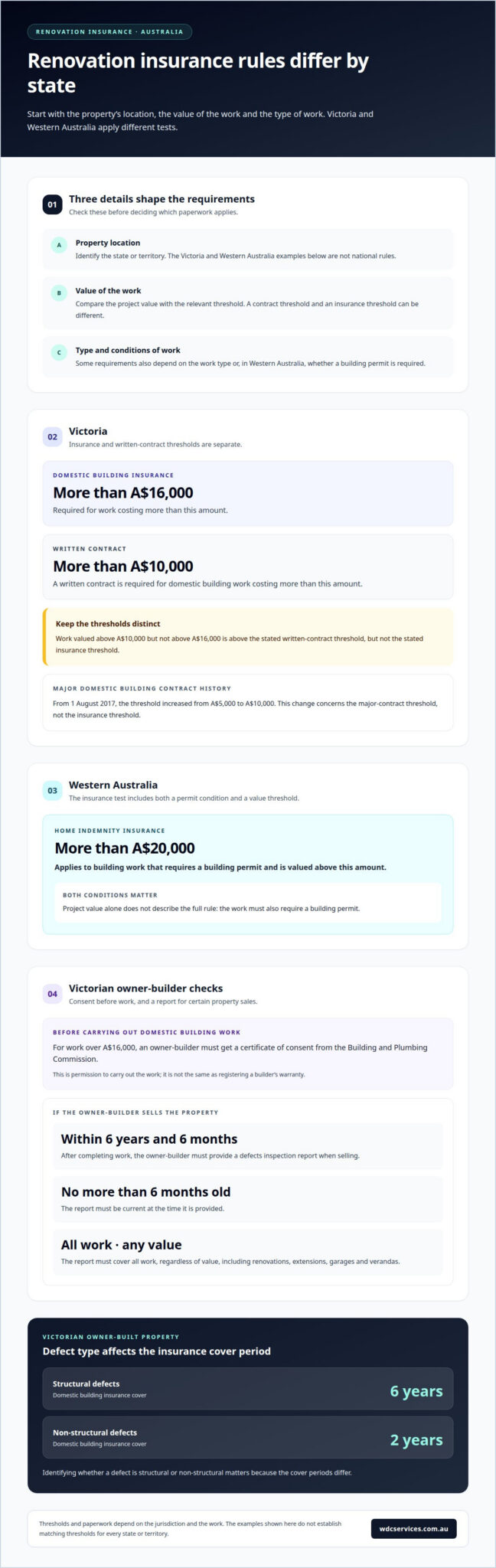
Renovation insurance requirements vary across Australia. In Victoria, domestic building insurance is required for work costing more than A$16,000; in Western Australia, home indemnity insurance is required for building work that needs a building permit and is valued at more than A$20,000. Registering your renovation warranty starts with understanding which state rules apply and what protection the insurance provides.
It’s understandable to want clear answers about whether defects are covered, especially because structural and non-structural problems can have different coverage periods. For Victorian owner-built property, domestic building insurance covers structural defects for six years and non-structural defects for two years.
This article explains how registering your renovation warranty relates to insurance cover, what defects inspection reports record, and why they matter when an owner-builder sells a property. It also explains why requirements vary between states, so you can identify the paperwork and protections relevant to your renovation.
Key Takeaways
- Insurance requirements depend on the state and type of work. In Victoria, domestic building insurance is required above A$16,000; in Western Australia, home indemnity insurance applies to certain permitted building work valued above A$20,000.
- Understand who handles the insurance paperwork and what homeowners should receive before making payments.
- Keep contracts, insurance documents and renovation records together to help clarify what work and cover they relate to.
- For Victorian owner-built homes sold within six years and six months of completed work, a defects inspection report must cover all work, regardless of value.
- Structural and non-structural defects can have different insurance cover periods, so identifying the defect type matters.
Is a renovation warranty legally required in each Australian state and territory?
There is no single threshold for renovation insurance requirements across Australia. Victoria and Western Australia, for example, have different requirements for certain domestic building work. These rules concern insurance and contracts, not simply registering a document called a renovation warranty. The property’s location, the value of the work and its type all matter.
In Victoria, domestic building insurance is required for work costing more than A$16,000. A written contract is required for domestic building work costing more than A$10,000. These are separate requirements: the contract threshold and insurance threshold are not interchangeable. For example, work valued above A$10,000 but not above A$16,000 falls above the stated written-contract threshold, but not the stated insurance threshold.
Victoria’s contract rules also have a history that can matter when reviewing older documents. From 1 August 2017, the threshold for a major domestic building contract increased from A$5,000 to A$10,000. That change concerns the major-contract threshold, not the insurance threshold. A homeowner reviewing a past renovation should compare the contract date and work value with the applicable rule, rather than assuming today’s thresholds applied at the time.
In Western Australia, home indemnity insurance is required for building work that requires a building permit and is valued at more than A$20,000. The permit requirement is part of this test, so value alone does not describe the full rule. Those protections concern insurance cover, not a general warranty registration form.
Other jurisdictions include New South Wales, Queensland, South Australia, Tasmania, the Australian Capital Territory and the Northern Territory. Don’t automatically apply the Victoria or Western Australia thresholds to work in those places. The renovation’s location and scope determine which local building and insurance requirements apply. The examples here do not establish a matching threshold for every state or territory.
- Separate the concepts: a contract, statutory insurance and a builder’s warranty are not the same document.
- Identify the jurisdiction: Victoria’s A$16,000 insurance threshold and Western Australia’s A$20,000 permit-linked threshold differ.
- Match the rule to the work: in Western Australia, both the building permit requirement and project value matter.
Registering your renovation warranty is not a substitute for understanding the insurance and contract rules that apply to the property. In Victoria, compare the work value with both thresholds. In Western Australia, consider the permit requirement as well as the value. In other states and territories, don’t treat either example as a national rule.
Who is responsible for registering a renovation warranty: the builder or homeowner?
There isn’t one national registration process that assigns every renovation warranty to either party. First, distinguish a builder’s warranty from insurance required under a state scheme. The policy documents, contract and type of work show who arranges cover and what records the homeowner should receive.
In Western Australia, the builder must give the homeowner a copy of the home indemnity insurance certificate. The homeowner should not pay until the insurance is in place. The builder must supply the certificate; the homeowner should keep it and confirm that it relates to the contracted work.
The certificate is evidence of insurance, not a universal warranty registration receipt. For example, keep a bathroom renovation contract and its insurance paperwork together to compare the address, scope and parties. If the certificate and contract describe different work, resolve the mismatch before payment rather than assuming it is a clerical detail.
Homeowners also have an important record-keeping role after work finishes. Keep the signed contract, approved changes, invoices, completion details, inspection records and insurance documents together in one project file. Label each record with the property address and builder’s details. This creates a clear trail if a defect appears or the property is later sold.
Owner-builders have distinct obligations in Victoria. Before carrying out domestic building work over A$16,000, an owner-builder must get a certificate of consent from the Building and Plumbing Commission. That requirement concerns permission to carry out the work; it is not the same as registering a builder’s warranty. The owner-builder should keep the consent and project records with the property documents.
A Victorian owner-builder selling within six years and six months of completing work must provide a defects inspection report no more than six months old. The report must cover all work, regardless of value, including renovations, extensions, garages and verandas. The owner-builder must arrange this sale documentation rather than rely on a renovation contractor to produce it later.
If you’re working with a builder, clarify the paperwork roles in writing before construction begins. Record who arranges applicable insurance, who supplies certificates and which documents will be handed over at completion. Then check that the names, property details and work descriptions match. These comparisons help distinguish the builder’s delivery obligations from your responsibility to preserve the records.
Planning a bathroom renovation also means organising project records from the outset. Explore bathroom renovation services alongside your documentation planning, so the project scope and paperwork stay connected.
What documents and details are needed to register a renovation warranty?
There is no single Australian document pack for every renovation warranty. The paperwork depends on the state, type of cover and work completed. Start with the signed building contract, then compare its property address, parties and renovation scope with the insurance certificate or warranty record. For a bathroom project, the documents should make clear which rooms and work they refer to.
Keep the contract and its variations together. A variation records an agreed change to the original scope, such as adding work or changing specified materials. If the finished work differs from the original contract, the variation helps explain the completed project. Keep dated copies and make sure both parties’ names and the property details are clear.
For insurance, retain the policy or certificate issued for the relevant work. In Western Australia, the builder must give the homeowner a copy of the home indemnity insurance certificate. Compare it with the contract to check that the property and insured work correspond. Keep the certificate with payment records and project correspondence, not as a substitute for the contract.
A useful project file can include:
- Contract records: the signed agreement, scope of work, plans and written variations.
- Party details: the homeowner’s name, builder’s name and the renovation property address.
- Cover documents: the applicable insurance certificate, policy or warranty paperwork.
- Completion evidence: invoices, dated photographs, handover notes and inspection records.
- Defect records: written descriptions, photographs and correspondence about any issue found.
These records help identify the work the cover relates to; they don’t mean every scheme requires every item for registration. For example, dated photographs of a completed laundry may help distinguish the renovation from later work. Invoices and handover notes can also connect the completed scope with the contract and approved changes.
Owner-builders selling a Victorian property may need a defects inspection report as part of the sale documentation. Keep it with the relevant building records, and preserve its inspection date and description of the work. A report documenting defects or incomplete work is distinct from an insurance certificate, so one does not replace the other.
Before submitting paperwork, organise it by property and project, then check that names, address and work descriptions match across records. This can reveal missing variations or a certificate linked to a different scope. Clear documentation makes the renovation, its completion and any applicable cover easier to identify later.
What are the registration deadlines after renovation work is completed
There is no single completion-based deadline for every renovation warranty across Australia. Distinguish the date work finishes from any deadline linked to insurance paperwork or a later property sale. The process depends on the type of cover and the circumstances of the renovation. Record the completion date, as it may be important when calculating a later reporting period.
One specific Victorian requirement applies to owner-builders selling a property. If an owner-builder sells within six years and six months of completing building work, they must provide a defects inspection report no more than six months old. The trigger is the proposed sale within that period, not simply the day the renovation ends.
An inspection report prepared soon after completion may be too old for a later sale. For example, if a Victorian owner-builder plans to sell several years after finishing an extension, the report must still meet the six-month age limit at sale. Plan the inspection around the sale process rather than treating an earlier renovation handover document as a substitute.
The report’s scope also matters. For a Victorian owner-builder selling within six years and six months, the defects inspection report must cover all work, regardless of value. That includes extensions, renovations, garages and verandas. A report limited to one bathroom would not cover the full required scope if other building work on the property also needs assessment.
Keep these dates in the property file:
- Completion date: record when the building work was completed, as the Victorian sale period is measured from completion.
- Inspection date: retain the report date to assess whether it is no more than six months old at sale.
- Planned sale date: compare it with the six-year-and-six-month period that applies to the Victorian owner-builder requirement.
- Work covered: list each relevant area, such as an extension, renovation, garage or veranda.
For other renovation insurance paperwork, keep the dates of contracts, certificates and completion records together. This timeline helps identify which document relates to the project and when it was issued. It also prevents confusion between an insurance document’s issue date and a defects report’s inspection date.
For a Victorian owner-builder, the practical deadline is tied to a sale within the specified period, and the report must be current at that point. Don’t assume a builder’s renovation warranty follows the same timeline. Treat each document according to its purpose, record its date, and use the completion date to organise later property-sale paperwork.
How can homeowners check whether a builder’s renovation warranty or insurance is valid
Start by identifying what the document represents. A builder’s warranty, an insurance certificate and a defects inspection report serve different purposes. Match each document to the renovation contract, property address and work described. A document bearing a builder’s name alone does not show that its cover applies to every part of a project.
In Western Australia, the builder must give the homeowner a copy of the home indemnity insurance certificate. The homeowner should not pay until the insurance is in place. Compare the certificate’s property and work details with the signed agreement. Keep the certificate and contract together so the insured project can be identified later.
Use a consistent comparison for every document:
- Property: check that the address matches the renovation site.
- Parties: compare the builder and homeowner names with the contract.
- Scope: confirm that the described work corresponds with the contracted renovation.
- Dates: record when the contract, certificate and completion documents were issued.
- Document type: distinguish insurance evidence from warranty terms and inspection findings.
For example, a certificate that names the correct property but describes different work may not clearly match the renovation contract. Keep the original documents and any written corrections together. This creates a traceable record of what was supplied and which project it was intended to cover.
Victorian owner-built property has specific insurance features to understand. Domestic building insurance covers structural defects for six years and non-structural defects for two years, with costs to fix defects covered up to A$300,000. For an owner-built property, that insurance becomes effective once the contract of sale is signed. These terms describe the stated owner-builder cover, not a universal period for every builder’s warranty.
Read any defects inspection report alongside the insurance documents. Victorian domestic building insurance for an owner-built property does not cover defects or incomplete work identified in that report. If the report records an unfinished item, it does not show that insurance will pay to complete it. Keep the report’s findings distinct from policy terms and warranty records.
Store the contract, certificate, warranty paperwork, inspection reports and related correspondence in one property file. If a defect arises, compare its location and description with the scope stated in the documents. This helps identify what each record says without confusing a builder’s promise with insurance cover.
Planning renovation work? Discuss your renovation project and keep its scope and paperwork clear from the outset.
Also check whether paperwork relates to a preparation of plans agreement: in Western Australia, a preparation of plans agreement is not part of a home building work contract and is not covered by a home indemnity insurance policy. In Victoria, an owner builder can get only one owner-builder permit for a single home and associated work on that property once every five years. Updates affecting certificates of consent for Victorian owner builders came into effect from 1 September 2016.
In Western Australia, fixed-cost home building contracts valued between AUD 7,500 and AUD 500,000 are covered by the Home Building Contracts Act 1991. For covered contracts, the maximum deposit before work starts is 6.5 per cent of the contract price. Upfront payments after the deposit are not allowed under the stated home building contract rules; progress payments should cover work already done or materials already supplied. Check payment requests against those terms and retain records with the contract documents.
WDC Services: Bathroom Renovations
WDC Services helps homeowners plan bathroom renovations, from design and planning through construction and installation. The team focuses on quality workmanship, careful finishes and clear communication, keeping you informed as the project progresses and valuing punctuality throughout the work.
Previous clients highly recommend WDC Services. Homeowners planning a laundry renovation or electrical work can also discuss how those needs fit their project. Services are available across the inner Melbourne eastern suburbs.
To discuss your renovation, contact Dominic (Dom) Crupi on 0425801004 or email info@wdcservices.com.au.
Set your renovation up for a clear next step
A renovation is easier to manage when its scope, decisions and records stay connected from the start. Before work begins, write down what the project includes and how agreed changes will be recorded. As work progresses, file relevant documents together so you can identify the completed work and its associated paperwork without piecing details together later.
An organised approach also helps you understand where registering your renovation warranty fits into the wider project. Treat warranty information as one part of good renovation record-keeping, alongside clear communication and careful documentation. For a bathroom project, WDC Services can coordinate design, planning and construction. Contact the team to discuss your renovation.
For a considered next step, contact WDC Services about your renovation. A clear conversation about your plans can help you move forward with confidence and a well-organised project.
Frequently Asked Questions
What is a renovation warranty in Australia, and what does it cover?
A renovation warranty describes protection associated with renovation work, but it isn’t one uniform national policy. The term may refer to a builder’s warranty or insurance required under a state scheme, and those protections are not interchangeable. Coverage depends on the document and applicable rules. Read a warranty statement for its stated work, exclusions and claim process rather than assuming it covers every defect or unfinished item.
How do you register a renovation warranty in Australia, step by step?
There isn’t one registration pathway for every Australian renovation. First, identify the state, work type and applicable insurance scheme. Then organise the contract and project details and follow the relevant scheme’s process for obtaining or recording cover. In Western Australia, the builder must provide the home indemnity insurance certificate, and the homeowner should not pay until insurance is in place. Keep the certificate with your project records when registering your renovation warranty.
What happens if a renovation warranty is not registered or the builder becomes insolvent?
The builder must provide the insurance certificate, and the homeowner should not pay until the insurance is in place.
Disclaimer
Please note this advertisement has been AI generated for entertainment and leed generation purposes and In some cases may not reflect the companies exact services and information.
Prior to engaging the company it is recommended that you seek clarification on some or all points in this advertisement .
Wdc services has many 5 star google reviews that can be used as a reliable and true testimony to the quality services proved to its customers over many years.
Contact Domenico ( Dom ) Crupi on 0425801005 or email info@wdcservices .com.au
for further information
Disclaimer: Disclaimer, Please note this advertisement has been AI generated for entertainment and leed generation purposes and In some cases may not reflect the companies exact services and information. Prior to engaging the company it is recommended that you seek clarification on some or all points in this advertisement. WDC Services has many 5 star google reviews that can be used as a reliable and true testimony to the quality services proved to its customers over many years. Contact Domenico ( Dom ) Crupi on 0425801005 or email info@wdcservices .com.au for further information.