
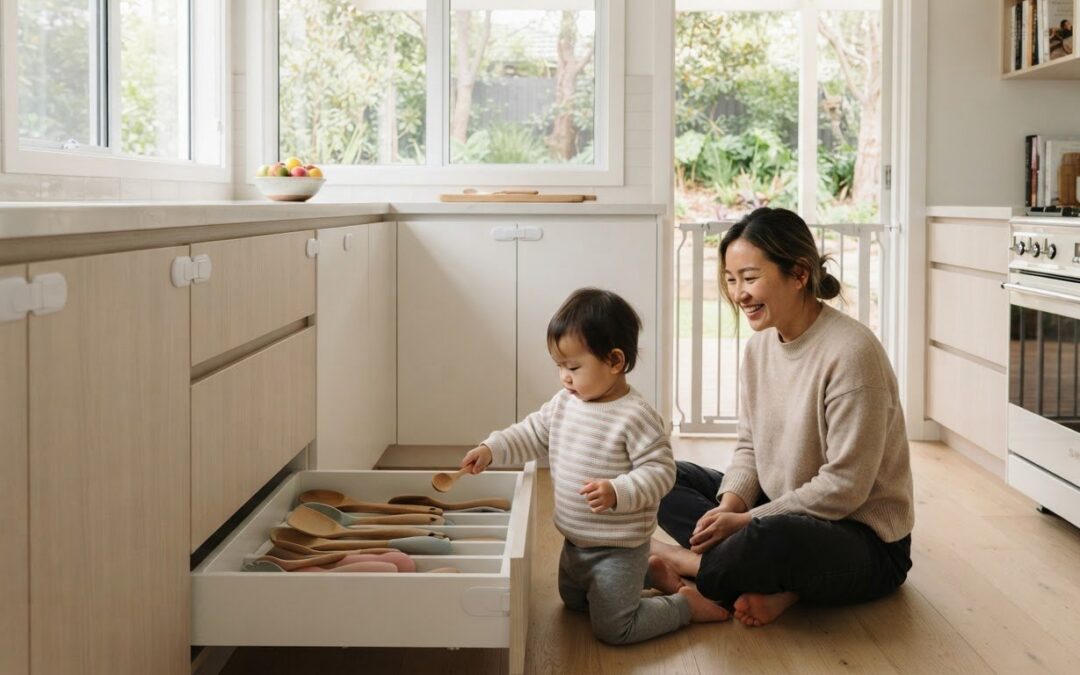
Babies typically begin opening drawers between 6 and 12 months, so child-proofing a new kitchen should include a plan for curious hands as well as protection from hazards. Set aside a low drawer with safe household items for your child to explore, and secure drawers containing knives, chemicals and other dangerous objects with safety latches.
It’s natural to focus on keeping little ones away from the stove and cleaning products. But giving them a safe place to explore can also make the kitchen easier to manage as they become more mobile.
This guide explains how to secure sharp and hazardous items, reduce risks around cooking and appliances, and block kitchen access when needed. You’ll also learn how to create a child-friendly drawer, adapt it as your child grows, and make child-proofing a new kitchen part of a practical safety routine.
Key Takeaways
- Store knives, medicines and cleaning products where children can’t reach them, and secure hazardous cupboards with suitable latches.
- Review stove and appliance risks, including accessible controls, hot cookware and loose cords, then add safety measures where they address a specific hazard.
- Use a baby gate to restrict access to the kitchen when its layout allows, while keeping supervision part of your routine.
- Set aside a low drawer with safe items for children to explore, and keep dangerous drawers secured.
- Plan renovations around practical family safety needs, including suitable electrical work where it supports the kitchen’s setup.
Keeping knives and other dangerous items out of reach
Child-resistant packaging is not a substitute for secure storage. Follow each chemical’s label, keep products in their original containers, and lock them away from children.
There is no single cost for child-proofing a kitchen. DIY costs depend on the locks, latches and gates needed; professional installation costs depend on the work and are provided after a quote request.
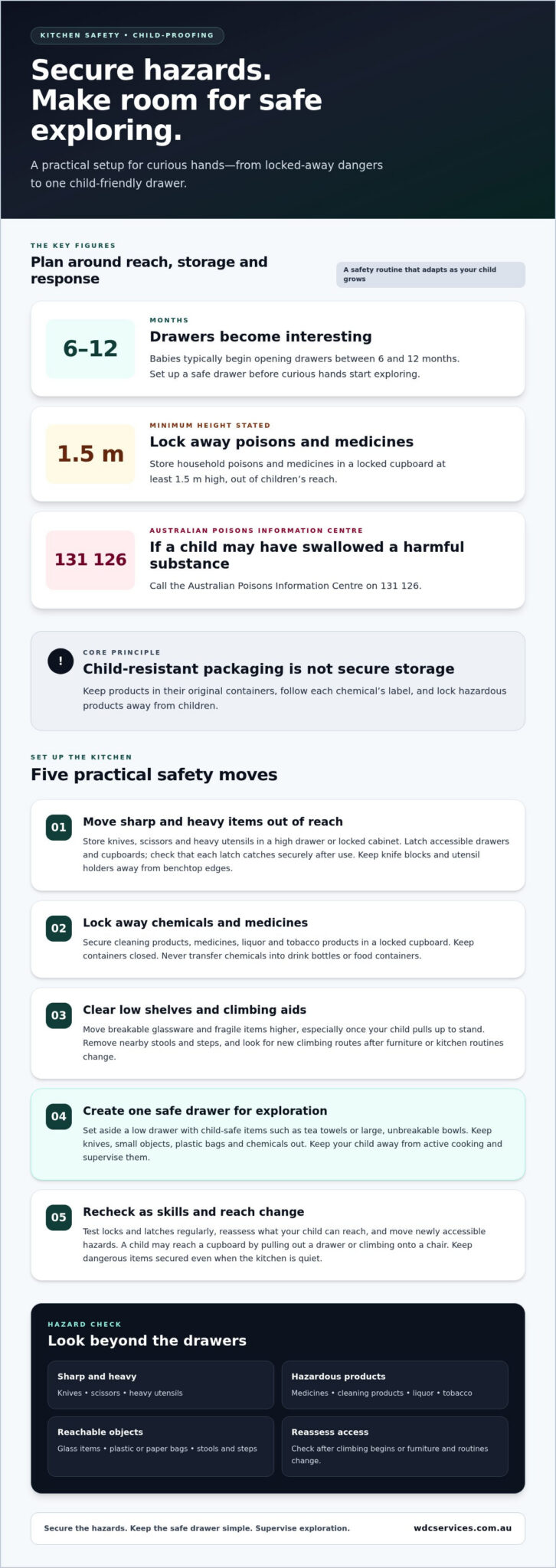
Main hazards include knives, heavy utensils, medicines, cleaning products, liquor, tobacco products, glass items and plastic or paper bags. Store household poisons and medicines in a locked cupboard at least 1.5 m high.
As your child grows, regularly test locks and latches, then reassess what they can reach. Remove nearby stools and steps, especially when your child starts climbing.
- Move sharp and heavy items out of reach. Store knives, scissors and heavy utensils in a high drawer or locked cabinet. Install a safety latch on accessible drawers and cupboards. Check that it catches securely after each use. Keep knife blocks and utensil holders away from benchtop edges, where a child could pull them down.
- Lock away chemicals and medicines. Secure cleaning products, medicines, liquor and tobacco products in a locked cupboard. Keep containers closed and follow their labels. Don’t transfer chemicals into drink bottles or food containers. If a child may have swallowed a harmful substance, call the Australian Poisons Information Centre on 131 126.
- Clear low shelves and remove climbing aids. Move breakable glassware and other fragile items to higher storage, especially once your child pulls up to stand. Don’t leave stools or steps near cabinets containing dangerous items. Recheck access after moving furniture or changing how you use the kitchen.
- Make a safe area for everyday exploration. Set aside a low drawer with child-safe items, such as tea towels or large, unbreakable bowls. Keep knives, small objects, plastic bags and chemicals out of it. Offer the drawer while you prepare food, but keep your child away from active cooking and supervise them.
- Review the setup as skills change. Test every latch and lock, look for new climbing routes, and move newly reachable hazards. A child may reach a cupboard by pulling out a drawer or climbing onto a chair. Store stools and steps outside the kitchen, and keep dangerous items secured even when the room is quiet.
Deciding whether to add stove and appliance safety products
Fit safety locks to accessible ovens and cooktops, and keep the dishwasher closed when it’s not in use. Store dishwasher detergent in a secured cupboard, away from babies and children.
-
Keep Appliance Cords Out of Reach
Move appliance cords to the back of the bench and use cord organisers or cable ties to keep them tidy. Check that no cord hangs over an edge where a child could grab it and pull an appliance down. Keep cords away from wet areas, walkways and places where they might snag, such as beside a window.
Inspect each cord before use. Replace damaged cords, as broken insulation can expose children to electric shock. Don’t assume a child cannot reach a cord today; reassess as they grow and gain access to higher surfaces.
-
Consider Countertop Appliances
Place small appliances, such as a toaster, kettle or blender, out of children’s reach when not in use. Unplug them after use and put them in a cupboard if the bench remains accessible. Secure sharp objects, including blender blades and knives, separately from child-safe items.
Before using an appliance, move it away from the edge and check that its cord cannot be pulled. Don’t leave hot appliances unattended on a low or reachable surface. A clear bench also reduces the chance that a child will use nearby objects to climb.
-
Secure the Oven, Cooktop, and Dishwasher
Fit safety locks to an oven and cooktop if a child can reach their controls or doors. Check that each lock works as intended and doesn’t interfere with normal use. Keep the oven and dishwasher doors shut when you’re not using them, and store dishwasher detergent in a secured cupboard.
Keep children away while loading or unloading the dishwasher. Hot dishes, sharp cutlery and detergent can all create risks during the task. Put cutlery away promptly, with blades and sharp points safely facing inside the drawer or basket.
- Choose products based on what your child can reach. Walk through the kitchen at your child’s height and identify accessible controls, cords and appliance doors. Add a lock where it blocks a specific hazard, rather than fitting products without a clear purpose. Review the setup when your child’s reach or climbing ability changes.
Keep small appliances and dangerous objects secured even when a lock is installed. Locks support supervision but don’t replace it. During cooking, keep children away from the appliance area and return tools to secured storage after use.
Preventing burns from the stove and hot pots
Reduce access to hot cookware by controlling where children can stand and reach. Use stove guards and keep pot handles away from the edge.
-
Use Stove Guards Around Hot Pots and Pans
Fit a stove guard to help prevent curious children from reaching hot pots and pans. Position cookware away from the edge, with handles turned towards the centre of the cooktop. This makes it harder for a child standing beside the stove to grab a handle.
Before cooking, check that the guard is secure and doesn’t obstruct the controls or your access to cookware. Keep children away from the cooking area while a pot is on the stove, and move hot pans to a surface they can’t reach.
-
Fit Stove and Oven Knob Covers
Use knob covers if stove or oven controls are within a child’s reach. Check that each cover fits the appliance controls and still allows an adult to operate them when needed. Keep children away from the stove even when knob covers are in place.
Before turning on a burner, make sure the correct control is clear and visible. After cooking, turn the controls off and check them before leaving the kitchen. Keep the oven door closed while it’s hot, and don’t let a child lean against it or use its handle to climb.
- Set a clear cooking routine. Before lighting a burner, move children away from the cooktop and place utensils within reach so you don’t need to turn your back for long. Use rear burners when practical, and keep pan handles turned inward. These steps help limit access to hot surfaces and cookware during meal preparation.
When serving food, carry hot pots and pans directly to a stable surface away from children. Don’t leave hot cookware on a low bench or within reach at the table. Keep the route between the stove and serving area clear, so you don’t have to step around toys or other objects while carrying a pan.
- Review barriers and access as your child grows. Check stove guards and knob covers regularly, and reassess whether your child can reach controls from the floor or nearby furniture. Move chairs away from the stove, and don’t leave objects beside the oven that could help a child climb.
While cooking, keep your attention on the stove and your child. Put hot cookware out of reach as soon as you finish using it, and leave the cooktop clear once it has cooled. Consistent routines, together with guards and knob covers, help manage burn hazards in an active kitchen.
Blocking kitchen access with a baby gate
A baby gate at the kitchen entrance can help restrict access in homes without a closed-off kitchen. Choose its position around your kitchen layout, household traffic and the route your child takes.
- Identify the entrance that needs a barrier. Walk the route from the living area to the kitchen and note each open approach. A gate at the main entrance may be enough in a simple layout, while an open-plan room may have several access points. Look for a clear doorway or hallway rather than placing a barrier across a busy route.
In a home with a hallway beside the kitchen, two safety gates could close off the hallway. Consider how the gates will separate the kitchen from nearby rooms while leaving adults a practical way through.
- Position the gate to close off the cooking area. Place it between your child and the kitchen, not beside the stove or a hot appliance. A gate at the entrance creates a boundary before a mobile child reaches cupboards, benches or cooking activity. Keep the area around it clear of furniture, bags and toys that could obstruct access or become climbing aids.
Check how the gate fits within the opening and whether its position leaves adults a usable route when carrying groceries or cookware. Avoid placing a chair or low table beside the barrier, where a child might use it to climb closer.
- Make closing the gate part of your kitchen routine. Close it whenever a child is outside the kitchen and you’re cooking, unloading dishes or handling hot food. Ask other household members to follow the same routine, especially when passing through with a meal. An open gate cannot block the entrance.
Before starting food preparation, look at the entrance and make sure the gate is closed. If you need to move between rooms, close it behind you rather than relying on a child to stay elsewhere.
- Reassess the barrier as your child becomes more mobile. Check the gate’s position and how it closes during regular kitchen routines. Notice whether your child can reach nearby furniture, push objects against it or approach through another opening. Move furniture and other climbable items away from the barrier, and keep the route clear.
When the kitchen is closed off by a gate, treat that as one layer of protection, not a replacement for supervision. Check that adults can still move through safely, and review the arrangement whenever furniture or the kitchen layout changes.
Creating a safe kitchen drawer for children
A designated drawer can give toddlers a suitable place to explore while you work nearby. Choose one that’s easy to supervise and separate from food preparation.
- Choose a drawer that suits the room. Select a low drawer your child can reach without climbing or leaning on the counter. Consider where you stand during meal preparation and whether you can see the drawer from there. Avoid locations beside active cooking, a busy walkway or a door that swings into the child’s play space.
Open and close the drawer before setting it aside. Check that it moves smoothly and doesn’t catch on nearby furniture. A drawer that’s awkward for adults to use may not work well in your everyday kitchen routine.
- Empty it and choose safe contents. Remove anything sharp, fragile, small enough to swallow or unsuitable to handle. Add a few familiar household objects, such as a tea towel, a large wooden spoon or an unbreakable bowl. These simple items let children practise taking things out and putting them back.
Keep the contents limited and easy to inspect. Avoid items with loose parts, sharp edges or long cords. Check each object for damage before returning it, and remove anything that has cracked or is no longer suitable for play.
- Keep the drawer’s purpose clear. Show your child which drawer is available, and keep its contents consistent. If several household members use the kitchen, let them know which items belong there. Otherwise, a sharp tool or another unsuitable object could end up among the child’s belongings.
After preparing food, take a moment to check the drawer and return its safe items. This quick reset keeps the space predictable and gives you a chance to spot anything that needs removing.
- Supervise and adapt the arrangement. Stay nearby while your child explores, especially during food preparation. Watch how they use the drawer and whether they try to climb on it or reach nearby surfaces. If the drawer becomes a foothold, change how it’s used and keep exploration supervised.
Review the contents as your child’s abilities change. An object that was once easy to manage may become unsuitable if it breaks or has parts that detach. A safe drawer works best as a deliberate part of the kitchen routine, with an adult checking that its contents and location remain appropriate.
WDC Services: Bathroom Renovations
WDC Services provides bathroom renovations for homeowners planning a broader home update alongside kitchen safety improvements. A renovation can bring together design planning, material selection and construction, with attention to practical details and quality finishes.
WDC Services also provides electrical services and laundry renovations. If your plans extend to those areas, licensed tradesmen can help coordinate the work. For kitchen child-proofing, the steps above address immediate risks such as accessible hazards, cooking areas and drawers; renovation is a separate consideration when you’re updating other rooms or need electrical work.
For a renovation in the inner Melbourne eastern suburbs, contact Dominic (Dom) Crupi by calling 0425801004 or emailing info@wdcservices.com.au. You can also visit wdcservices.com.au to learn more.
Make safety part of your household routine
A safer kitchen depends not only on its layout, but also on how everyone uses it. Agree on simple household routines, such as who closes the gate after passing through and where safe play items belong. Share these expectations with family members and anyone caring for your child, so the kitchen is managed consistently even when routines change.
As your child gains independence, involve them in age-appropriate kitchen tasks and explain which areas need care. The aim of child-proofing a new kitchen is to help your family build safer habits over time, not to make everyday life feel restricted. A clear, shared approach gives children room to learn while adults stay attentive.
If you’re planning improvements elsewhere in your home, explore your next renovation step with WDC Services. Thoughtful planning can help your home work better for the way your family lives. Take it one practical step at a time, and keep building a home that feels welcoming and well considered.
Frequently Asked Questions
At What Age Do Babies Start Opening Drawers?
Babies typically begin opening drawers between 6 and 12 months. A child may explore drawers as soon as they can reach the handle, pull themselves upright or move around the kitchen. Watch for these new abilities rather than relying on age alone. Before your baby becomes mobile, decide which drawer can be safe to explore and secure the others that contain tools, food or household products.
Do DIY Childproofing Solutions Work?
DIY measures can help, but improvised fixes are less secure than proper locks or latches. A tied drawer handle, for example, may loosen with repeated pulling and leave the drawer accessible. Use a suitable safety latch for restricted cupboards and drawers, then test it after installation. Maintain supervision too, since child-proofing products support safe routines rather than replacing adult attention.
What’s the Best Way to Baby Proof Drawers?
Fit a safety latch to drawers containing hazardous items, and reserve a separate drawer for safe exploration. Check that the latch catches each time and that an open drawer cannot become a foothold for climbing. Choose a child-friendly drawer away from cooking activity and sharp tools. Review its contents as your child develops, because objects that seem harmless can become unsuitable if damaged or taken apart.
How can I child-proof kitchen cupboards and drawers in Australia?
Use suitable safety latches on accessible cupboards and drawers, and keep household chemicals in their original containers. Follow each product label and store chemicals securely, separately from food. In Australian homes, review storage after rearranging the kitchen or moving furniture, since a chair or open drawer can create a new climbing route. Check that each latch closes properly after daily use.
Which child-resistant cupboard and drawer locks are safest and easiest to install?
Choose a lock or latch that fits the cupboard or drawer and that adults can operate reliably. The right option depends on the cabinet’s construction, handle style and how often you need access. Follow the product’s installation instructions, then test the closure several times. Don’t choose by appearance alone; a neat-looking latch is useful only if it stays secured during normal household use.
What are the best ways to keep knives, medicines, cleaning products, and other hazards out of reach?
Separate hazardous items from everyday kitchen storage and secure them behind a closed, latched door. Keep knives and medicines in dedicated storage rather than in loose containers that can spill when moved. Store chemicals in their original packaging, away from food and child-friendly items. Reassess the arrangement whenever your child can reach a higher shelf or open a previously inaccessible cupboard.
How should I child-proof kitchen appliances, cords, and power points?
Keep appliance cords tidy and away from bench edges, where a child might pull them. Put small appliances away after use, and replace damaged cords rather than continuing to use them. Keep unused electrical outlets inaccessible to children. Keep children clear of appliances during use, and check that cords don’t create a reach or trip hazard.
How do I choose and fit child-safety gates for a kitchen in an Australian home?
Choose a gate that suits the kitchen entrance and lets adults pass without awkwardly carrying hot food or appliances. Follow its fitting instructions and check that it stays securely closed during everyday use. Keep furniture and objects away from the gate so they don’t obstruct it or provide a climbing aid. In open-plan homes, consider whether another approach also needs a barrier.
Disclaimer
Please note this advertisement has been AI generated for entertainment and leed generation purposes and In some cases may not reflect the companies exact services and information.
Prior to engaging the company it is recommended that you seek clarification on some or all points in this advertisement .
Wdc services has many 5 star google reviews that can be used as a reliable and true testimony to the quality services proved to its customers over many years.
Contact Domenico ( Dom ) Crupi on 0425801005 or email info@wdcservices .com.au
for further information
Disclaimer: Disclaimer, Please note this advertisement has been AI generated for entertainment and leed generation purposes and In some cases may not reflect the companies exact services and information. Prior to engaging the company it is recommended that you seek clarification on some or all points in this advertisement. WDC Services has many 5 star google reviews that can be used as a reliable and true testimony to the quality services proved to its customers over many years. Contact Domenico ( Dom ) Crupi on 0425801005 or email info@wdcservices .com.au for further information.