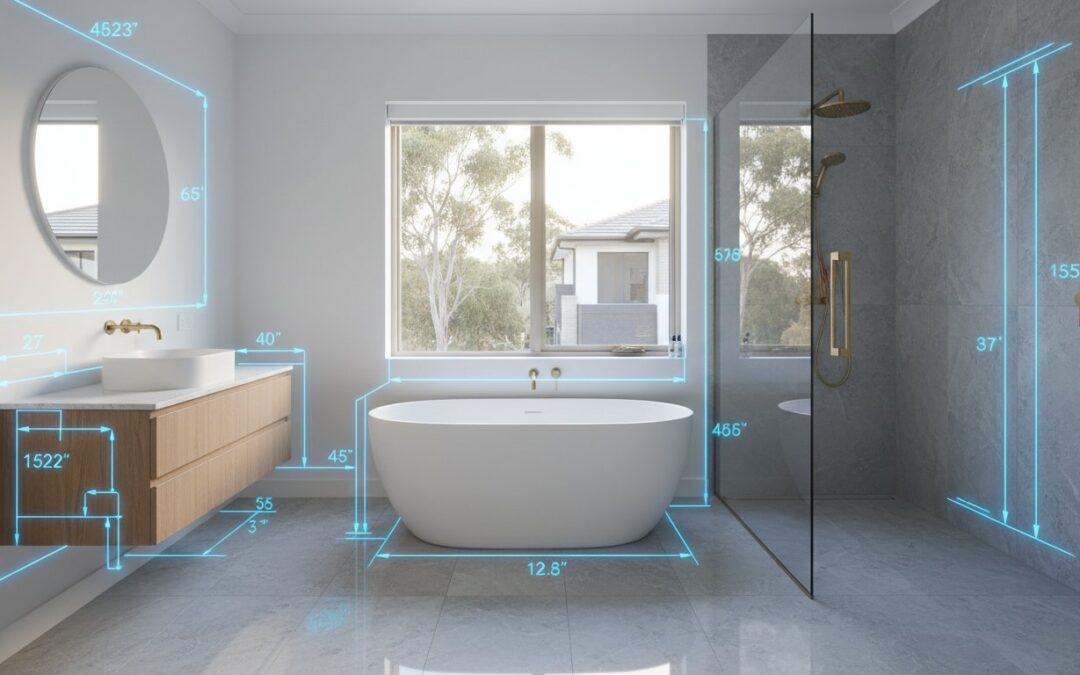
What if your sleek 3D bathroom sketch is actually impossible to build under current Australian standards? It’s a common frustration for homeowners who spend hours on a digital bathroom layout planner melbourne residents often use, only to find that the software didn’t account for structural load-bearing walls or the proximity of existing plumbing. You want a space that feels open and luxurious, but the fear of creating a cramped, dysfunctional room is very real when you’re staring at a blank floor plan.
We understand that a successful renovation requires more than just a pretty picture. It demands technical precision and a deep knowledge of the NCC 2022 regulations. This guide provides a clear path from your initial concepts to a finished, high-value room in Melbourne’s Eastern Suburbs. You’ll learn the essential clearance requirements for Australian standards, how to determine if moving a toilet is feasible, and the professional design principles used to maximize even the smallest ensuite. We aim to move you from a rough sketch to a technically sound floor plan that ensures your project runs smoothly from start to finish.
Key Takeaways
- Understand why a professional bathroom layout planner melbourne framework is essential for mapping plumbing and traffic flow to prevent unbuildable designs.
- Identify the specific Victorian clearance requirements and wet zone regulations under NCC 2022 that ensure your project meets current safety standards.
- Learn why free 3D software often overlooks critical structural elements like load-bearing walls, subfloor access, and asbestos risks.
- Master a methodical five-step process to create a functional floor plan that prioritizes accurate measurements and fixed plumbing points.
- Discover how a professional partnership bridges the gap between a digital sketch and a high-quality renovation with premium finishes.
Why a Bathroom Layout Planner is Essential for Melbourne Renovations
A layout planner is far more than a simple drawing of where your tiles go. It acts as a strategic framework that maps the complex interaction between plumbing lines, traffic flow, and fixture placement. When you use a bathroom layout planner melbourne residents often rely on, you’re building a technical roadmap for the entire project. This process involves calculating precise clearances and ensuring that every element, from the vanity to the shower screen, works in harmony. Without this methodical approach, you risk creating a design that looks beautiful on a screen but remains physically impossible to construct within your specific walls.
Melbourne’s older homes, particularly those in the Eastern Suburbs, often feature unique structural constraints. DIY software typically treats every room as a blank canvas with infinite possibilities. In reality, the difference between aesthetic planning and structural feasibility is where most renovations succeed or fail. You must account for existing plumbing stacks, heritage limitations, and the potential presence of hazardous materials in older substrates. A proper plan identifies these hurdles early, preventing the dreaded ‘change orders’ that can unexpectedly blow out your renovation budget by thousands of dollars. We prioritize stability and high standards by addressing these variables before the first hammer swings.
The ‘Dream vs. Reality’ Gap in Digital Tools
Many residents start their journey with free 3D rendering tools. While these are great for visualizing colors, a 3D render doesn’t show you the location of your floor joists or the pitch of your waste pipes. Placing a toilet too far from the existing stack might require cutting through structural timber, which isn’t just expensive; it’s dangerous. Using a bathroom layout planner melbourne professionals trust ensures you don’t overlook these critical details. At WDC Services, we take these digital concepts and validate them against the physical reality of your home. We ensure your dream layout aligns with the practical limits of your subfloor and plumbing infrastructure.
The Impact of Layout on Property Value in the Eastern Suburbs
In high-demand areas like Balwyn and Kew, functional flow is a top priority for prospective buyers. A bathroom that feels cramped or lacks intuitive movement will hurt your property value, regardless of how expensive the tapware is. When considering essential design considerations, we look beyond the standard templates. Bespoke layouts that prioritize natural light and ventilation often yield a much higher ROI in 2026. Buyers today look for spaces that feel airy and organized. We help you achieve that by managing the complex details so you can enjoy a high-value, functional result.
Essential Standards for Bathroom Planning in Victoria
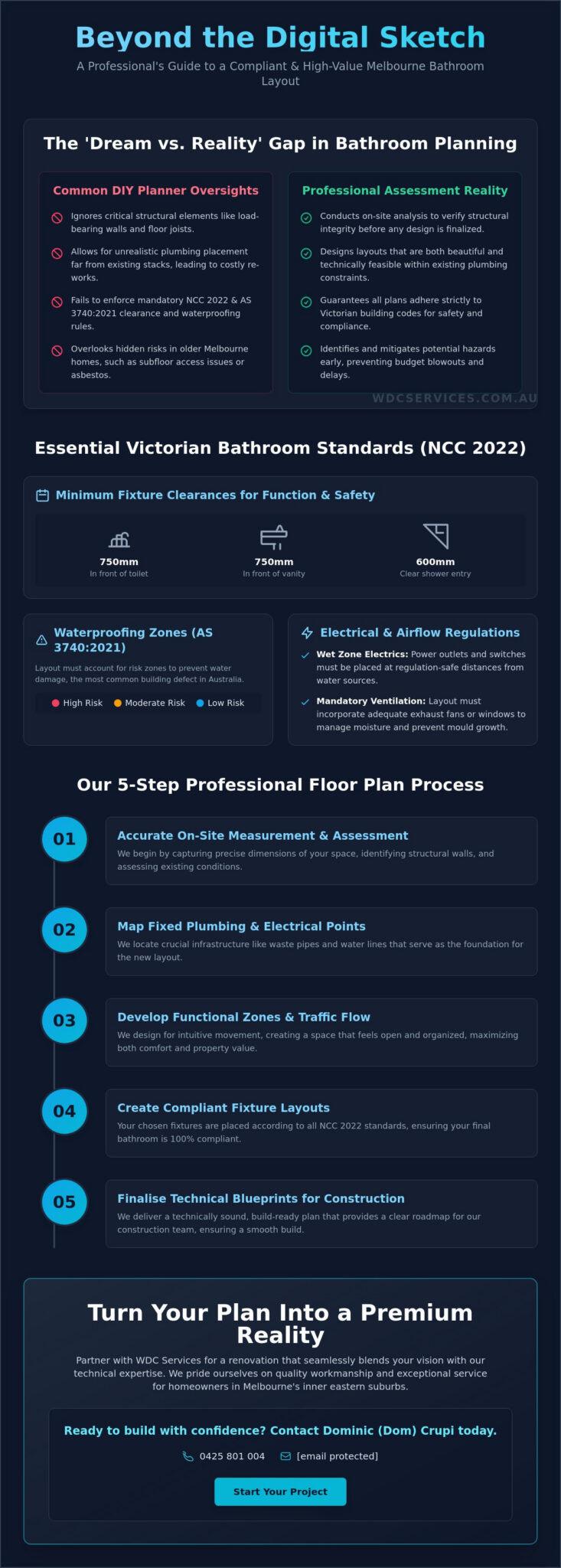
Transitioning from a digital sketch to a compliant construction plan requires a strict adherence to Victorian building codes. While a basic bathroom layout planner melbourne homeowners use might allow you to drag a toilet anywhere on the screen, the reality is governed by the National Construction Code (NCC 2022) and AS 3740:2021. This waterproofing standard was updated to include a risk-based approach, categorizing areas into high, moderate, and low risk. Your layout must account for these zones from day one to ensure the structural substrate remains protected for decades. Precision at this stage prevents the most common building defect in Australia: waterproofing failure.
Compliance also involves meeting specific spatial requirements to ensure the room is safe and usable. You must maintain minimum distances between fixtures to allow for comfortable movement and cleaning access. Following established Australian bathroom layout guidelines ensures your vanity doesn’t impede the shower entry and your toilet has enough lateral clearance. We also prioritize ‘Wet Zone’ regulations, which dictate the safe placement of electrical outlets and switches relative to water sources. These rules aren’t just red tape; they are essential safety measures that protect your family and your investment.
Airflow is another critical factor often overlooked in DIY planning. Victorian standards require adequate ventilation to manage moisture and prevent mould growth. Your layout should prioritize the placement of exhaust fans and windows to create a cross-breeze or efficient extraction path. A well-ventilated room preserves your quality finishes and maintains a healthy indoor environment. If you’re unsure how these regulations apply to your space, exploring professional bathroom renovations can provide the technical clarity you need.
Navigating the Plumbing Code of Australia (PCA)
Plumbing is the most rigid part of your layout. In many Melbourne homes, the location of the 100mm soil stack is fixed. Moving a toilet away from this stack requires specific fall requirements for waste pipes, which can significantly impact your floor height or require expensive structural modifications. We rely on licensed trades to verify that your desired layout is hydraulically feasible. This methodical verification ensures your drainage functions perfectly without the risk of future blockages or leaks.
Small Bathroom Layout Strategies for Melbourne Homes
Maximizing space in inner-eastern suburbs often requires clever design thinking. We frequently recommend wall-hung vanities and toilets to reveal more floor area, which immediately makes a room feel larger. The ‘wet room’ trend is also gaining traction, where a single glass panel or a completely open shower area replaces bulky enclosures. This approach improves traffic flow and creates a seamless, modern aesthetic. Integrated storage niches within wall cavities further reduce clutter without encroaching on your precious floor space.
DIY 3D Software vs. Professional Design Planning
Free online tools like Reece Imagin3D and Roca Blophome have transformed how homeowners approach the initial stages of a project. These platforms offer a user-friendly way to experiment with different aesthetics, allowing you to swap tile patterns or test various vanity finishes in a virtual environment. However, a bathroom layout planner melbourne residents find online is fundamentally a visualization tool rather than a technical solution. While these programs produce impressive renders, they lack the capacity to account for the structural and regulatory complexities inherent in Victorian homes. Relying solely on a digital sketch without professional validation often leads to unbuildable designs and costly mid-project corrections.
The primary limitation of DIY software is what it fails to see. These tools don’t identify load-bearing walls, the presence of asbestos in older substrates, or the specific location of floor joists. If your virtual plan places a heavy stone bath in a position that the subfloor cannot support, the software won’t flag the error. Professional planning bridges this gap by layering technical expertise over your aesthetic goals. We treat your initial sketches as a creative starting point, then apply methodical engineering and plumbing logic to ensure the design is physically feasible. This proactive approach prevents the budget blowouts that occur when a “finished” plan meets the reality of an open wall.
When to Use Free Online Planners
These platforms are excellent for exploring color palettes and gaining a rough sense of spatial awareness. They help you decide if you prefer a walk-in shower over a freestanding tub or how a specific light fixture might complement your chosen tiles. They are particularly useful for basic fixture placement in modern homes with standard layouts. Their accuracy is significantly compromised in heritage properties throughout Melbourne’s East, where uneven floors and non-standard wall thicknesses are common. Use these tools for inspiration, but always verify the dimensions with an on-site measurement before ordering materials.
The Value of a Site Feasibility Study
Dominic Crupi recommends a comprehensive on-site inspection before any layout is finalized. This study identifies non-negotiable structural elements, such as existing plumbing stacks and electrical circuits, that software simply ignores. We examine subfloor access and ventilation paths to ensure your project complies with the latest standards. Integrating this level of detail into your bathroom renovations ensures a smooth transition from design to construction. Our team manages these complex details so you don’t have to, providing the peace of mind that comes from working with industry veterans who value precision and high-quality workmanship.
5 Steps to Creating a Functional Bathroom Floor Plan
Designing a layout that works requires a logical framework that goes beyond the basic features of a bathroom layout planner melbourne homeowners typically use. While digital tools provide a visual start, they don’t offer the technical decision-making logic needed for a high-value result. We follow a disciplined five-step process to ensure every project in Melbourne’s Eastern Suburbs is both feasible and aesthetically superior. This structured flow brings order to the complex variables of spatial design and ensures your project starts on a stable foundation.
Step 1: The Precision Measurement Phase
Accuracy is the core of every successful renovation. Being off by as little as 10mm can ruin a custom shower screen installation or result in a vanity that won’t fit between walls. You must account for floor leveling compounds and the thickness of your chosen tiles, as these factors reduce the final available space. Document every obstacle, including existing electrical points and the exact swing radius of the door. We prioritize this level of detail to avoid costly adjustments during the construction phase.
Once measurements are locked, identify your fixed points. Plumbing stacks, windows, and doorways are the anchors of your layout. Moving these elements is often possible, but it requires careful consideration of structural integrity and budget. We then define the path between the shower, vanity, and toilet. This ensures that the most frequently used areas are easily accessible without creating bottlenecks in high-traffic zones, especially in busy family homes.
Step 3: Zoning for Privacy and Function
Effective zoning separates wet shower areas from dry vanity zones to improve both safety and comfort. We often apply the hidden toilet rule, ensuring the loo isn’t the first thing you see when the door opens. Instead, we create a focal point with a feature vanity or a freestanding bath to elevate the room’s visual appeal. For those coordinating multiple projects, our guide on kitchen and bathroom renovations provides additional insights into maintaining a consistent flow throughout your home.
Review and refine your layout by testing it for accessibility. Consider the user experience: is there enough room to towel off comfortably? Can you reach the vanity drawers without hitting the shower door? This final check ensures your plan delivers a functional, high-quality finish that stands the test of time. Using a professional bathroom layout planner melbourne residents can rely on is about more than just aesthetics; it’s about long-term usability. If you want to ensure your plan is ready for construction, you can book a layout consultation with our expert team. Dominic Crupi and the WDC Services team take pride in turning these meticulous plans into reality with exceptional workmanship and premium finishes.
Turn Your Layout Plan into Reality with WDC Services
Bridging the gap between a digital sketch and a functional, high-value room requires more than just a list of fixtures. While a bathroom layout planner melbourne residents find useful provides a visual guide, the transition to construction demands the oversight of an industry veteran. Dominic (Dom) Crupi and the WDC Services team specialize in this critical phase, transforming technical floor plans into high-quality finishes. We understand that a renovation is a significant investment, which is why we approach every project in Melbourne’s Eastern Suburbs with a focus on stability and precision. Our comprehensive services ensure that the vision you’ve mapped out is physically sound and built to last.
Expert Trade Coordination in Melbourne’s East
A seamless build relies on the fluid integration of various specialized trades. We manage the coordination of licensed electricians and expert tilers, ensuring every aspect of the installation meets strict Australian safety standards. Rather than offering one-size-fits-all packages, we provide tailored service models that respect the unique structural needs of your home. This individualized approach ensures that your specific layout is executed with the thoroughness and precision it deserves. We manage the complex logistics of trade schedules and material deliveries, so the construction process remains steady and organized from day one.
Start Your Renovation Journey Today
WDC Services is highly recommended by homeowners throughout Balwyn, Kew, and the inner eastern suburbs for our end-to-end reliability. We manage the complex details, from the initial layout review to the final tile installation, so you don’t have to worry about the technical hurdles. If you’re ready to turn your vision into a reality with exceptional workmanship, contact Dominic (Dom) Crupi directly to discuss your project. You can reach us on 0425801004 or via email at info@wdcservices.com.au to start your journey toward a beautiful, functional bathroom today. We look forward to bringing order and clarity to your next renovation project.
Secure Your Vision with Professional Layout Expertise
A bathroom layout planner melbourne homeowners use is a productive first step, but the path to a high-value renovation requires technical validation. We’ve explored the critical importance of adhering to NCC 2022 standards and the methodical steps needed to ensure your design is physically feasible. By choosing a partner who understands the unique structural demands of Melbourne’s Eastern Suburbs, you eliminate the risks of unbuildable designs and budget blowouts. Our team of licensed Victorian tradesmen provides a comprehensive design-to-install service that prioritizes quality workmanship and clear communication.
Ready to finalise your plan? Contact Dominic Crupi at WDC Services today or call 0425801004 to discuss your Melbourne bathroom renovation. You can also reach us at info@wdcservices.com.au to share your initial sketches. We take pride in managing the complex details so you can enjoy a seamless transformation and a beautiful, functional home. Let’s build a space that reflects your standards and enhances your property’s value for years to come.
Frequently Asked Questions
Can I move my toilet to a different wall in a Melbourne bathroom?
You can move a toilet to a different wall, provided there is enough fall for the waste pipes to connect to the existing 100mm soil stack. Moving a toilet far from the stack often requires raising the floor or cutting into structural joists, which adds significant complexity and cost. We recommend a site inspection to determine if your desired change is hydraulically feasible without compromising your home’s structural integrity.
What is the minimum size for a functional full bathroom in Victoria?
A functional full bathroom in Victoria generally requires a minimum footprint of approximately 3.6 to 4 square meters. This size allows for a standard shower, vanity, and toilet while maintaining the clearance requirements dictated by NCC 2022. While smaller ensuites are possible, a full family bathroom needs this space to ensure comfortable movement and compliance with waterproofing standards for high-risk wet areas.
Do I need a permit for a bathroom layout change in Melbourne?
A building permit is required in Victoria if your renovation involves structural changes or altering the plumbing and drainage. Cosmetic updates like retiling or replacing fixtures in the same position don’t usually need a permit. However, most layout changes involve moving pipes, which triggers the need for a permit and a licensed plumber to ensure the work meets current Australian Standards and safety regulations.
How much space should I leave between the vanity and the shower?
We recommend leaving a minimum of 600mm to 700mm of clear floor space between the vanity and the shower screen. This ensures you have enough room to towel off and move comfortably without feeling restricted. When using a bathroom layout planner melbourne residents must account for these clearances to prevent the room from feeling dysfunctional or cramped once the final fixtures are installed.
Is it cheaper to keep the same bathroom layout during a renovation?
Keeping the same layout is significantly more cost-effective because it eliminates the labor and materials required to relocate plumbing lines. Plumbing relocation can account for a large portion of a renovation budget. If your current layout is functional, we often suggest focusing your investment on premium finishes and quality workmanship to maximize property value without the high cost of structural and hydraulic changes.
What are the most common layout mistakes in DIY bathroom planning?
Common layout mistakes include ignoring the door swing radius and failing to account for the thickness of tiles and wall linings. Many DIY plans also overlook the location of existing electrical points and essential ventilation paths. These errors often lead to a room that feels tight or fails to meet Victorian safety standards. A methodical review of your floor plan helps identify these hurdles before construction begins.
Should I include a bathtub in my layout for better resale value?
Including a bathtub is generally recommended for family-oriented suburbs to improve resale value. In areas like Balwyn or Kew, buyers often expect at least one full suite with a tub. However, in smaller inner-city apartments, a spacious walk-in shower is often preferred over a cramped bathtub. We suggest evaluating your target market. A high-quality finish on a spacious shower often yields a better ROI than a forced bathtub.
How do I plan a bathroom layout for a small apartment in Melbourne?
Planning for a small apartment requires a focus on wall-hung fixtures and wet-room designs to maximize available floor space. Using a bathroom layout planner melbourne professionals trust helps you integrate clever storage and seamless transitions that make small spaces feel airy. We prioritize high-performance ventilation and smart zoning to ensure compact bathrooms remain functional and comfortable, even with the limited footprints common in urban Melbourne developments.
Disclaimer
Please note this advertisement has been AI generated for entertainment and leed generation purposes and In some cases may not reflect the companies exact services and information.
Prior to engaging the company it is recommended that you seek clarification on some or all points in this advertisement .
Wdc services has many 5 star google reviews that can be used as a reliable and true testimony to the quality services proved to its customers over many years.
Contact Domenico ( Dom ) Crupi on 0425801005 or email info@wdcservices .com.au
for further information
Disclaimer: Disclaimer, Please note this advertisement has been AI generated for entertainment and leed generation purposes and In some cases may not reflect the companies exact services and information. Prior to engaging the company it is recommended that you seek clarification on some or all points in this advertisement. WDC Services has many 5 star google reviews that can be used as a reliable and true testimony to the quality services proved to its customers over many years. Contact Domenico ( Dom ) Crupi on 0425801005 or email info@wdcservices .com.au for further information.