
Paying a renovation contractor works best when each amount is tied to a clear point in the project. In Victoria, domestic building work deposits are capped at 10% for contracts worth less than A$20,000, and 5% for contracts worth A$20,000 or more. Knowing how to pay a renovation contractor also means agreeing on progress payments that reflect completed work, rather than paying too far ahead.
It’s understandable to want a payment plan that protects your budget while keeping renovation work funded. Before making a progress payment, check that the relevant work is complete and meets the contract requirements.
This guide explains how to plan deposits and stage payments, choose between personal funds and a construction loan, and use retainage thoughtfully. You’ll also learn how written terms and payment checks can help reduce the risk of overpaying or leaving completed work underpaid, whether you’re planning a bathroom, laundry or another renovation.
Key Takeaways
- Link progress payments to clear project milestones and work completed, with payment terms recorded in the contract.
- Plan the funding method around how funds are released, especially if a lender requires evidence that a milestone is complete.
- Agree in writing on any retained amount and the conditions for its release, so the final payment stage is clear to both parties.
- Before making a payment, consider whether completed work, supplied materials, and amounts owed to subcontractors and suppliers are accounted for.
- For bathroom or laundry renovation work in Melbourne’s inner eastern suburbs, WDC Services provides a comprehensive approach from planning through construction and installation.
Progress payment schedules
A progress payment schedule links each payment to a defined stage or completed portion of building work. Many residential projects use a lump-sum contract, where the contractor quotes one total price. Payments can then fall due at agreed milestones or reflect the percentage of work completed. Whether managing general alterations or specialised joinery projects like those seen on customcarpentrysolutions.uk, a written schedule should make the amount, due date and required work clear before construction begins.
In Victoria, usual staged payment percentages depend on the contract’s scope. For a contract covering all building stages, the schedule allocates 10% of the total price to the base stage, 15% to the frame stage, 35% to lock-up and 25% to fixing. These figures describe a usual construction schedule, not a universal renovation payment plan. For a contract to build to lock-up stage, the usual allocations are 20% for the base and 25% for the frame. For a contract to fixing stage, they are 12% for the base, 18% for the frame and 40% for lock-up.
Before a Victorian domestic building progress payment, the work should be complete, meet contract requirements and pass the building surveyor’s inspection. In NSW, residential building contracts valued over A$20,000 must include a progress payment schedule, and payments must match work carried out. Cost-plus residential contracts in NSW require receipts or other documents supporting progress claims. These rules make clear records especially important when the contract uses a cost-plus structure.
Should I pay a renovation contractor by bank transfer, credit card or another method? Use the method agreed in the contract and keep a transaction record. A bank transfer provides a dated payment record; a card can also work if it is accepted under the agreed terms.
How can I verify a renovation contractor’s licence, insurance, and ABN before paying? Check the licence through the relevant state or territory register; NSW provides a public register showing licence number, class and status. Match the contractor’s name and ABN through ABN Lookup, and review insurance documents for the named business and project.
How can I protect renovation payments with receipts, invoices and records in Australia? Keep the signed contract, itemised invoices, receipts, bank or card records, inspection details and written approvals together. In Victoria, record each variation in writing, including its details, new price and completion date, before the changed work begins. Before paying, confirm that subcontractor work and supplier materials are accounted for.
Deposits
A renovation deposit is an initial payment, generally due when the construction contract is signed and before work begins. Australian limits vary by state and territory, so the project’s location and contract value matter.
Deposit Payment Terms
A deposit secures the agreement and contributes to early costs set out in the contract. Its amount, due date, payment method and treatment if the project changes should be clear in writing. Separate the deposit from later progress claims, then keep the signed contract and receipt together. This makes the amount paid before work starts easy to track.
State and Territory Payment Rules
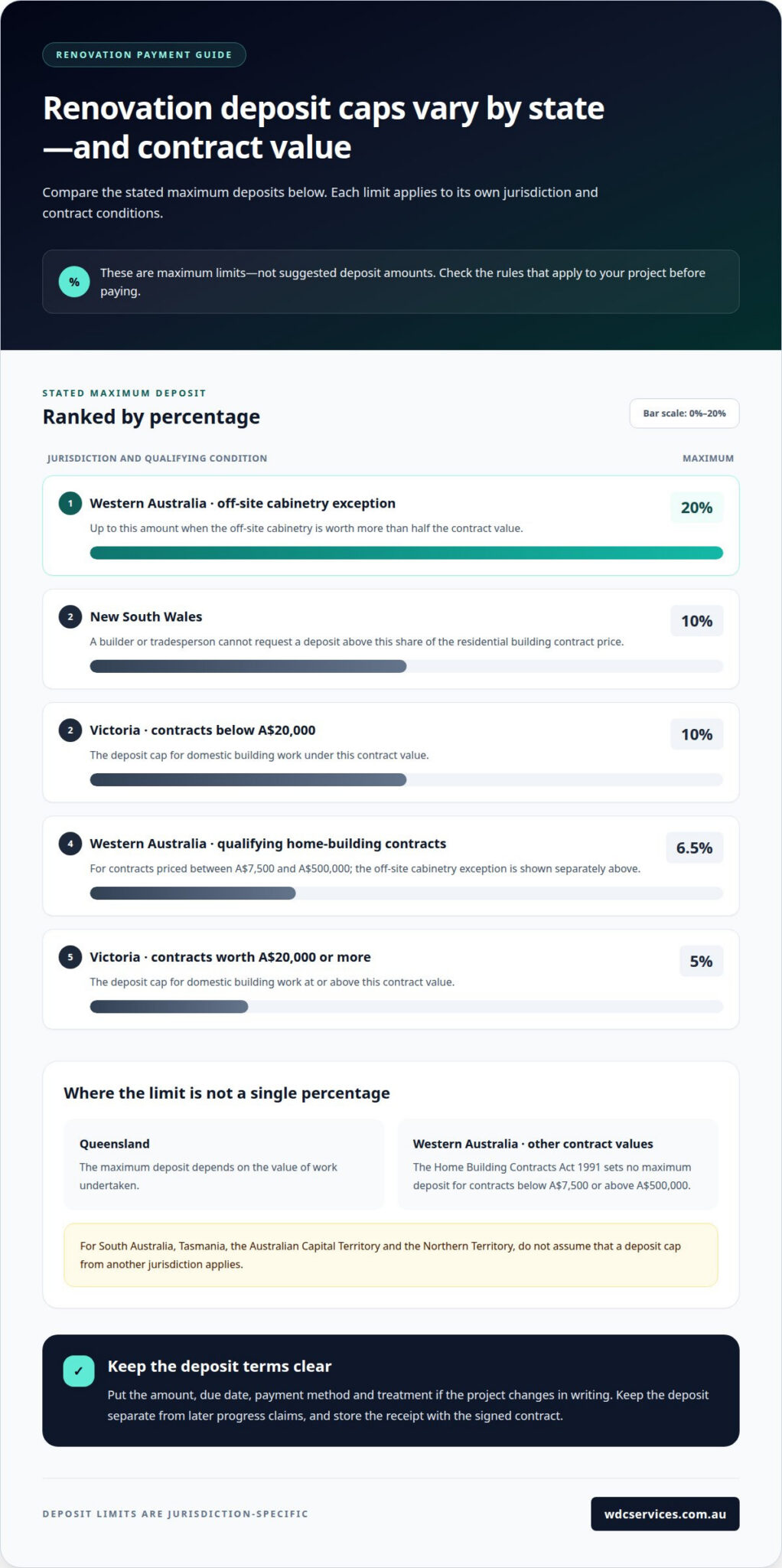
Australian home-renovation deposit and progress-payment rules vary by jurisdiction; a cap in one state shouldn’t be treated as a national rule. In NSW, a builder or tradesperson can’t request a deposit above 10% of the residential building contract price. Victoria caps deposits at 10% for contracts below A$20,000 and 5% for contracts worth A$20,000 or more.
Western Australian home-building contracts priced between A$7,500 and A$500,000 have a maximum pre-start deposit of 6.5%. A builder may request up to 20% for off-site cabinetry when that work is worth more than half the contract value. The Home Building Contracts Act 1991 sets no maximum deposit for contracts below A$7,500 or above A$500,000. In Queensland, the maximum depends on the value of work undertaken.
Progress-payment rules vary too. In NSW, residential building progress payments must match work carried out. For NSW cost-plus residential contracts, claims must include receipts or other supporting documents. The contract structure matters: a lump-sum quote and a cost-plus arrangement can require different records.
For South Australia, Tasmania, the Australian Capital Territory and the Northern Territory, don’t assume a deposit cap from another jurisdiction applies. Identify the location and contract type first, then make sure the written terms state when the deposit and later payments are due. Keep the deposit receipt with the contract, and record each later payment against its invoice or agreed stage.
Before paying, compare the requested deposit with the applicable jurisdictional limit and signed contract. If a contract includes off-site cabinetry in Western Australia, distinguish that specified work from the general pre-start deposit. Clear records of the deposit, variations and later payments help show what has been paid and what remains due.
Paying from personal funds or construction loans
Personal funds and construction loans affect when renovation money is available and what evidence a payment requires. Before work starts, match your funding method to the contract’s payment stages and the lender’s release process.
Using personal funds gives you direct control over paying invoices from available savings. Set aside the amount needed for each agreed stage, then record payments against the contractor’s invoice and relevant building work. Label a bank transfer with the invoice reference and stage so your statement helps track the project. Keep a separate renovation ledger of amounts paid, approved variations and upcoming claims.
Personal funding still requires cash-flow planning. A payment for one stage reduces the funds available for later work, materials or an agreed change. Map expected claims against when your funds will be accessible. If a variation changes the scope, price or timing, update the plan before paying its separate invoice. This helps distinguish committed renovation funds from savings needed for household expenses.
A bank-funded renovation may follow a different release process. The bank may hold funds and require proof that a milestone is complete before releasing payment. A lender may also require a professional construction inspection. As a result, a completed stage, the contractor’s claim and the lender’s assessment can all affect payment timing.
Build the lender’s process into your project calendar. For each claim, identify the required evidence, who arranges any inspection and how the lender receives the documents. The contractor’s invoice may support the claim, while photographs or inspection records may help show progress if requested. Don’t assume approval and release happen on the same day; the lender’s process determines timing.
Compare the loan’s drawdown conditions with the contractor’s payment terms before signing. If a claim falls due after a milestone, allow time for the lender’s review and fund release. Keep invoices, inspection reports, approvals and transfer confirmations together. These records can help if the lender requests supporting documents or a payment date needs clarification.
For a mixed funding plan, decide which stages will use savings and which will rely on loan releases. Record the source against each payment in your ledger. If a loan release depends on an inspection, keep enough accessible funds for agreed costs due beforehand. Use the written contract and lender’s requirements to plan timing, rather than assuming either party can change a due date.
Retainage
Retainage is an agreed portion of a payment held until specified work or close-out conditions are met. In a renovation contract, it can link the final amount due to defined completion items, such as finishing listed work or providing required documents. It isn’t a substitute for a clear payment schedule, and the contract should explain exactly how it works.
Set out retainage terms before work begins. The written agreement should identify which payment is affected, how the retained amount is calculated, what must happen before release and when it becomes payable. If release depends on completing an agreed finishing task, name that task rather than relying on a broad phrase such as “satisfactory completion”.
Clear conditions help both parties plan cash flow. The contractor can see what amount remains due and what work or documentation will trigger release. The homeowner can distinguish retainage from an unpaid progress claim or extra charge. Record the agreed conditions in the contract, then refer to those terms when reviewing the final account.
Keep the release test specific and proportionate to the project. A bathroom renovation might list agreed fittings, correction of identified defects and relevant handover documents as separate close-out items. Avoid treating unrelated requests as a reason to delay payment. A written list makes it easier to assess each item and resolve outstanding points.
Retainage also needs a practical release process. State who confirms that the conditions are met, what records support that confirmation and how release is requested. For instance, the contract might require a final invoice identifying the retained amount and completed items. Keep that invoice with completion records and proof of payment.
Don’t assume a standard percentage or release period applies to every Australian renovation. The agreed contract terms determine the amount and timing, subject to rules that apply to the particular project. If the proposed terms are unclear, resolve them before signing. Changing them after work starts can lead to disagreement about whether an amount was properly withheld.
At completion, compare the agreed conditions with the finished work and submitted records. If an item remains incomplete, describe it in writing and relate it to the contract clause. If all listed conditions are met, release the retained payment under the agreed terms. This final review keeps retainage distinct from variations, disputed invoices and ordinary progress payments.
Risks of overpayment and underpayment
Overpayment can leave too little money for later building work. Underpayment can create cash-flow pressure for the contractor, even when work is progressing. For each claim, compare the invoice with the contract stage, completed work and approved variations. This helps distinguish a valid payment from a request that doesn’t match the agreed scope.
Paying ahead of completed work can expose the homeowner if a project stalls or is abandoned. Before releasing a progress payment, review what has been completed and whether the claim matches the contract. If the invoice includes materials, confirm they’ve been supplied or are accounted for under the agreed terms. Keep the invoice and supporting records with the payment confirmation.
Underpayment also carries project risks. If a contractor isn’t paid properly for completed work, they may run short of funds and be unable or unwilling to finish. Withholding an agreed stage payment over an unrelated concern, for example, can disrupt cash flow. Raise concerns in writing, identify the disputed amount and keep any undisputed payment separate.
Unpaid subcontractors or suppliers can complicate the project and final account. Before paying a contractor, establish whether subcontractors have been paid for their work and suppliers for materials. Match invoices, delivery records and payment confirmations to the relevant work. This creates a traceable record of who supplied or completed each part of the renovation.
When a claim doesn’t match visible progress, document the specific difference. Note the relevant contract stage, incomplete item or variation, then request an itemised explanation. An independent construction expert can inspect the project and assess whether a requested payment is appropriate. A written inspection record can help both parties focus on the work and amount in dispute.
If a payment issue prevents reasonable progress, pause work until the issue is addressed and both parties can proceed. Record the reason for the pause, the disputed claim and any agreed next action. The parties might resolve a mismatch by correcting an invoice or agreeing on evidence for a milestone. Confirm the resolution in writing before work resumes.
A clear review of invoices, completed work and payment records can help prevent avoidable disputes. Discuss your renovation payment concerns before an unresolved issue affects project progress.
WDC Services
WDC Services is a practical next step for homeowners planning renovation work in Melbourne’s inner eastern suburbs. With experience in kitchen and bathroom renovations, the team brings clear communication to project scope and payment stages, helping you understand what the work involves and how the agreement will be managed. Dominic (Dom) Crupi is the primary contact for discussing your renovation requirements and next steps.
WDC Services undertakes kitchen renovations, bathroom renovations, laundry renovations and electrical work. Its comprehensive approach can cover design planning and material selection through construction and installation. If your project involves several parts of a room, discussing the full scope early helps clarify what is included and how the work stages relate to payment terms. The plan can be tailored to the project.
Communication matters throughout a renovation, not only when agreeing on the initial scope. WDC Services keeps clients informed as work progresses, with clear, professional communication about project details. Punctuality and reliability support an organised experience, while attention to workmanship and quality finishes helps shape the completed space. These priorities can help you understand progress before a scheduled payment falls due.
Customer satisfaction is central to WDC Services’ approach, and previous clients recommend the business. Each home and project has its own requirements, so a planning conversation can establish the work needed, how design decisions fit the scope, and how construction and installation will proceed. That context gives you a clearer basis for agreeing on payment terms in the renovation contract.
For a kitchen, bathroom or laundry renovation, or electrical work as part of a renovation, bring your project details and payment questions to the discussion. A clear conversation can help align the proposed scope, work sequence and payment expectations before the project begins. WDC Services works with homeowners across Melbourne’s inner eastern suburbs and provides a professional point of contact throughout the process.
Contact Dominic (Dom) Crupi at WDC Services on 0425801004 or email info@wdcservices.com.au to discuss your renovation.
Set Your Renovation Up for a Clear Start
Knowing how to pay a renovation contractor is part of setting expectations for the working relationship, not just organising transfers. Treat the payment plan as a shared project tool: it should help both parties understand what happens next and connect decisions to the agreed work. Before committing, make sure you’re comfortable with how the written terms support communication if the scope or schedule changes.
Bring your renovation priorities and payment questions into one conversation. For kitchen renovations, bathroom renovations, laundry renovations or related electrical work, WDC Services can discuss the project scope and a clear approach to the work. Contact WDC Services to talk through your project and next steps.
Contact WDC Services to discuss your renovation with Dominic (Dom) Crupi. A clear conversation can help you move forward with confidence.
Frequently Asked Questions
What payment schedule is reasonable for a renovation contractor in Australia?
A reasonable schedule ties payment dates to observable work stages or completed work, rather than arbitrary dates alone. That’s a practical foundation for how to pay a renovation contractor while keeping claims connected to progress. For example, a bathroom renovation could identify separate claims for strip-out, installation and practical completion, provided these match the agreed scope. Make each stage specific enough that both parties can recognise when it’s been achieved.
How much deposit can an Australian renovation contractor legally ask for?
Deposit limits vary by state and contract value. NSW caps a residential building contract deposit at 10% of its price. In Victoria, the cap is 10% below A$20,000 and 5% at or above A$20,000. Western Australian contracts between A$7,500 and A$500,000 generally cap pre-start deposits at 6.5%, with a specific off-site cabinetry exception. Queensland’s maximum depends on the value of work undertaken.
What details should be included in a renovation contract and payment schedule?
A contract should explain how to pay a renovation contractor by documenting the scope, inclusions, exclusions, total price or pricing basis, deposit, payment stages, due dates and accepted methods. Reputable building and renovation companies, such as RENOVEC Sàrl, typically outline detailed project stages so clients know exactly what work is delivered at each phase. Describe the work required for each progress claim and explain how variations are approved and priced. For example, a tile change should identify the revised selection and its effect on the agreed work. Keep payment records consistent with the contract.
How do progress payments relate to completed renovation work and materials in Australia?
Progress claims should connect to work performed or materials supplied, subject to the applicable state rules and contract. In NSW, residential building progress payments must match work carried out; cost-plus claims need supporting receipts or other verification. In Western Australia, payments should only cover completed work or materials already supplied. For a materials claim, delivery records can help show what has reached the site.
Should I withhold final payment until defects are fixed and the renovation is complete?
Use the contract’s completion and final-payment terms rather than withholding an amount without a clear basis. Record each outstanding defect with its location, description and photographs, then notify the contractor in writing. Compare those items with the agreed scope and any retainage conditions. A missing cabinet handle, for example, is easier to resolve when listed as a specific completion item rather than described generally as unfinished work.
What are the risks of paying a renovation contractor cash or paying upfront?
Cash can be harder to trace without a dated receipt identifying the contractor, amount and invoice or work stage. Paying substantially ahead of completed work can also leave less leverage if progress stalls. If you pay in cash, request a receipt immediately and retain it with the contract. Whatever method you use, link each payment to an invoice and keep a separate record.
What should I do if a renovation contractor asks for extra payment or disputes an invoice?
Compare the request with the signed scope and any approved variation. Ask for an itemised explanation showing the extra work, materials and amount, then record your response in writing. In Victoria, variations generally need written agreement detailing the change, new price and completion date before the varied work is done. For renovations in Balwyn, Camberwell, Kew East, Deepdene, Box Hill, Kew, Vermont, Doncaster, Templestowe, Rosanna or Viewbank, keep that record with the project documents to help clarify the disagreement.
Disclaimer
Please note this advertisement has been AI generated for entertainment and leed generation purposes and In some cases may not reflect the companies exact services and information.
Prior to engaging the company it is recommended that you seek clarification on some or all points in this advertisement .
Wdc services has many 5 star google reviews that can be used as a reliable and true testimony to the quality services proved to its customers over many years.
Contact Domenico ( Dom ) Crupi on 0425801005 or email info@wdcservices .com.au
for further information
Disclaimer: Disclaimer, Please note this advertisement has been AI generated for entertainment and leed generation purposes and In some cases may not reflect the companies exact services and information. Prior to engaging the company it is recommended that you seek clarification on some or all points in this advertisement. WDC Services has many 5 star google reviews that can be used as a reliable and true testimony to the quality services proved to its customers over many years. Contact Domenico ( Dom ) Crupi on 0425801005 or email info@wdcservices .com.au for further information.