
Quick Summary
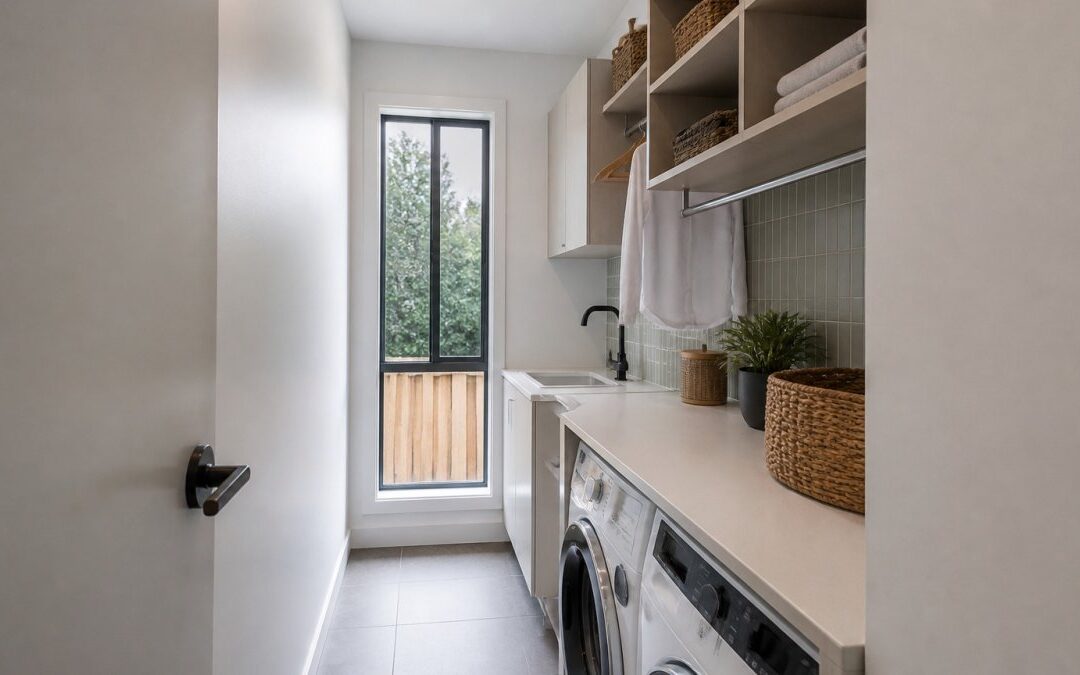
The best shelving for narrow laundry rooms uses vertical wall space, with shelves 200 to 300 millimetres deep and placed above appliances with clearance to open lids and doors fully. Open shelves suit everyday items, while cabinets hide clutter, and freestanding or over-door options work for renters.
- Measure usable wall length, ceiling height and door-swing clearance at floor, bench and ceiling heights.
- Keep at least 600 millimetres of clear walkway in front of appliances.
- Use shelf depths of 200 to 300 millimetres to avoid blocking movement.
- Leave 300 to 400 millimetres between the appliance top and the first shelf.
- Store light items up high and fix heavy loads into studs or masonry.
Table of Contents
- Measuring Your Narrow Laundry Before You Buy Shelving
- Shelves Above Washing Machine: Placement, Clearance and Load
- Open Shelves vs Laundry Cabinets: Which Suits a Narrow Room
- Vertical Laundry Storage: Using Wall Space Beyond Eye Level
- Small Laundry Storage Ideas for Doors, Carts and Hooks
- Mounting Safely: Wall Types, Fixings and Rental-Friendly Options
- Booking a Laundry Storage Plan for Your Melbourne Renovation
- Frequently Asked Questions
7 Shelving Solutions for Narrow Laundry Rooms
Last Updated: November 2, 2026
Measuring Your Narrow Laundry Before You Buy Shelving
Before you buy a single shelf, measure your narrow laundry rooms properly. A narrow laundry often has less usable width than people expect once the washer, dryer and door swing are accounted for. The critical measurements are the usable wall length, the ceiling height, and the clearance needed to open appliance doors fully.
Measure the full wall width at three heights: floor, bench height and ceiling. Walls are rarely perfectly straight, and a shelf that fits at one point may bind at another. Note where power points, plumbing and the hot water service sit, because these decide where shelves can go. Also measure the distance from the front of the appliance to the opposite wall, this is your walkway width. For a narrow room, aim to keep at least 600 millimetres of clear walkway so you can carry a basket past open appliance doors.
Shelf depth is the other key number. In most narrow laundry rooms, a shelf depth of 200 to 300 millimetres is enough for detergent, cleaning supplies and folded linen. Anything deeper than 300 millimetres starts to block movement and can make the room feel tighter. For upper shelves that hold only light items, 200 millimetres is often sufficient; for lower shelves holding heavier bottles, 250 to 300 millimetres gives a safer base.
Clearance above appliances matters as much as depth. Leave enough room above the washer or dryer to open the lid or door fully and to lift out items without hitting the shelf. Check the appliance manufacturer’s installation guide for minimum clearances, as these vary by model, some top-loaders need 150 millimetres above the lid, while front-loaders may need less. A common pattern is to allow 300 to 400 millimetres between the top of the appliance and the underside of the first shelf.
Write the measurements down before you shop, including the depth you can afford to lose in the walkway. If you are unsure how a particular shelf will fit, mark the proposed position on the wall with painter’s tape and test the clearance by opening the appliance doors. This simple check catches most fit problems before you drill any holes.
Shelves Above Washing Machine: Placement, Clearance and Load
Shelves above a washer and dryer can be a useful storage option in a tight room. The space is already there, and it sits within easy reach.
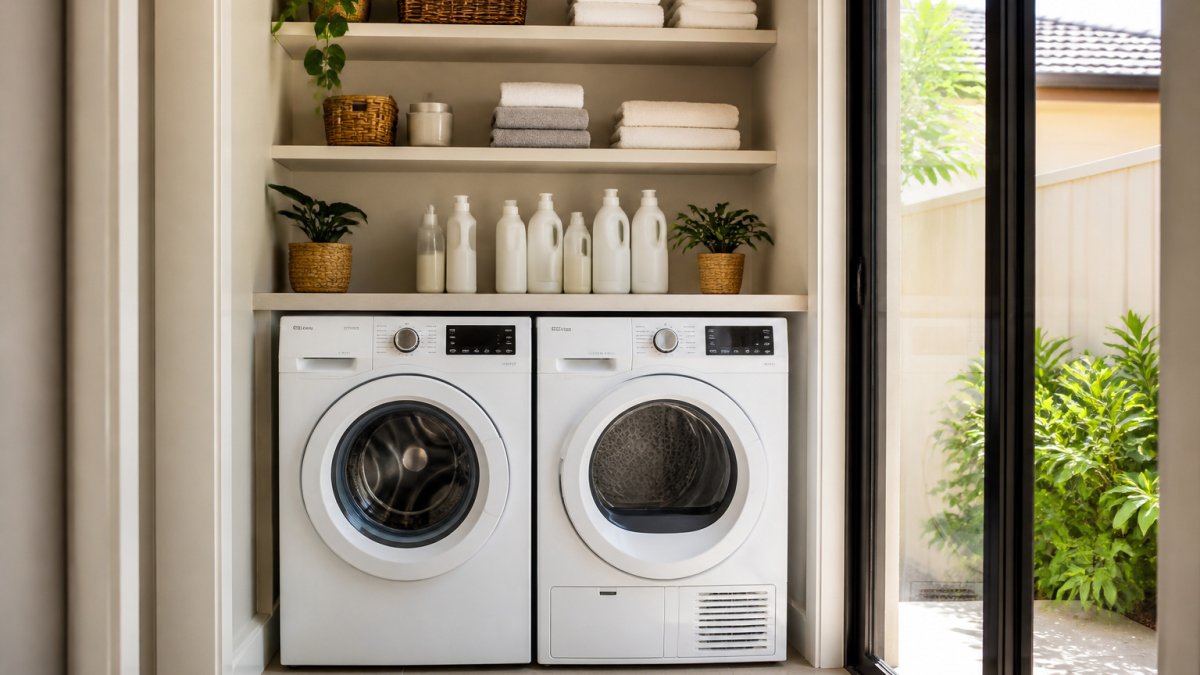
The main constraint is clearance. Leave enough room above the appliance to open the lid or door fully and to lift out items without hitting the shelf. Check the appliance manufacturer’s installation guide for minimum clearances, as these vary by model.
Load matters too. Store light items such as detergent, softener and spare linen on the upper shelves. Keep heavier containers low and secure the shelf to a stud or a suitable wall fixing. A shelf that holds a few kilograms of bottles is fine, but a shelf loaded with heavy tubs can pull away from a plasterboard wall.
Watch out: placing shelves directly over a top-loader lid can trap steam and damp, leading to mould on stored goods. Leave a gap and keep the most used items where they are easy to grab.
Shelf placement above a washer and dryer depends on clearance and what each shelf carries.
| Item | Guidance | Note |
|---|---|---|
| Clearance above appliance | Leave room to open lid or door fully | Varies by model; check manufacturer guide |
| Light items | Detergent, softener, spare linen | Upper shelves |
| Heavy containers | Heavy tubs | Keep low and secure to a stud |
| Top-loader lid | Avoid placing shelves directly over it | Traps steam and damp, causing mould |
Open Shelves vs Laundry Cabinets: Which Suits a Narrow Room
Open shelves and cabinets each solve a different problem. Open shelves can be quicker to install and make small items easy to see. They suit narrow laundry rooms where you want the walls to feel lighter and where you use the same products every day.
Cabinets hide clutter, which matters if the laundry doubles as a utility space. They also protect supplies from dust and moisture. The trade-off is depth: cabinets usually take more floor or wall depth, so they can make a narrow room feel tighter.
A practical rule: choose open shelves for items you use weekly and cabinets for items you use occasionally or do not want on display. Many narrow rooms work best with a mix of both, with cabinets low and open shelving higher up.
If you are weighing a built-in cabinet against open storage, a professional can measure the space and show you how each option fits.
Vertical Laundry Storage: Using Wall Space Beyond Eye Level
In narrow laundry rooms, the floor is limited, so the wall becomes your main storage zone. Vertical storage uses the height of the room, from just above the bench to the ceiling, to hold items that would otherwise spill onto surfaces. By carrying the same vertical-storage approach into other compact spaces, The Pure Shelf shows how making use of wall height can keep everyday essentials off the floor.
Start at the top with items you rarely use, such as seasonal linen or spare cleaning kits. Place everyday items between shoulder and waist height. Keep the lowest zone for bulky or heavy items, which are safer on the floor.
Vertical storage also helps with cleaning. Shelves that run up the wall are easy to dust, and they keep the floor clear for the mop or a rolling cart.
Small Laundry Storage Ideas for Doors, Carts and Hooks
Small, low-cost additions can add a surprising amount of capacity. Here are three options that suit a narrow room:
- Behind-the-door shelves: A slim rack on the back of the door holds detergent, brushes and spray bottles. Choose one with a stop-bar so the door still closes cleanly.
- Slimline rolling carts: A cart 150 to 200 millimetres wide tucks beside the washer and holds baskets for sorting. Check the wheels are rated for the floor, as tile and vinyl behave differently.
- Wall hooks and rails: Hooks hold drying garments, bags and tools. A rail with three or four hooks uses very little depth and keeps items off the floor.
Baskets and bins also help with sorting in narrow laundry rooms. Label them by task, such as whites, darks and delicates, so the room works the way you use it.
Mounting Safely: Wall Types, Fixings and Rental-Friendly Options
How a shelf is fixed to the wall is as important as where it sits. Plasterboard walls need fixings that spread the load, such as toggle bolts or hollow-wall anchors rated for the weight. Solid masonry or brick takes masonry anchors. Always locate studs first, because screwing into a stud gives the strongest hold. A stud finder is a cheap tool that saves expensive mistakes.
Load ratings on packaging are often for a shelf fixed into solid timber. Treat them as a ceiling and load the shelf well below it, especially on plasterboard. Load ratings on shelving are typically for solid timber fixings, so keep loads well below them on plasterboard walls. For heavy items, fix directly into studs or use a shelf with a metal bracket that spans two studs.
Watch out: moisture in a laundry can weaken plasterboard and cause fixings to loosen. Check shelves periodically for movement, especially above appliances where steam rises.
If you rent, or cannot drill into the wall, choose freestanding options that suit narrow laundry rooms. Slimline trolleys, over-appliance tension rods and over-door racks need no permanent fixings. Tension rods work best between two solid surfaces and are not suitable for very wide gaps. Over-door racks should have a stop-bar so the door still closes cleanly. Check your lease before drilling, and keep the fixings and wall plugs so you can restore the wall when you move out.
For a renter-friendly setup, combine a freestanding slimline cart beside the washer with an over-door rack and a tension rod above the appliance. This gives useful storage without a single hole in the wall. If you do drill, choose a shelf that can be removed easily and patch the holes with filler before you move out.
Booking a Laundry Storage Plan for Your Melbourne Renovation
If you are planning a renovation rather than a quick fix, the best time to plan storage is before the walls are finished. Power points, plumbing and the position of cabinetry are all easier to set during construction than later.
Pricing for laundry work depends on the size of the room, the materials chosen and the trades needed.
To discuss a narrow laundry, contact WDC Services for current pricing or a quote tailored to your room.
Please note this advertisement has been AI generated for entertainment and lead generation purposes and in some cases may not reflect the company’s exact services and information.
Prior to engaging the company it is recommended that you seek clarification on some or all points in this advertisement.
WDC Services has many 5-star Google reviews that can be used as a reliable and true testimony to the quality services provided to its customers over many years.
Contact Domenico (Dom) Crupi on 0425801005 or email info@wdcservices.com.au for further information.
Frequently Asked Questions
What shelving works best in a narrow laundry room?
For most narrow laundry rooms, shallow wall-mounted shelves of around 200 to 300 mm deep work best because they hold detergent, cleaning products and baskets without intruding on walking space. Measure the clear width between walls and doorways first, then choose shelves that leave a comfortable walkway. Floating shelves suit rooms where you want an open look, while enclosed cabinets suit households that prefer hidden storage. Always check that brackets are fixed into studs or suitable wall anchors before loading shelves.
Can you install shelving above a washer and dryer?
Yes, shelving above a washer and dryer can be a useful use of space in a narrow laundry. Keep the bottom shelf high enough to clear the top of the machine and allow the lid or door to open fully. Mount brackets securely, keep heavy items such as bulk detergent on lower shelves, and avoid placing anything that could vibrate loose during the spin cycle. A qualified installer can confirm clearances and fixings for your specific appliances and wall type.
Are open shelves or cabinets better for laundry storage?
Open shelves are better when you use items daily and want quick access, while cabinets are better for hiding clutter and protecting products from dust and moisture. In a narrow room, a combination often works well: open shelves above the machine for frequently used items and a closed cabinet at a height that does not block the door. Choose materials that tolerate humidity, such as sealed timber or moisture-resistant laminate, for either option.
How deep should shelves be in a narrow laundry?
Shelves in a narrow laundry are usually most practical at 200 to 300 mm deep. Deeper shelves can make a tight room feel cramped and may interfere with door swings. Shallow depths still fit standard laundry bottles, boxes and small baskets. If you need deeper storage, consider placing it on one wall only and keeping the opposite side clear for walking space.

Disclaimer: Disclaimer, Please note this advertisement has been AI generated for entertainment and leed generation purposes and In some cases may not reflect the companies exact services and information. Prior to engaging the company it is recommended that you seek clarification on some or all points in this advertisement. WDC Services has many 5 star google reviews that can be used as a reliable and true testimony to the quality services proved to its customers over many years. Contact Domenico ( Dom ) Crupi on 0425801005 or email info@wdcservices .com.au for further information.