
A fixed price can still change. Knowing what’s included in a fixed price renovation contract means looking beyond the agreed sum: the contract should define the work, labour and materials, approvals, specified fixtures and finishes, allowances, exclusions, and how variations are handled. In NSW, residential contract variations must be documented in writing and signed by the builder and owner before work begins under the Home Building Act 1989 (NSW).
It’s reasonable to expect a set price to make budgeting more predictable, but allowances and changes to the agreed scope can affect the final cost. This guide explains what a fixed-price renovation contract should cover, how prime cost items and provisional sums work, and what to check before signing. It also shows how written variations can change the price and timing, so you can see where a fixed price provides clarity and where adjustments may still arise.
Key Takeaways
- Read the scope, exclusions, specifications and payment schedule together to understand what the agreed contract sum covers.
- Allowances can affect the final amount: compare each allowance with the intended selection and understand how differences are priced.
- In NSW, residential building work variations must be documented in writing and signed by the builder and owner before the work begins.
- Match the contract type to the project: a defined scope can support a fixed price, while evolving work may involve greater cost uncertainty.
- Before signing, identify clauses and allowances that could change the price, and understand how approved changes may affect timing.
What Are the Risks of a Fixed Price Contract in NSW?
A fixed-price contract improves cost certainty for a clearly defined renovation, but allowances, exclusions and contract terms can still affect the final amount. When working with WDC Services in Melbourne’s eastern suburbs, the main risk is signing without understanding which costs may change and how variations must be approved under Victorian regulations.
Cost Certainty and Contract Risk
A fixed-price contract sets an agreed amount for defined work. A cost-plus contract charges the actual labour and material costs, plus an agreed builder’s margin or fee. Fixed pricing can limit exposure to ordinary cost increases, but only for work included in the contract. With cost-plus, homeowners carry more risk if labour, materials or time increase.
Under Victorian legislation, domestic building contracts are heavily regulated by the Domestic Building Contracts Act 1995 and the Victorian Building Authority (VBA) framework to protect homeowners. While other states operate under different frameworks like the Home Building Act in New South Wales, Victorian projects must adhere to strict state-specific standards. A cost-plus arrangement may suit a renovation with evolving plans or substantial unknowns, but legal advice can help clarify its risks before signing.
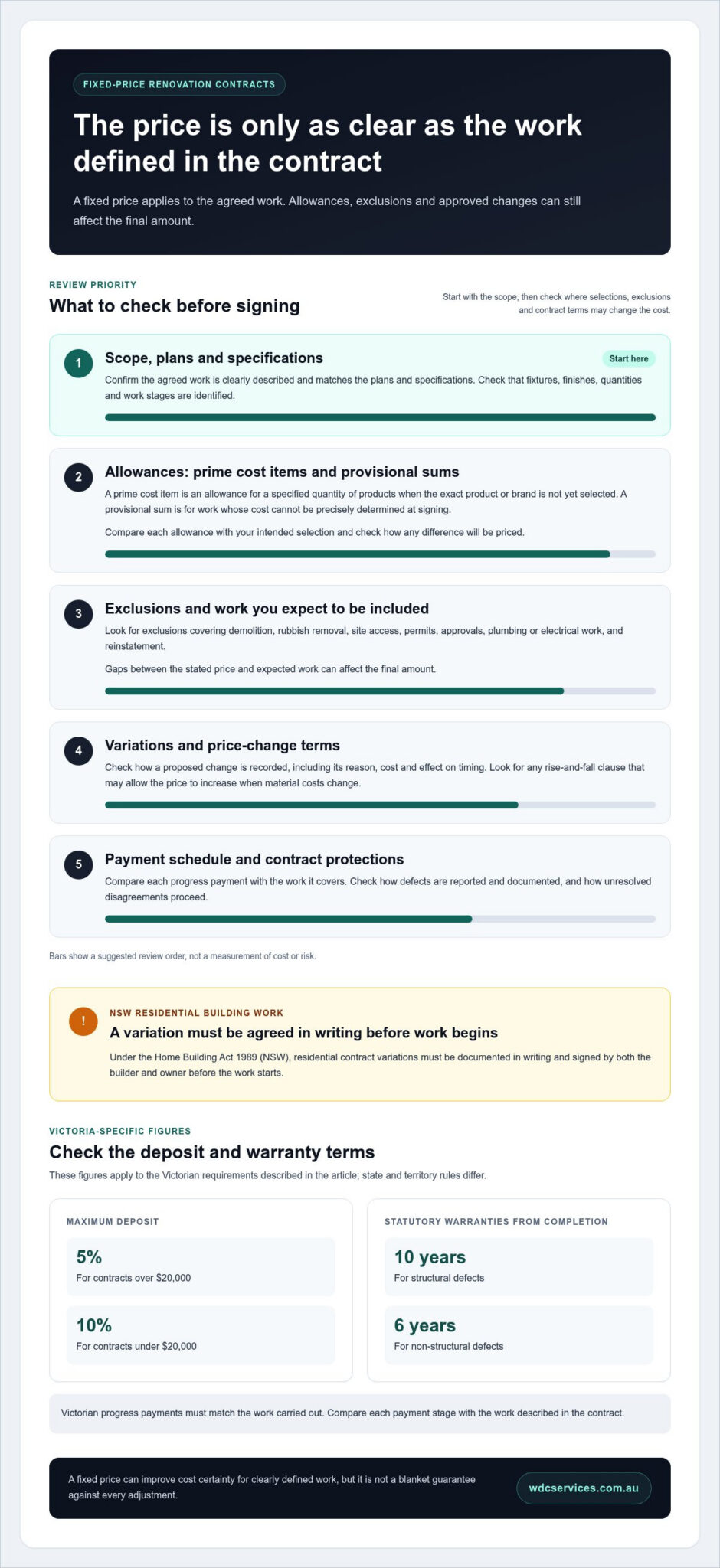
Allowances are another source of uncertainty. A prime cost item is an allowance for a specified quantity of products where the exact product or brand has not yet been selected. A provisional sum covers work whose cost cannot be precisely determined when the contract is signed. For example, plumbing work may involve a tank, trenches to the home and pipe laying, with the final cost depending on the work required and materials used.
Check whether the contract includes a rise-and-fall clause, which may allow the price to increase when material costs change. Identify how cost changes will be explained, approved and recorded, including any effect on timing. A fixed price is not a blanket guarantee against every adjustment.
Payment, Exclusions, and Contract Protections
Payment terms affect cash flow and provide a record of what each payment covers. In Victoria, the maximum deposit for home building work is capped at 5 percent for contracts over $20,000, or 10 percent if the contract price is under $20,000. Residential building work contracts must include a clear progress payment schedule, and payments must match the work carried out. Compare each payment stage with the described work before signing.
Victorian statutory warranties run for ten years for structural defects and six years for non-structural defects from completion. The contract should explain how to report defects, how rectification will be documented, and how unresolved disagreements proceed. Clear steps for written notice, responses and dispute escalation help both parties keep a useful record.
Before signing, compare the scope with the plans and specifications. Look for exclusions covering demolition, rubbish removal, site access, permits, approvals, plumbing or electrical work, and reinstatement. Experienced trade and general contracting firms such as Underline Energy Concepts highlight the value of detailing these specific scopes upfront to avoid unexpected out-of-pocket gaps. These details can reveal gaps between the stated price and the work you expect. Check whether fixtures, finishes and quantities are identified, and whether an allowance could be exceeded. Ask how each proposed change will be documented, including its reason, cost and effect on timing.
Choosing a contract for project scope and complexity
Yes. Australian building contract requirements differ by state and territory, so the rules depend on where the renovation takes place. For a project in Victoria, follow Victorian requirements; NSW and Queensland have separate contract rules and processes.
Choose a contract structure that reflects how clearly the renovation can be defined. A fixed-price building contract suits a settled scope, with plans, specifications, selections and work stages agreed before signing. For example, a bathroom renovation with selected fittings and a documented layout is easier to price as defined work than a project with unresolved structural details or selections.
A cost-plus or variable arrangement may suit a project with an evolving scope, ongoing decisions or substantial unknowns. It offers flexibility at the expense of price certainty: the amount payable depends on actual work and costs as the project progresses. Weigh that exposure against the value of making decisions later. With either arrangement, identify which plans and specifications form part of the contract and which decisions remain outstanding.
State rules also affect contract documents. Put the agreed terms in writing and make sure both parties sign before work begins. Building work valued at $20,000 or more is a Level 2 contract and must include Level 1 requirements plus additional inclusions. Queensland Level 1 contracts apply to work valued between $3,301 and $19,999. The contract should connect the parties, work address, description, price or calculation method, plans and specifications, and completion date or how it will be determined.
Queensland contracts must also describe the work in line with relevant laws and any plans or specifications that form part of the agreement. If the work includes making a home suitable for occupation, the finished home must be suitable for occupation. These requirements highlight why the completion description matters: define the deliverables rather than relying on a broad label such as “renovation”.
Time extensions need a clear process too. In Victoria, a builder claiming an extension must give the owner the claim within 15 business days after the delay ends. The owner generally has 10 days to respond in writing. These Victorian timeframes show why a contract should explain how delays are notified, assessed and reflected in the completion date.
Before signing, compare the stated completion date with the work sequence, access arrangements and decisions still required. Record how completion will be assessed, including whether the listed work, agreed specifications and any outstanding defects affect handover. A specific completion standard gives both parties a shared reference when reviewing progress or a proposed extension.
Written variation documentation and approvals
A variation changes the agreed work, price or timing after the original contract is signed. In NSW, the Home Building Act 1989 (NSW) requires residential contract variations to be documented in writing and signed by the builder and owner before work begins.
Documenting and Approving Variations
A written variation records exactly what changes and gives both parties a shared reference before altered work starts. In NSW, provide a written description of the variation, together with any relevant plans or specifications, before the work begins. The document should identify the change, its pricing and any effect on the agreed completion timeframe.
For example, replacing a specified tap with another model may affect the prime cost allowance, supply arrangements and installation labour. Record the original selection and the replacement, then show how the price changes. Both parties should approve the variation in writing before work proceeds, so the revised scope and agreement are clear.
Homeowner-Requested Changes
A homeowner-requested variation adds, removes or changes work after the contract scope has been agreed. Moving a vanity, changing tile selections or adding storage can affect materials, labour and the construction sequence. A written proposal makes the practical and financial consequences clear before the owner approves the change.
Ask the variation document to separate added work from credits for deleted work. For instance, removing a specified fitting may reduce one item, while a replacement may require different materials or installation. A clear breakdown shows how the revised total was calculated, including any allowance adjustment. It also ensures an informal conversation is not the only record of an important design decision.
Changes can also affect work already completed or scheduled. A revised layout may require an updated plan, while a different finish may alter ordering or installation coordination. Record the new specification and related work so the builder and owner can assess the full change, not just the visible item.
Variation Time Impacts
Variations can change the completion date if they add work, require new materials or disrupt scheduled trades. Before approval, the written variation should explain the expected timing impact and the reason for it. This gives the owner a basis for deciding whether the change is worth the revised schedule.
For example, a late selection change may mean sourcing a different product before installation. The variation should distinguish any supply delay from extra on-site labour or changes to the construction sequence. Recording the expected timing impact alongside the price makes the decision clearer and keeps the schedule aligned with the agreed change.
Keep each approved variation with the original contract, plans and specifications. If questions later arise about what was agreed, the record shows the changed scope, cost and timing. If several changes are made, maintain an up-to-date variation list so each approval and its effect on the overall project remain clear.
Allowances and provisional costs
An allowance assigns an estimated amount to a selection or task that cannot yet be priced precisely. In a fixed-price renovation, allowances matter because the contract sum may include provisional sums and prime cost items, while the final amount can change if actual costs differ.
A prime cost item is an allowance for a specified quantity of products when the exact product or brand has not yet been chosen. Bathroom fittings are a clear example: the contract may allow for a tap, basin or toilet, but the selected model may cost more or less. Check the quantity, product standard and whether installation labour is included, rather than comparing the allowance figure alone.
A provisional sum covers work whose cost cannot be accurately determined when the contract begins. Unlike a prime cost item, it relates to a task rather than a product selection. For example, concealed conditions may affect the work needed to prepare a wall for new finishes, a challenge frequently seen in structural and masonry restoration where teams like Progressive Contracting NY Corp must account for subsurface deterioration. The contract should describe the assumed work and explain how the actual cost will be calculated.
When the work is completed or an item is selected, compare the actual amount with the allowance and follow the contract’s adjustment process. Ask how the difference is calculated, what supporting details are provided, and whether the builder’s margin applies. NSW builders may add a margin, typically 15-20%, to excess costs for provisional sum or prime cost items. This is not the same as the allowance itself, so read the pricing terms carefully.
Allowances also affect payment planning. A contract may include an allowance in its upfront total, but that figure does not necessarily cap the final cost. A fixed-price contract can include provisional sums and prime cost items, and the final cost may exceed the signed contract price if actual costs exceed those allowances. A low allowance can make a quote appear cheaper without covering the products or work you expect.
Review each allowance against your intended fittings and likely scope before signing. Check whether it covers supply only or also delivery, installation and associated labour. For a shower screen, for instance, confirm the assumed size and specification, then compare the allowance with the product you plan to choose. This makes potential differences clear before a selection affects the final payment.
Queensland requires allowances for Prime Cost Items and Provisional Sums to be calculated with reasonable care and skill. Across states, the contract wording determines how adjustments are documented and charged. Keep selection records, invoices and variation approvals together, then compare each item with its allowance when the work is complete. A clear, itemised record helps explain why the final account differs from the original contract sum.
Fixed-price contract benefits and risks
A fixed-price contract can make budgeting more predictable when the residential renovation scope is complete and clearly documented. The builder agrees to deliver the defined work for a set amount and bears cost overruns, including increases in labour and material costs during construction. For example, a signed scope that identifies specified fixtures gives both parties a clearer basis for assessing what the agreed price covers.
That certainty depends on the contract’s boundaries. If the written scope excludes a task or identifies a selection only through an allowance, extra costs may still arise. A bathroom plan might specify a vanity but leave its tapware undecided. The final amount can change if the selected fittings cost more than the allowance. Review exclusions and assumptions alongside the price, not as separate paperwork.
Cost-plus contracts allocate risk differently. The owner pays the actual cost of completed work, plus an agreed builder’s margin or fee. This approach can accommodate evolving plans, but homeowners have more exposure to cost increases and delays. The final cost may not be known until the work is complete, making changes to labour requirements, material choices and site conditions relevant to the eventual bill.
Reports and complaints to the Queensland Building and Construction Commission (QBCC) indicate that some cost-plus contract totals can exceed homeowners’ initial expectations by more than double. This is not a prediction for every project; it illustrates why the payment basis matters. Before signing either contract type, compare how it handles actual costs, margin, allowances, changes and supporting records.
In Australia, most domestic building contracts must be fixed-price under the Domestic Building Contracts Act (DBCA) and Building Regulations 2006, unless certain conditions are met. A rise-and-fall clause may allow a builder to increase the price when material costs change. Read clauses that can adjust the signed amount, and consider how each adjustment is explained and approved. The contract’s stated scope still matters: a fixed sum applies to defined work, not automatically to every unforeseen task.
Use the project’s certainty as the deciding factor. If plans, specifications, fixtures and selections are settled, fixed pricing can make the financial commitment easier to assess. If key decisions or site details remain open, allowances or a different payment model may leave greater uncertainty. List unresolved items before signing, then compare their impact on cost, timing and flexibility. For a renovation with a defined scope, discuss your renovation plans as a practical next step.
WDC Services: Bathroom Renovations
WDC Services manages bathroom renovations from design planning and material selection through construction and installation. A clearly planned scope supports considered decisions about layout, fittings and finishes, helping create a space that suits your household’s needs.
Professional communication, punctuality and attentive customer service guide the project. WDC Services keeps homeowners informed as work progresses, with care given to workmanship and quality finishes. Previous clients have recommended the company, with feedback recognising its reliability and attention to detail. Laundry Renovations and Electrical can also be part of your renovation plans.
For homeowners in the inner Melbourne eastern suburbs, contact Dominic (Dom) Crupi on 0425801004 or email info@wdcservices.com.au to discuss your project.
Set Your Renovation Up for a Clear Start
Knowing what’s included in a fixed price renovation contract gives you a useful starting point. Next, define what matters most in the finished space. Write down your priorities, preferred selections and any decisions still to make. This brief can help shape a renovation plan around how you use your home, rather than relying on assumptions.
As you plan, consider how the project should function and feel. A practical layout, considered storage and finishes that suit your household can guide the conversation from early planning through installation. A clear discussion helps turn your priorities into a scope you can review with confidence.
WDC Services can discuss your renovation plans and help you consider the next steps for your home. Talk with WDC Services about your renovation and take the first step towards a well-planned project.
Frequently Asked Questions
What Should Be Included in a Fixed Price Quote?
A fixed-price quote should identify the work, materials, labour, assumptions, exclusions and selections covered by the total. For example, a bathroom quote could state whether removing existing tiles and disposing of debris are included. It should also show which fixtures are selected and which remain subject to an allowance. Compare every line with your renovation plans so omissions are clear before the contract is prepared.
What should a fixed-price renovation contract include in Australia?
It should identify the contracting parties and work address, describe the work, and include the plans and specifications that define it. Understanding what’s included in a fixed price renovation contract also means reviewing payment stages, timing, exclusions and applicable warranties. Requirements differ between Australian states and territories. In NSW, large home building contracts must include a sufficient work description, attached plans and specifications, and relevant warranties required by the Home Building Act 1989.
Which renovation works, materials and labour are included in the fixed price?
Only work expressly covered by the contract is included in the fixed price. Check that each task identifies its materials and labour, rather than relying on a broad description such as “bathroom upgrade.” For example, a tiling line should clarify the area, tile selection or allowance, and installation work. Apply the same check to removal, preparation and fitting installation. If a task appears in the plans but not in the scope, resolve the mismatch before signing.
How should plans, specifications, finishes and allowances be documented in an Australian renovation contract?
Attach the final plan set and identify its revision, then list the specifications and finishes for each area. Record selections in enough detail to distinguish products, such as by model, size, colour or finish. Mark undecided selections as allowances and state the quantity or task they cover. Keep approved samples or selection schedules with the contract. This makes it easier to check whether an installed finish matches the documented choice.
Are GST, permits, inspections, engineering and waste removal included in a fixed-price renovation quote?
They’re included only if the quote or contract says so; request clear inclusions or exclusions for each item. The document should show whether its total includes GST and identify who arranges permits, inspections or engineering. Consumer Affairs Victoria recommends checking that relevant building and planning fees, council charges and government levies are included in the contract price. Also clarify whether rubbish removal and disposal are covered, rather than assuming they fall within site preparation.
What are provisional sums and prime cost items in Australian building contracts?
A prime cost item is an allowance for a specified quantity of products not yet selected, while a provisional sum covers work whose cost cannot be precisely determined at signing. For example, a basin selection may be a prime cost item; uncertain work behind an existing wall may be a provisional sum. Compare each allowance with the expected selection or task, then understand how the final amount is reconciled against actual costs.
How are variations and extra work priced and approved under a fixed-price renovation contract?
Document each variation with the revised work, price, timing effect and approval before that work proceeds. In NSW, residential contract variations must be in writing and signed by the builder and owner before work begins. A useful variation record also identifies additions or deletions, any allowance adjustment, and the updated plans or specifications. For example, changing a vanity layout should capture related labour and materials, not only the replacement unit.
What completion date, delays and extension-of-time terms should a renovation contract specify?
The contract should state a completion date or explain how it will be determined, then describe how delay notices and extension requests are handled. Check what reason and supporting information are required, how responses work and how a revised date is set. For example, the terms should explain how a selection delay is recorded and assessed against the schedule. Apply the rules for the location of the renovation.
Disclaimer
Please note this advertisement has been AI generated for entertainment and leed generation purposes and In some cases may not reflect the companies exact services and information.
Prior to engaging the company it is recommended that you seek clarification on some or all points in this advertisement .
Wdc services has many 5 star google reviews that can be used as a reliable and true testimony to the quality services proved to its customers over many years.
Contact Domenico ( Dom ) Crupi on 0425801005 or email info@wdcservices .com.au
for further information
Disclaimer: Disclaimer, Please note this advertisement has been AI generated for entertainment and leed generation purposes and In some cases may not reflect the companies exact services and information. Prior to engaging the company it is recommended that you seek clarification on some or all points in this advertisement. WDC Services has many 5 star google reviews that can be used as a reliable and true testimony to the quality services proved to its customers over many years. Contact Domenico ( Dom ) Crupi on 0425801005 or email info@wdcservices .com.au for further information.