
Table of Contents
- Is Quartz Worth It for Kitchens?
- Quartz Benchtop Pros and Cons
- Durability and Everyday Wear
- Quartz Benchtop Heat Resistance: What You Need to Know
- How to Clean Quartz Benchtops
- Quartz vs Granite Benchtops: Which Suits Your Kitchen?
- Long-Term Value and Lifecycle Costs
- Frequently Asked Questions
Last Updated: October 14, 2026
Is Quartz Worth It for Kitchens?
Whether is quartz worth it for kitchens isn’t straightforward. At WDC Services, we help homeowners evaluate countertop materials, and quartz deserves serious consideration, but it’s not right for every kitchen.
Quartz benchtops are non-porous, highly durable, and need minimal maintenance compared to natural stone, with hundreds of colours and patterns. But they cost more upfront than laminate and have heat limitations that matter if you cook frequently.
The real question is whether quartz fits your cooking habits, budget, and long-term plans. Below, we compare the pros and cons and help you decide if it belongs in your kitchen.
Quartz Benchtop Pros and Cons
Quartz benchtops combine engineered stone with resin binders to create a durable, low-maintenance surface. Understanding the strengths and limitations helps you choose well.
Pros of quartz benchtops:
- Non-porous surface. Quartz doesn’t absorb liquids or bacteria, making it naturally stain-resistant and hygienic.
- Minimal sealing required. Unlike granite or marble, quartz needs no annual sealing, a huge maintenance advantage.
- Scratch and chip resistant. The engineered composition is harder than most natural stones, resisting everyday wear better.
- Wide colour and pattern options. Manufacturers offer far more variety than natural stone, with consistent colours across slabs.
- Consistent appearance. No natural variation means your benchtop looks the same from edge to edge.
Cons of quartz benchtops:
- Heat sensitivity. Direct heat from hot pans can damage the resin binder, causing discolouration or surface cracking. You must use trivets.
- Higher upfront cost. Quartz typically costs more per square metre than laminate or some granite options.
- Not truly “natural.” If you prefer authentic stone, the engineered aesthetic may not appeal.
- Difficult to repair. Deep chips or burns often require professional repair or full slab replacement.
- UV sensitivity. Prolonged direct sunlight can fade some colours, particularly darker shades.
Durability and Everyday Wear
How quartz holds up to daily kitchen life depends on your cooking intensity and care habits.
Quartz resists everyday damage well: chopping and normal food prep don’t scratch it, and spilled wine, coffee, or oil won’t stain. That makes it excellent for busy families.
The engineered stone is often harder than granite, but quartz’s weakness isn’t mechanical damage, it’s thermal shock.
When a hot pan sits directly on quartz, the resin binder can soften, discolour, or even crack. Even premium brands can be damaged by direct heat, so always use a trivet or hot pad.
Quartz holds up well to spills, stains, and rough handling, but needs care with heat. If someone regularly places hot cookware directly on the bench, quartz will disappoint.
Quartz Benchtop Heat Resistance: What You Need to Know
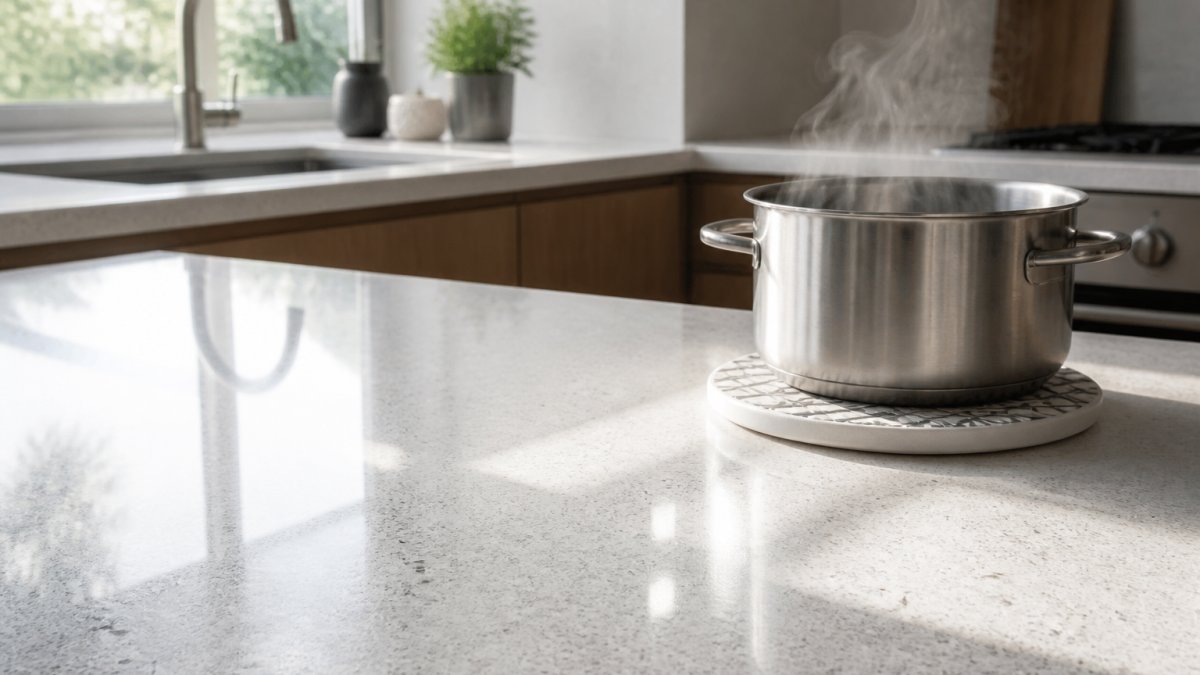
Quartz benchtops tolerate moderate heat but are not heat-proof. The resin binders soften around 80-90°C, lower than cookware fresh from the stovetop.
Heat damage prevention:
- Always use trivets or pot stands beneath hot cookware.
- Let hot pans cool slightly before placing them on the benchtop.
- Avoid resting hot baking trays directly on the surface.
- Use heat-resistant mats in areas where you regularly place hot items.
Thermal shock, rapid temperature change, is the real risk. A very hot pan on a cool quartz surface can crack it, especially on darker colours.
Small discolourations sometimes fade with time and sunlight; deeper damage requires professional repair, and severe cases need section replacement.
For minimal cooks or disciplined trivet users, heat resistance isn’t a practical concern. For households that cook frequently and casually, it matters.
How to Clean Quartz Benchtops
One genuine advantage of quartz is cleaning simplicity. The non-porous surface means most spills wipe away easily.
Daily cleaning:
- Wipe spills immediately with a soft cloth and warm water.
- Use mild dish soap for sticky residue.
- Dry with a clean cloth to prevent water spots.
Weekly deep clean:
- Mix warm water with a small amount of mild dish soap.
- Wipe the entire benchtop with a soft cloth or sponge.
- Rinse with clean water and dry thoroughly.
What to avoid:
- Abrasive scrubbers or scouring pads (they dull the finish).
- Acidic cleaners like vinegar or lemon juice (they can etch the surface over time).
- Bleach or harsh chemical cleaners.
- Wax-based polishes (unnecessary and can leave residue).
Quartz requires no sealing, special treatments, or complicated routines. Compared to granite or marble, which need regular sealing and careful handling, it’s genuinely low-effort.
Quartz vs Granite Benchtops: Which Suits Your Kitchen?
Most comparisons stop at a feature table, which doesn’t answer the real question: given how my household cooks and lives, which one should I put in?
Here is the head-to-head, plus a decision framework most guides skip.
| Feature | Quartz | Granite |
|---|---|---|
| Porosity | Non-porous; stain-resistant | Porous; requires sealing |
| Maintenance | Soap and water only | Periodic sealing needed |
| Heat resistance | Moderate; needs trivets | Higher; more heat-tolerant |
| Colour consistency | Uniform; engineered patterns | Natural variation per slab |
| Durability | Excellent; scratch-resistant | Excellent; very hard |
| Appearance | Modern, consistent | Natural, unique |
| Repairability | Difficult; often section replacement | Can sometimes be patched |
| UV stability | Some colours can fade in strong sun | Generally stable |
The decision framework most guides miss
The right choice depends less on the material than on the household. See which profile sounds like your kitchen.
Frequent, intense cooks (wok cooking, cast iron, baking marathons).
Granite has the edge here.
Busy families with young children.
Quartz is usually the better fit.
Homeowners who prioritise natural variation.
Granite wins on character. Every slab is unique, and no two benchtops look identical.
Low-maintenance, time-poor households.
Quartz is the clear answer. No sealing, no special cleaners, no re-polishing. The surface asks almost nothing of you beyond basic wiping and heat discipline.
Rental properties and short-hold renovations.
Neither premium material is the obvious pick if you are not staying.
Sun-drenched kitchens.
If the benchtop sits in strong, direct sunlight for hours a day, check the specific colour’s UV stability.
The questions to ask before you decide
Whichever way you lean, get clear answers to these before signing a quote:
- What is the exact brand and colour of the slab, and is it in stock?
- Is the quote inclusive of removal, disposal, cutouts and GST?
- What does the warranty cover, and specifically what does it exclude?
- Who installs it, and are they approved by the manufacturer?
- If damage occurs later, can a single section be replaced, or would the whole benchtop need to come out?
Quartz and granite are both excellent surfaces. The right answer is not ‘which is better’ but ‘which one matches how this household actually cooks, cleans and plans to stay’.
Both materials last decades with proper care. The choice comes down to maintenance tolerance, aesthetic preference, and how you use your kitchen, neither is objectively better.
Long-Term Value and Lifecycle Costs
Whether quartz is worth the premium comes down to one question: do the maintenance and replacement savings over the benchtop’s life outweigh the higher upfront spend? You need the full installed cost, not just the slab price.
What you are actually paying for
A quartz benchtop quote is rarely a single number. Understanding its line items helps you compare quotes fairly:
- Material (per square metre). Engineered stone is priced by the slab or by the square metre, and the range between entry-level and premium brands is wide. Two quotes for the ‘same’ quartz can differ significantly if one is a budget import and the other a named brand.
- Fabrication. Cutting, polishing and shaping the slab to your template. Complex shapes, waterfall edges and curved islands add labour.
- Edge profile. A simple square or pencil round edge is typically included; mitred, bullnose or ogee profiles are usually a paid upgrade.
- Cutouts. Each sink cutout and cooktop cutout is normally charged individually. Undermount sinks and flush-mount cooktops take more time than drop-in styles.
- Removal and disposal. Taking out the old benchtop and disposing of it is a separate cost that many homeowners forget to budget for.
- Installation and site access. Stairs, tight doorways, lift access and after-hours installs can all attract surcharges.
- GST. Always confirm whether a quote is inclusive or exclusive.
When comparing quotes, ask each fabricator to itemise material, fabrication, edge, cutouts, removal and installation separately. A single lump-sum figure makes it almost impossible to see where the value sits.
Lifespan and warranty reality
Quartz benchtops commonly last 15 to 20 years or more in a domestic kitchen with normal use and sensible heat management, comparable to granite and well ahead of laminate.
Warranties are where the fine print matters. Most cover material defects such as manufacturing faults or resin failures, but typically exclude:
- Heat damage from hot cookware placed directly on the surface.
- Chips or cracks caused by impact.
- Damage from harsh or abrasive chemicals.
- Improper installation by a non-approved fabricator.
In other words, the warranty protects against a faulty slab, not against how the kitchen is used, a distinction worth understanding before you sign a quote.
Maintenance costs over time
This is where quartz quietly wins. Granite and marble need periodic sealing, and natural stone may need re-polishing if it etches or dulls. Quartz needs none of that, just soap, water, and a soft cloth.
Over 15 years, the sealing products, labour, and occasional re-polishing natural stone requires add up. Quartz front-loads the cost and then asks very little, for homeowners who value predictability, that’s the core of the value case.
Repair and replacement scenarios
Quartz is not easy to repair invisibly. A deep chip, scorch mark, or crack usually means one of three outcomes:
- Cosmetic repair. Small surface marks can sometimes be filled and blended by a specialist, but the result is rarely invisible.
- Section replacement. If the damage sits in a single run, a fabricator may be able to replace just that section, provided the same slab or a close match is still available.
- Full benchtop replacement. If the colour has been discontinued or the damage spans multiple sections, you may be looking at replacing the whole surface.
This is why heat discipline matters: one careless moment can mean a fabrication and installation bill, not just a cleaning bill.
When the maths favours quartz
Quartz tends to make financial sense when:
- You plan to stay in the home long enough to enjoy the low-maintenance years.
- You cook moderately and are comfortable using trivets.
- You value not having to think about sealing, staining or special cleaners.
It tends to make less sense when:
- You are renovating purely to sell within a few years and will not recoup the premium.
- The property is a rental and the benchtop will face heavy, unsupervised use.
- Your budget is tight and laminate or a budget natural stone would free up funds for higher-impact upgrades.
The value case for quartz is not about the slab price. It is about the total installed cost, the warranty exclusions you accept, and how many years of low-maintenance use you actually get to enjoy.
When planning a kitchen renovation, WDC Services can help you evaluate countertop options alongside your overall design and budget, integrating your benchtop choice with cabinetry, electrical layout, and workflow to create a kitchen that works for how you actually live.
Frequently Asked Questions
What is the main downside to a quartz countertop?
Quartz’s primary limitation is heat sensitivity. Unlike natural stone, engineered quartz can suffer thermal damage from direct contact with hot pans or pots. Prolonged exposure to temperatures above 71°C can cause discoloration or cracking. Always use trivets or hot pads under cookware. Additionally, quartz costs more upfront than laminate or tile alternatives, though this is offset by lower maintenance over time.
Is quartz a good choice for a busy kitchen?
Yes, quartz is excellent for busy kitchens. Its non-porous surface resists stains from spills, and it requires only soap and water for cleaning, making daily upkeep simple. The scratch and chip resistance suits households with frequent cooking and heavy use. However, you must use trivets for hot pans and avoid dragging heavy objects across the surface to maintain its appearance long-term.
Does a quartz kitchen benchtop need sealing?
No. Unlike natural stone such as granite or marble, quartz benchtops do not require sealing. The engineered resin binder already provides a protective, non-porous finish that resists stains and moisture. This is one of quartz’s key maintenance advantages over natural stone alternatives, saving you time and cost over the benchtop’s lifespan.
How does quartz compare to granite for kitchen benchtops?
Quartz offers superior stain resistance and requires no sealing, while granite demands regular maintenance but offers better heat tolerance. Quartz provides more consistent colour and pattern options, whereas granite features natural variation. Quartz typically costs more initially but has lower lifetime maintenance costs. For busy kitchens, quartz wins on convenience; for heat-intensive cooking, granite edges ahead. Your choice depends on your cooking habits and aesthetic preferences.
Disclaimer: Disclaimer, Please note this advertisement has been AI generated for entertainment and leed generation purposes and In some cases may not reflect the companies exact services and information. Prior to engaging the company it is recommended that you seek clarification on some or all points in this advertisement. WDC Services has many 5 star google reviews that can be used as a reliable and true testimony to the quality services proved to its customers over many years. Contact Domenico ( Dom ) Crupi on 0425801005 or email info@wdcservices .com.au for further information.