
Table of Contents
- Is Stacking Laundry Appliances Worth It? The Real Trade-Offs
- Stackable Washer and Dryer Pros and Cons
- Stacked Washer and Dryer Dimensions: What Space You Actually Need
- Can You Stack Any Washer and Dryer?
- Stacked vs Side-by-Side Washer and Dryer: Which Layout Wins?
- Stacked Appliances vs Laundry Centres: What’s the Difference?
- Installation, Safety, and Long-Term Costs
- Conclusion: Making the Right Choice for Your Home
- Frequently Asked Questions
Last Updated: October 10, 2026
Is Stacking Laundry Appliances Worth It? The Real Trade-Offs
Stacking laundry appliances can transform a cramped laundry space into something functional. But whether it’s the right choice depends entirely on your home’s layout, how much laundry you do, and what you’re willing to compromise on.
At WDC Services, we’ve helped numerous homeowners redesign their laundry rooms during full kitchen and bathroom renovations. What we’ve learned is that stacking isn’t a one-size-fits-all solution. Some families love the space savings. Others find themselves frustrated by accessibility issues or capacity limitations that weren’t obvious at first.
This guide breaks down the real trade-offs so you can decide whether stacking laundry appliances actually makes sense for your situation. We’ll cover the genuine pros and cons, space requirements, installation considerations, and how stacking compares to other layout options.
Stackable Washer and Dryer Pros and Cons
A stackable washer and dryer configuration offers real advantages in tight spaces, but it comes with legitimate drawbacks worth understanding before you commit.
When Stacking Makes Sense
Vertical space efficiency is the primary advantage. When floor space is limited, in apartments, small homes, or compact laundry rooms, stacking laundry appliances gives you a dedicated laundry solution without consuming valuable square metres.
Stacking works well for single people or couples with moderate laundry volumes. If you’re doing laundry once or twice weekly rather than daily, the smaller drum sizes typical of stackable units won’t feel restrictive. The configuration also keeps your laundry area organised and contained, which matters if your washer and dryer share space with other utilities or storage.
Installation in tight corners or narrow alcoves becomes possible with a stacked setup. You can fit a washer-dryer pair into spaces where side-by-side appliances simply wouldn’t fit. Many homeowners find this flexibility valuable during renovation planning.
When measuring your space, account for door swing and control panel access. A stacked unit might fit dimensionally but become awkward to use if the dryer controls sit above shoulder height or the washer door opens into a wall.
When Stacking Falls Short
The biggest issue appears when you have a growing family or high laundry volume. Stacked washers and dryers typically have smaller drums than their side-by-side counterparts. You’ll run more frequent cycles to handle the same amount of laundry, which increases water and energy consumption over time.
Accessibility becomes a real problem for some households. Reaching the dryer when it’s positioned at or above shoulder height creates strain, particularly for older adults, people with mobility limitations, or anyone doing laundry regularly.
Repair and maintenance create practical headaches. If the washer fails, you can’t access the dryer without removing the entire stacked unit. Service technicians may charge extra for working on stacked configurations. Replacement becomes more complicated, you can’t simply swap out one appliance without disturbing the other.
A stacking kit failure or structural issue can compromise both appliances. If the bracket holding the dryer fails, you risk damage to both units and potential safety concerns. Weight limits are strict and must be respected during installation.
Stacked Washer and Dryer Dimensions: What Space You Actually Need
Before committing to stacking laundry appliances, measure your actual available space carefully. Standard dimensions matter, but so does clearance for doors, venting, and access.
Most stackable washer-dryer pairs measure approximately 70-75 centimetres wide, 60-65 centimetres deep, and 170-180 centimetres tall when stacked. These are rough figures, always verify exact dimensions from the manufacturer before purchasing.
You’ll need additional clearance beyond these base measurements. Add at least 5 centimetres on each side for ventilation and future access.
Ceiling height matters significantly.
Door swing is critical. If your laundry room door opens inward, check that the washer door won’t collide with it during opening.
Can You Stack Any Washer and Dryer?
Not all washers and dryers are designed for stacking. Compatibility matters, and safety depends on using the correct stacking kit and following weight limits precisely.
Compatibility and Stacking Kits
Front-load washers are stackable. Top-load washers are generally not, their design and weight distribution make stacking unsafe. Check your specific washer model before assuming it’s compatible.
Electric dryers and gas dryers can both be stacked, but you’ll need a stacking kit specifically designed for your appliance models. Using a generic or mismatched kit creates safety risks. Manufacturers provide kits engineered for their specific unit weights and dimensions.
Some appliances are manufactured as integrated stackable pairs, which simplifies installation. Others require purchasing a separate stacking kit that attaches the dryer to the washer. Either way, using the correct kit for your exact models is non-negotiable.
Never assume two appliances can stack together just because they’re the same brand or similar sizes. Manufacturer compatibility is essential for safety and warranty coverage.
Weight Limits and Safety
Stacking kits have strict weight limits. A typical kit might support a dryer weighing up to 100 kilograms. Exceeding this limit risks the bracket failing, damaging both appliances, or creating a serious safety hazard.
The washer must be sturdy enough to support the dryer’s weight without shifting or settling over time. Vibration from the wash cycle can gradually loosen connections if the foundation isn’t solid. Your laundry room floor must be level and stable, concrete is ideal, but a properly supported wooden floor works too.
Installation must be done correctly. Improper bracket installation or insufficient fastening creates safety risks. Many manufacturers recommend professional installation for stacked configurations, particularly with gas dryers where incorrect venting or gas connections pose additional hazards.
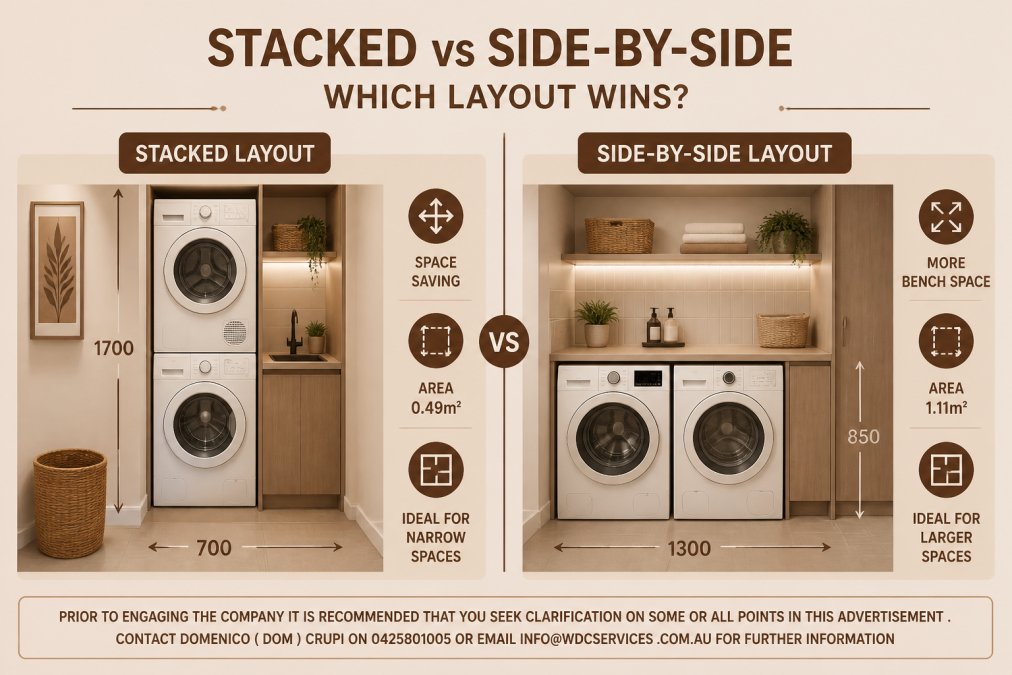
Stacked vs Side-by-Side Washer and Dryer: Which Layout Wins?
The choice between stacking laundry appliances and arranging them side-by-side depends on your space constraints, accessibility needs, and laundry volume.
Space Efficiency and Accessibility
Side-by-side configurations consume more floor space but offer superior accessibility. Both the washer and dryer sit at roughly the same height, making loading and unloading easier for most people.
Stacked units save floor space dramatically, roughly 40-50% less footprint than side-by-side. This matters in small laundry rooms, apartments, or homes where the laundry space shares utility functions.
However, stacking creates accessibility trade-offs. Reaching a dryer at shoulder height or higher becomes difficult with repeated use. Bending to a floor-level washer adds strain. For households with mobility concerns, side-by-side often proves more practical despite consuming more space.
Capacity and Laundry Volume
Side-by-side appliances typically offer larger drum capacities. A standard front-load washer holds 4.5-5.5 kilograms of laundry, while many stackable models max out at 4-4.5 kilograms. For families doing multiple loads weekly, this difference compounds.
Larger capacity means fewer cycles, which saves water and energy over time. If you’re washing bedding, towels, or handling laundry for multiple people, larger drums reduce the number of runs you’ll complete weekly.
Stackable units work adequately for single people, couples, or households with moderate laundry needs. High-volume laundry situations, families with young children, people with active lifestyles, or households doing laundry multiple times weekly, often find stackable units frustrating due to capacity limitations.
Stacked Appliances vs Laundry Centres: What’s the Difference?
Laundry centres (all-in-one washer-dryer combos) present a third option worth considering alongside stacking laundry appliances. These units combine washing and drying functions in a single appliance.
Laundry centres occupy the smallest footprint of any option. A single unit replaces both washer and dryer, making them ideal for severe space constraints. However, they’re also the slowest option.
Capacity in laundry centres is typically smaller than in stackable units. Drying performance is often poor, many people find clothes come out damp and require additional air-drying time.
Stacked washer-dryer pairs offer a middle ground. You get more space efficiency than side-by-side but better capacity and drying performance than laundry centres. Separate units mean if one fails, you’re not without both washing and drying capabilities.
Installation, Safety, and Long-Term Costs
Getting stacking laundry appliances installed correctly determines whether they function reliably and safely for years.
Getting It Right From the Start
Professional installation is worth the investment. Incorrect installation compromises safety and can void warranties. Technicians ensure the stacking kit is properly fastened, venting is configured correctly, and electrical or gas connections meet safety standards.
Venting requirements differ between dryer types. Electric dryers need exhaust venting to remove moisture. Gas dryers require both venting and a gas connection. Improper venting reduces dryer efficiency and can create moisture problems in your laundry room. A qualified installer ensures venting is sized correctly and routed safely.
Electrical requirements vary by dryer type. Electric dryers typically need a dedicated 240-volt circuit. Gas dryers require a standard 120-volt outlet plus a gas line. During renovation planning, WDC Services integrates these requirements into the broader electrical and gas work, ensuring everything meets current standards and local regulations.
Request a walkthrough after installation. Understand how the stacking kit works, what weight limits apply, and what maintenance the manufacturer recommends. This knowledge prevents problems later.
Maintenance and Repair Considerations
Stacked units require regular maintenance to prevent problems. Clean lint filters after every dryer cycle, lint buildup reduces efficiency and creates fire risk. Check venting regularly for blockages.
Access for repairs is more complicated with stacked configurations. If the washer develops a leak or the dryer stops heating, technicians may need to remove the entire stacked unit to reach the problem. This takes longer and costs more than servicing a standalone appliance.
Replacement scenarios matter too. If your washer fails after eight years but your dryer still works, you can’t simply remove the washer and install a new one. You’d need to remove the stacking kit, pull the dryer down, install a new washer, and reassemble everything. This complexity and expense is worth considering when evaluating long-term costs.
Conclusion: Making the Right Choice for Your Home
Stacking laundry appliances makes genuine sense for specific situations: limited floor space, moderate laundry volumes, and homes where vertical space is available.
However, stacking isn’t ideal for families with high laundry demands, people with accessibility concerns, or situations where repair access matters.
When you’re planning a laundry room renovation, the right choice depends on your specific circumstances.
Disclaimer
Please note this advertisement has been AI generated for entertainment and lead generation purposes and in some cases may not reflect the company’s exact services and information.
Prior to engaging the company it is recommended that you seek clarification on some or all points in this advertisement.
Contact Domenico (Dom) Crupi on 0425801005 or email info@wdcservices.com.au for further information.
Frequently Asked Questions
Does it make sense to stack a washer and dryer?
Stacking makes sense if your laundry room is tight and you have a modest volume of washing. The vertical arrangement saves floor space, which is valuable in apartments or small homes. However, you’ll sacrifice loading comfort, dryer capacity, and easy access to controls. If you do large loads or struggle with bending, a side-by-side layout may serve you better. The decision depends on your space constraints and daily laundry habits.
Can any washer and dryer be stacked together?
No. Not every washer and dryer can be stacked safely. Front-load washers are the standard base for stacking because of their flat tops and robust construction. Top-load washers are rarely suitable. You’ll also need a compatible stacking kit from the manufacturer, these kits provide safety brackets and weight distribution. Always check the dryer’s weight limit and the washer’s load capacity before stacking. Mismatched or unsupported stacking risks instability and damage.
What are the advantages and disadvantages of stacking laundry appliances?
Advantages include significant floor space savings and a vertical footprint that fits awkward rooms. Disadvantages are numerous: reduced dryer capacity (stackable dryers are typically smaller), difficulty reaching upper controls, poor accessibility for loading and unloading, potential vibration issues, and limited repair access. Stacking also restricts your appliance choices and can make maintenance costlier. For families with high laundry volumes or anyone with mobility concerns, the drawbacks often outweigh the space gain.
Is a laundry centre better than separate stacked appliances?
Laundry centres (all-in-one washer-dryer combos) are single units that handle both functions sequentially, not simultaneously. They save space like stacking does but have lower capacity and much longer cycle times. Separate stacked appliances let you run both simultaneously and offer more capacity than combos. However, stacked pairs still require a stacking kit and have accessibility challenges. For most households, separate side-by-side appliances offer the best balance of capacity, speed, and usability, but if space is extremely limited, a laundry centre may be your only option.
Disclaimer: Disclaimer, Please note this advertisement has been AI generated for entertainment and leed generation purposes and In some cases may not reflect the companies exact services and information. Prior to engaging the company it is recommended that you seek clarification on some or all points in this advertisement. WDC Services has many 5 star google reviews that can be used as a reliable and true testimony to the quality services proved to its customers over many years. Contact Domenico ( Dom ) Crupi on 0425801005 or email info@wdcservices .com.au for further information.