
What if the insurance you expected to help with a renovation dispute isn’t designed to settle the disagreement itself? If work has stalled or the finish doesn’t match what you agreed, you may be asking whether domestic building insurance victoria renovation cover will help.
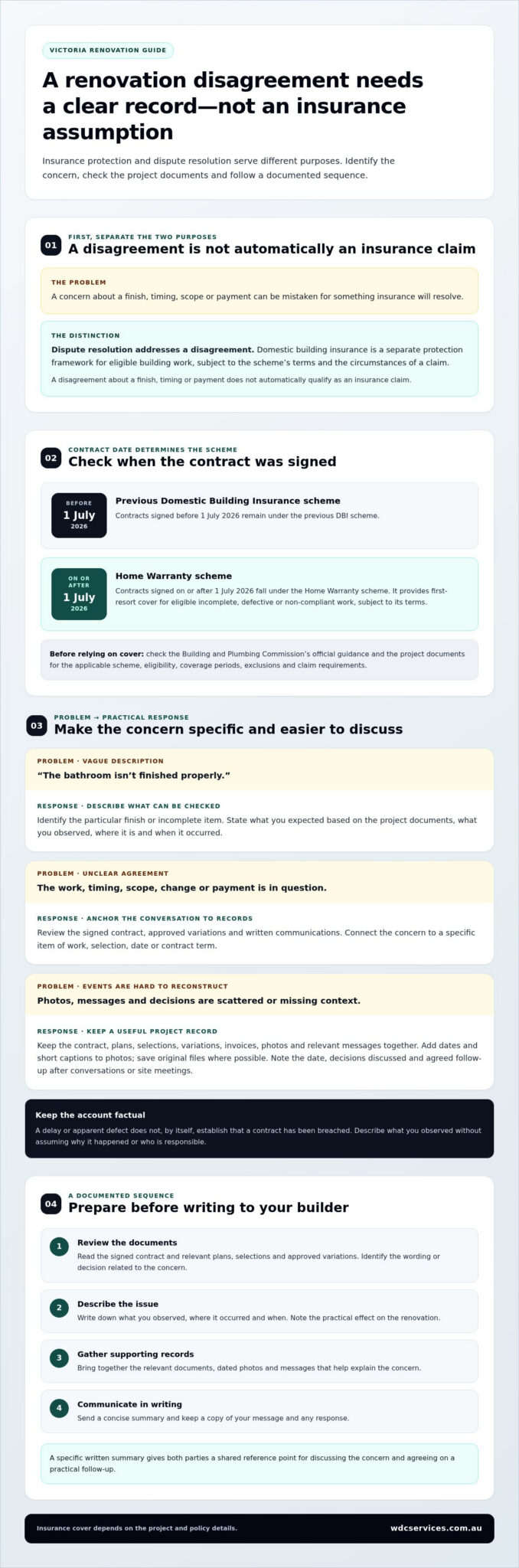
It’s reasonable to want clarity before taking the next step. In Victoria, the contract date matters: contracts signed before 1 July 2026 remain under the previous Domestic Building Insurance scheme, while contracts signed on or after that date fall under the new Home Warranty scheme. Insurance protection and dispute resolution serve different purposes, so understanding which applies can help you choose a practical next step.
This guide explains what each scheme is intended to cover, what it doesn’t resolve and how to raise a concern with your builder in a clear, documented sequence. It also outlines when to approach the Building and Plumbing Commission (BPC), which records to organise and where to check current Victorian process and eligibility details. Clear communication, an agreed scope and well-kept project records help keep expectations aligned as you work through an issue.
Key Takeaways
- Identify whether the concern involves workmanship, delays, agreed scope or payment before deciding how to raise it.
- Keep your contract, plans, selections, variations, invoices, photos and relevant messages together to support a clear account of the issue.
- Understand how domestic building insurance victoria renovation protection differs from builder discussions, regulator guidance and formal dispute pathways.
- If the issue remains unresolved, use a documented sequence and check official Victorian sources for deadlines and procedural requirements before escalating.
- Clear planning, material selections and coordinated trades help align expectations and reduce misunderstandings during a renovation.
Renovation disputes with builders in Victoria: identify the issue before acting
A renovation concern can be stressful, particularly when work is underway and you’re unsure whether to raise it, wait for more information or seek outside guidance. A renovation dispute is a disagreement between a homeowner and builder about the work or how the project is progressing. It might involve workmanship, timing, what the agreed scope includes, a change to the work or a payment. Pinpointing the issue is a calm, practical first step.
Start with the project record rather than assumptions about who is responsible. The signed contract, approved variations and written communications can help clarify what was agreed, what changed and what each party understood. A concern is easier to discuss when you can connect it to a particular item of work, selection, date or contract term.
What kinds of renovation disagreements can arise?
Concerns may involve a finish that appears different from the approved selection, an incomplete task, a delay against an agreed timeframe, or a proposed change whose effect on scope or payment is unclear. These examples are issues to clarify, not conclusions about fault. A delay or apparent defect doesn’t, by itself, establish that a contract has been breached.
Make the issue specific. Note the location or item, what you expected based on the project documents, what you observed and when it occurred. For example, instead of saying “the bathroom isn’t finished properly,” identify the particular finish or incomplete item and refer to the relevant plan, selection or written agreement. This gives both parties a clearer basis for discussing what happened and what may need attention.
Why domestic building insurance is not the same as dispute resolution
Domestic building insurance is a separate protection framework for eligible building work, subject to the scheme’s terms and the circumstances of a claim. It isn’t a general service for deciding every disagreement between a homeowner and builder. A dispute about a finish, timing or payment doesn’t automatically qualify as an insurance claim.
In Victoria, the contract signing date helps determine which scheme may apply. Under the current arrangements, contracts signed before 1 July 2026 remain under the previous Domestic Building Insurance (DBI) scheme. Contracts signed on or after that date fall under the Home Warranty scheme, which provides first-resort cover for eligible incomplete, defective or non-compliant work, subject to its terms. The applicable protection depends on the project and policy details.
Dispute resolution addresses a disagreement; insurance protection responds to eligible risks under a separate scheme.
For homeowners assessing domestic building insurance victoria renovation protection, check the Building and Plumbing Commission’s official guidance and the documents for the specific project. Confirm the applicable scheme, eligibility, coverage periods, exclusions and claim requirements before relying on cover. Keeping these questions separate from the builder disagreement can help you choose an informed next step without assuming one process will resolve the other.
How to prepare for a builder dispute in Victoria: records and clear communication
An organised record can make a difficult conversation more focused. Before writing to your builder, review the documents and observations in a deliberate order. This helps you explain the concern clearly, distinguish what you know from what you’re still checking, and keep the discussion anchored to the project.
Use this sequence:
- Review the documents. Read the signed contract and relevant plans, selections and approved variations. Identify the wording or decision that relates to the concern.
- Describe the issue. Write down what you observed, where it occurred and when. Note the practical effect on the renovation, such as a room or installation that can’t yet be used as planned.
- Gather supporting records. Bring together relevant documents, dated photos and messages that help explain the issue.
- Communicate in writing. Send a concise summary and keep a copy of your message and any response.
A specific written summary gives both parties a shared reference point, making it easier to discuss the concern and agree on a practical follow-up.
Build a useful renovation project record
Keep the contract, plans, selections, variations, invoices, photos and relevant messages together in a folder or organised digital file. For each concern, note which document is relevant and how it relates to the work. For example, if an installed finish appears different from the selected one, record the selection details and identify the area in question without assuming why the difference occurred.
Use photographs where they accurately show the condition or work being discussed. Add the date and a short caption, such as the room or item photographed. Keep original files where possible, and avoid editing an image in a way that could change how the condition appears. Save messages and make brief notes after conversations or site meetings, including the date, decisions discussed and any agreed follow-up. A reliable timeline is more useful than trying to reconstruct events later.
Raise the concern clearly with the builder
Write in a neutral, direct tone. Identify the affected work, refer to the relevant agreement or selection, explain what you observed and state what outcome you’re seeking, such as a discussion, clarification or inspection. Separate confirmed details from opinions: “The item remains unfinished as of this date” is clearer than a conclusion about why it hasn’t been completed.
Ask for a response within a reasonable timeframe, taking the project circumstances into account, and retain the exchange. If an issue still needs inspection, say so rather than presenting an assumption as fact. A clear written record can also help you explain your circumstances if you later seek guidance about domestic building insurance victoria renovation matters, while keeping the insurance question distinct from the builder discussion.
Good documentation starts before a disagreement arises. Clear scope, selected materials and consistent progress communication help keep renovation expectations aligned. For homeowners planning work in Melbourne’s inner eastern suburbs, a carefully planned bathroom renovation can provide a clear foundation for project conversations from design through installation.
Compare Victorian dispute-resolution options with domestic building insurance
The best next step depends on what you want addressed. A direct discussion may clarify a misunderstanding, while regulator guidance can help you understand the relevant process. A formal pathway and an insurance enquiry serve different purposes, and neither guarantees a particular outcome. Treat them as distinct routes, not interchangeable ways to resolve the same issue.
| Option | General purpose and when it may suit | What it doesn’t guarantee |
|---|---|---|
| Direct discussion with the builder | Raise a specific concern, clarify what was agreed or discuss a practical next step. This may suit an issue that can still be addressed through project communication. | It doesn’t guarantee agreement, a particular response or that work will be changed. |
| Building and Plumbing Commission (BPC) guidance | Use the BPC as an official starting point for current Victorian building dispute information and to understand which process may fit your circumstances. | Guidance alone doesn’t decide the dispute or establish that insurance cover applies. |
| Formal dispute pathway | Consider a formal process when direct discussions haven’t resolved the issue and the relevant pathway accepts disputes of that type. | Eligibility, jurisdiction, process and outcome depend on the facts. A particular resolution or binding decision isn’t assured. |
| Insurance enquiry | Ask whether the project and concern may fall within the applicable insurance scheme and policy terms. | An enquiry isn’t a claim decision, and a disagreement with a builder doesn’t automatically qualify for a payout. |
When is domestic building insurance relevant to a renovation?
Insurance is a separate protection framework for eligible building work. Whether it may respond depends on current Victorian requirements, the project circumstances, the applicable policy and its terms. A claim enquiry is not the same as asking an agency to help resolve an active disagreement about scope, workmanship, timing or payment.
For domestic building insurance victoria renovation questions, check the Building and Plumbing Commission’s current information on eligibility, required cover, exclusions and claims. Review the project’s insurance documents as well. The contract date can affect which scheme applies, so don’t assume information about one scheme describes another.
What Victorian dispute pathway may apply?
The BPC is Victoria’s current official starting point for domestic building dispute information. Since 1 July 2025, it has brought together functions previously handled across the Victorian Building Authority, Domestic Building Dispute Resolution Victoria and domestic building insurance administration. From 1 July 2026, the BPC can issue rectification orders for eligible incomplete, defective or non-compliant work, subject to the relevant conditions and time limits.
The right pathway still depends on the issue, contract and circumstances. Check BPC guidance before applying, and use Consumer Affairs Victoria or Victorian Civil and Administrative Tribunal information to confirm whether their processes are relevant to your situation. Verify current jurisdiction, eligibility, procedural steps and deadlines through official sources before committing to a route.
A practical action plan when a renovation dispute is unresolved
If direct discussions haven’t resolved the concern, move forward methodically. Keep the record organised, state your position clearly in writing, consider the builder’s response, then check which official guidance or process fits the circumstances. Each step helps you avoid decisions based on assumptions while preserving a clear account of what has happened.
- Organise the evidence. Collect the relevant contract terms, plans, approved variations, selections, dated photos and messages. Put events in date order and identify documents that relate directly to the unresolved point.
- Send a written summary. State what remains unresolved, refer to the relevant agreement or communication, explain the practical effect on the renovation and describe the response or next step you’re seeking.
- Consider the reply. Compare it with the written record. Note any proposed action, timing or points that still need clarification, and keep any agreement or revised arrangement in writing.
- Seek suitable guidance. If you still can’t resolve the issue, consult current official Victorian information to understand the available process and whether it applies to your situation.
What to do if direct discussions do not resolve the issue
Keep further communication factual and preserve both your messages and the builder’s responses. Before lodging a complaint or application, check the Building and Plumbing Commission’s current service information, eligibility criteria and process. Requirements can depend on the type of work and dispute, so confirm them before you act.
Pause before abandoning work, withholding payment or making major changes to the project. Those steps may have contractual or practical consequences that generic online information can’t assess. Check the relevant contract terms and seek tailored advice if you’re unsure how a proposed action could affect your position. If there’s an immediate safety concern, prioritise safety and obtain appropriate professional guidance.
Deadlines matter. Before lodging anything or relying on an insurance process, verify current time limits, application requirements and the scheme that applies to your project through official Victorian sources. Questions about domestic building insurance victoria renovation cover should be checked against the applicable policy and current Building and Plumbing Commission guidance, not inferred from a general description of insurance.
When to seek tailored legal or technical advice
Independent advice may be appropriate if the disagreement turns on contract interpretation, involves a suspected safety issue or major defect, or could lead to significant financial loss. A legal adviser can help explain contractual options; a suitably qualified building professional may be able to assess technical concerns. The appropriate adviser depends on the issue, and neither should be assumed to guarantee a particular outcome.
Prepare a concise file for the adviser: the contract and variations, relevant correspondence, dated photos, payment records and any inspection reports. Mark the questions you need answered and separate documented facts from points that remain uncertain. This helps make the discussion more focused and can clarify what information or next steps may be needed.
Clear scope and selections can reduce uncertainty from the outset. If you’re planning a kitchen or bathroom project, discuss your renovation plans with WDC Services, serving Melbourne’s inner eastern suburbs.
Prevent renovation misunderstandings with a well-managed Melbourne project
Many renovation misunderstandings can be reduced by making decisions visible before construction begins. A clearly documented scope, agreed material selections and consistent progress updates give everyone a shared reference as the work moves from planning to installation. They also make it easier to identify when a proposed change needs discussion and written agreement, rather than relying on different recollections later.
Good project management can’t guarantee that every issue will be avoided. It does create a more organised way to raise questions, keep decisions aligned and respond to changes as they arise. This preparation complements, but doesn’t replace, understanding the contract or checking applicable domestic building insurance victoria renovation requirements through official sources.
How clear planning supports a smoother renovation
At the planning stage, define the work and record key choices so the project has a practical point of reference. Material selections, finishes, installation details and agreed changes all shape expectations. If a selection changes, documenting the decision helps keep the project team and homeowner aligned about what’s proceeding.
Communication remains important once work starts. Timely updates help homeowners understand progress, upcoming stages and decisions that need attention. Coordinated trades support an end-to-end approach, connecting the design plan with construction and installation. A clear sequence also gives homeowners a better view of how different parts of a bathroom or laundry renovation fit together.
WDC Services provides comprehensive renovation services from design planning and material selection through coordinated trades, construction and installation. Professional communication, punctuality and careful workmanship help keep the process organised, with attention to the quality finishes that complete a renovation. Previous clients highly recommend WDC Services.
Discuss your renovation with WDC Services
For homeowners in Melbourne’s inner eastern suburbs, a tailored renovation begins with a conversation about how you want the space to work, the project scope and the finishes that suit your home. Clear planning turns those priorities into practical decisions and keeps expectations visible as the work progresses.
Contact Dominic (Dom) Crupi, WDC Services’ primary contact, to discuss your bathroom or laundry renovation. Call 0425801004 or email info@wdcservices.com.au to start planning a project shaped around your home and priorities.
Take your next renovation step with confidence
A building disagreement doesn’t need to define the rest of your renovation. Treat it as a prompt to make the next decision carefully: keep a clear record, check the right Victorian guidance and get tailored advice if the consequences are significant. For domestic building insurance victoria renovation questions, rely on current official information and the terms that apply to your project.
For future work, a well-planned scope and clear communication can help keep decisions visible from the first discussion through to installation. WDC Services supports homeowners with carefully coordinated renovation projects, focusing on a reliable, communicative process, quality workmanship and attention to detail. No renovation process can promise that every issue will be prevented, but thoughtful planning can help you move forward with greater clarity.
If you’re planning a bathroom or laundry renovation in Melbourne’s inner eastern suburbs, discuss your renovation plans with WDC Services. Speak with Dominic (Dom) Crupi by calling 0425801004 or emailing info@wdcservices.com.au. With a clear plan and the right support, you can move forward with confidence in the work ahead.
Frequently Asked Questions
Does domestic building insurance resolve a dispute with a builder in Victoria?
No. Domestic building insurance isn’t a general process for deciding whether a builder met the contract or settling every disagreement. It provides protection for eligible work under the applicable scheme and policy terms, while dispute processes address unresolved concerns between parties. Even if a defect is alleged, an insurance claim isn’t automatic. Check the contract date, insurance documents and current Building and Plumbing Commission guidance to understand which scheme and claim requirements may apply.
What should I do first if I have a renovation dispute with my builder?
Start by identifying one specific unresolved issue and checking the relevant contract clause, plan or approved change. Then send the builder a brief, factual message describing the affected work and the clarification or next step you’re seeking. If there may be an immediate safety risk, prioritise safety and seek suitable professional help. Avoid consequential decisions about payment or access until you understand the contract and have obtained tailored advice if needed.
How do I make a complaint about a builder in Victoria?
Raise the concern with the builder first, then put your request in writing if discussion doesn’t resolve it. If the issue remains unresolved, check the Building and Plumbing Commission’s current domestic building dispute information and confirm whether your matter is eligible before applying. The BPC’s role and processes have changed, so older instructions may no longer be current. Check official guidance for the right application, supporting documents and steps for your circumstances.
Can I claim domestic building insurance for renovation defects?
Possibly. A domestic building insurance victoria renovation claim depends on the applicable scheme, eligibility, policy terms, defect category and relevant time limits. For contracts signed from 1 July 2026, Victoria’s Home Warranty Scheme provides first-resort cover for eligible incomplete, defective or non-compliant work. Earlier contracts remain under the previous DBI scheme. The schemes provide different cover periods for major and other defects, subject to terms, so verify your project’s details with the BPC.
What evidence should I keep during a building dispute?
Keep a dated chronology alongside your project documents. For each event, note when you first noticed the concern, who was present, what was discussed and whether anything changed afterward. Preserve complete email or message threads rather than isolated extracts, and label photos with their date, room and viewpoint. Keep any inspection report with related follow-up correspondence. This makes it easier to trace how the issue developed without relying on memory alone.
Can I take a building dispute to VCAT in Victoria?
Potentially, but VCAT isn’t automatically the right first step for every domestic building dispute. Whether it can hear a matter, and what steps may be required beforehand, depends on the dispute, contract and current Victorian procedures. Check the BPC’s current dispute guidance and VCAT’s information before filing, including any referral or eligibility requirements. If the matter has major financial or contractual consequences, consider independent legal advice before choosing a forum.
How can I reduce the chance of a renovation dispute?
Agree on the scope, selected finishes, responsibilities and how changes will be recorded before work begins. Keep a decision record and arrange progress updates, especially where trade sequencing affects access or installation. For homeowners planning work across Melbourne’s eastern suburbs, including Kew East, Deepdene, Box Hill, Balwyn, Kew, Camberwell, Surry Hills, Vermont, Doncaster, Templestowe, Rosanna and Viewbank, clear decisions can help keep expectations aligned. They can’t remove every uncertainty, but they support considered project communication.
Disclaimer
Please note this advertisement has been AI generated for entertainment and leed generation purposes and In some cases may not reflect the companies exact services and information.
Prior to engaging the company it is recommended that you seek clarification on some or all points in this advertisement .
Wdc services has many 5 star google reviews that can be used as a reliable and true testimony to the quality services proved to its customers over many years.
Contact Domenico ( Dom ) Crupi on 0425801005 or email info@wdcservices .com.au
for further information
Disclaimer: Disclaimer, Please note this advertisement has been AI generated for entertainment and leed generation purposes and In some cases may not reflect the companies exact services and information. Prior to engaging the company it is recommended that you seek clarification on some or all points in this advertisement. WDC Services has many 5 star google reviews that can be used as a reliable and true testimony to the quality services proved to its customers over many years. Contact Domenico ( Dom ) Crupi on 0425801005 or email info@wdcservices .com.au for further information.