

What if the lowest quote you received for your air conditioning is actually the most expensive risk to your home’s electrical safety? Many homeowners in Melbourne’s inner eastern suburbs find that a “standard” split system installation cost melbourne often excludes the critical electrical upgrades required to keep a property compliant and safe. You likely want a transparent, upfront figure that accounts for the technical reality of your specific home rather than a generic estimate that changes the moment the installer arrives.
We understand that true value comes from a combination of fair pricing and meticulous workmanship. This guide provides a clear, no-nonsense breakdown of 2026 installation requirements, from basic back-to-back configurations to complex multi-storey challenges. You will discover how the latest Victorian Energy Upgrades (VEU) program impacts your bottom line and why your current switchboard capacity is the most important factor in your budget. We preview the essential compliance steps, including the mandatory Certificate of Electrical Safety, to ensure your new system runs efficiently without voiding your manufacturer’s warranty.
Key Takeaways
- Understand the current baseline for a split system installation cost melbourne, ranging from efficient 2.5kW bedroom units to high-capacity 8kW+ systems.
- Identify how specific structural elements, such as double-brick veneer or complex pipe runs, directly influence your final installation quote.
- Learn why a dedicated circuit and modern RCBO safety switches are mandatory for a compliant, warranty-protected electrical installation.
- Evaluate how proper unit sizing and room orientation prevent long-term energy waste and excessive system strain in Melbourne homes.
- Discover the benefits of an integrated trade approach that ensures high-quality finishes and seamless communication throughout the process.
Average Split System Installation Costs in Melbourne (2026)
Calculating the split system installation cost melbourne homeowners encounter in 2026 involves more than just the unit price. It’s an investment in a technical process that integrates your home’s electrical capacity with high-performance cooling technology. A professional quote covers the labour of licensed trades, high-grade materials, and the mandatory compliance certificates that protect your property. We believe in providing a transparent breakdown so you understand exactly where your investment goes, ensuring there are no surprises once the work begins.
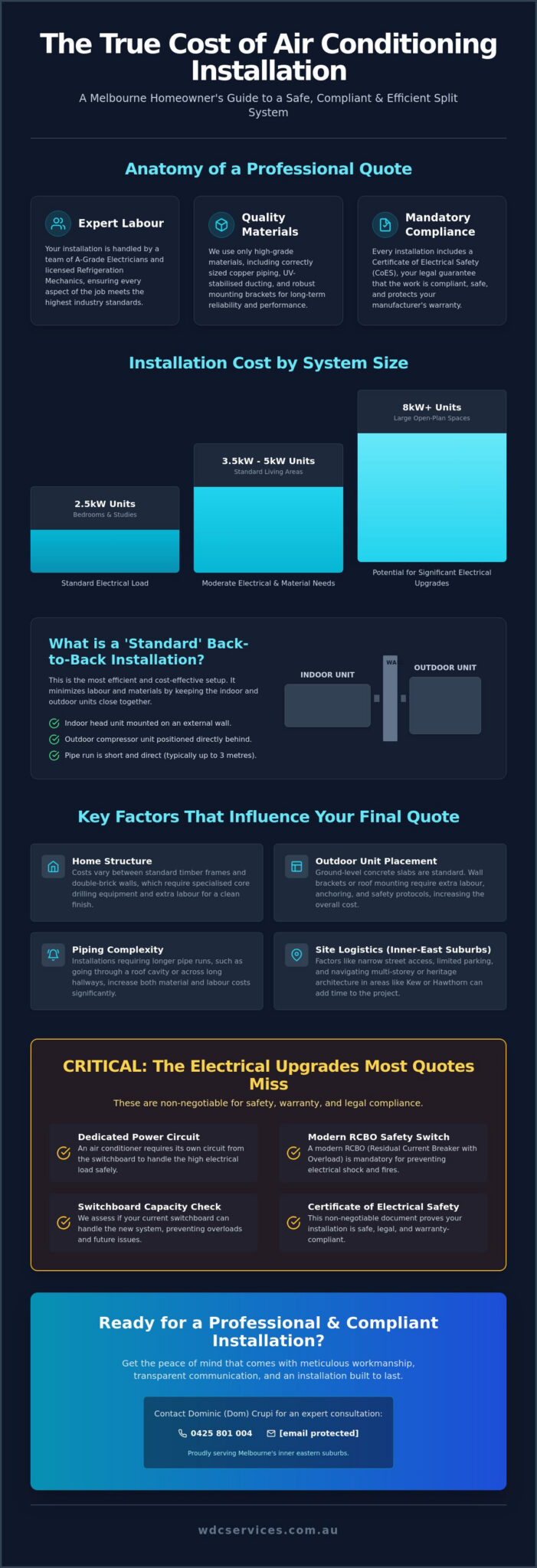
System size is the primary driver of cost variance across Victoria. A small 2.5kW unit intended for a study requires less refrigerant and simpler electrical termination than a heavy-duty 8kW+ system designed for an open-plan living area. Larger units often demand upgraded circuit breakers and thicker cabling to handle the increased electrical load safely. For a standard 3.5kW bedroom installation, the market average typically reflects a mid-tier investment that balances efficient cooling capacity with standard residential electrical requirements.
Every professional quote should clearly outline three core components. First is the expert labour from both an A-Grade electrician and a licensed refrigeration mechanic. Second is the material kit, which includes copper piping, UV-stabilised ducting, and mounting brackets. Finally, the price must include a Certificate of Electrical Safety (CoES). This document is your legal proof that the work meets Victorian regulatory standards and that your manufacturer’s warranty remains valid.
What is a ‘Standard’ Back-to-Back Installation?
A back-to-back setup is the most streamlined and cost-effective configuration available. In this scenario, the indoor head unit is mounted on an external wall, while the outdoor compressor sits directly behind it on the ground or a wall bracket. This layout typically uses up to three metres of pipework. It minimises labour time and material waste, making it a popular choice for residents seeking a high-quality finish without the complexity of internal roof runs. Understanding how air conditioning works through the heat exchange between these two units clarifies why keeping them close together improves overall efficiency.
Why 2026 Prices Vary Across Melbourne Suburbs
Location plays a significant role in your final project estimate. In established inner-eastern suburbs like Kew, Hawthorn, or Balwyn, installers often navigate narrow streets, limited on-site parking, and multi-storey Victorian-era architecture. These logistical factors can add time to the project. The 2026 market also reflects current Victorian labour rates for dually licensed trades and the fluctuating global prices of copper piping. Choosing a local specialist who understands the specific building styles of the eastern suburbs ensures the workmanship is tailored to your home’s unique structural needs.
Key Factors That Influence Your Installation Quote
While the unit price is a fixed variable, the structural layout of your home introduces several technical factors that fluctuate the split system installation cost melbourne. Melbourne’s inner eastern suburbs feature a diverse range of architectural styles, from heritage weatherboards to modern double-brick veneer residences. Each material demands a different approach. Drilling through a standard timber frame is a straightforward process, but core drilling through double-brick requires precision and heavy-duty equipment to ensure a clean, professional finish without compromising the structural integrity of your home.
Mounting the outdoor compressor unit also impacts the final project estimate. A ground-level concrete slab is often the most stable option for vibration control and long-term reliability. However, in suburbs like Camberwell where property boundaries are tight, wall brackets or roof mounting may be necessary. These alternatives require extra labour for secure anchoring and often involve working at heights, which brings additional safety protocols into play to protect both the tradespeople and your property.
Pipe length and the complexity of the run are critical cost drivers. A standard installation assumes a short, direct path between the indoor and outdoor components. If the unit needs to move “up and over” through a roof cavity or across a long hallway, you’ll see an increase in both material costs and labour hours. Choosing the right size air conditioner is only half the battle; ensuring the refrigerant lines are as short and efficient as possible protects the system’s performance and longevity.
Pipe Runs and Containment
For high-end renovations in Melbourne’s East, aesthetics are just as important as functionality. While external PVC ducting is the standard for containing pipes, many homeowners prefer “hidden” internal piping for a seamless look. This requires more intensive labour to route lines through wall cavities. Additionally, if the indoor unit is located on an internal wall where gravity drainage isn’t possible, we must install a condensate pump. This small but vital component ensures moisture is removed effectively, preventing water damage to your plasterwork. Our comprehensive electrical services ensure these pumps are integrated perfectly into your system’s power supply.
Access and Equipment Requirements
Multi-storey challenges in areas like Balwyn North frequently require specialized access equipment. Installing a head unit on the second floor isn’t just about the height; it’s about managing the drainage and electrical runs across two levels safely. This often requires scaffolding or specialized ladders to meet Victorian WorkSafe regulations. These safety requirements are non-negotiable and contribute to the overall split system installation cost melbourne, but they provide the peace of mind that the project is being handled by disciplined professionals who value site safety and high standards of workmanship.
The Electrical Factor: Switchboards and Dedicated Circuits
One of the most frequent surprises regarding the split system installation cost melbourne is the requirement for a dedicated electrical circuit. Many homeowners assume the unit can simply be tapped into an existing power point circuit. Under Victorian wiring standards (AS/NZS 3000:2018), this is strictly prohibited for most modern units. A dedicated circuit ensures the air conditioner has its own path back to the switchboard, preventing it from overloading your kitchen appliances or lighting. An undersized electrical supply creates excessive heat in the wiring, significantly increasing the risk of a domestic fire.
Professional installation must be performed by a licensed Registered Electrical Contractor (REC). This ensures the work is not only functional but fully compliant with state regulations. Upon completion, we provide a Certificate of Electrical Safety (CES). This document is your legal guarantee that the work meets high standards. Without it, you may face significant issues with insurance claims or manufacturer warranty support if an electrical fault occurs. We prioritise this level of accountability to give you total peace of mind.
Does Your Switchboard Need an Upgrade?
Many older homes in Melbourne’s eastern suburbs still rely on outdated ceramic fuse boxes. While these were standard decades ago, they aren’t designed to handle the high-draw requirements of modern climate control systems. Upgrading to modern RCBO (Residual Current Breaker with Overcurrent protection) safety switches is often a necessary “hidden cost” that should be factored into your budget. At WDC Services, we integrate our electrical expertise into every project. We don’t just install the unit; we ensure your entire electrical system is robust enough to support it safely, providing quality finishes that protect your home.
Mains Capacity and Phase Power
Before proceeding with an installation, it’s vital to assess your home’s total mains capacity. If you plan to install multiple units across several rooms, your property may require more “Amps” than the current street connection provides. Most residential homes use single-phase power, which is sufficient for one or two systems. However, larger estates may require an upgrade to three-phase power to maintain stability during peak usage. Understanding these requirements is a key part of our Essential Electrical Upgrades for a Melbourne Reno, ensuring your home remains functional as you modernise your living space. We take pride in managing these complex technical details so you don’t have to worry about tripped breakers during a heatwave.
Sizing and ROI: Getting the Most Value for Your Money
True value in climate control isn’t found in the cheapest quote, but in the long-term efficiency of the system. While the initial split system installation cost melbourne might be your primary focus, the return on investment (ROI) is determined by how the unit performs over the next decade. An undersized unit is a common pitfall. It’s forced to run at maximum capacity for hours to reach the desired temperature, which accelerates mechanical wear and significantly increases your monthly energy bills. Modern inverter technology solves this by modulating power usage, allowing the system to maintain comfort levels while drawing minimal current from your electrical board.
Choosing between a budget model and a 5-star energy-rated unit involves looking at the total cost of ownership. High-efficiency models often pay for themselves within three to five years through reduced running costs. In Melbourne’s inner eastern suburbs, we must also account for specific architectural variables. High ceilings in period homes increase the volume of air that needs to be conditioned, while large expanses of North-facing glass in modern renovations can dramatically increase heat gain during summer. These factors mean a generic “room size” estimate often falls short of reality.
Room Size vs. kW Capacity Chart
A professional heat load calculation is the only way to ensure your system isn’t working harder than it needs to. Use the following guide as a baseline for standard Melbourne homes:
- 2.5 kW: Ideal for small bedrooms or studies (approx. 10 to 20 sqm).
- 3.5 kW: Suited for master bedrooms or medium living areas (20 to 35 sqm).
- 5.0 kW: Designed for larger living rooms or master suites (35 to 50 sqm).
- 7.0 kW to 8.0 kW+: Required for large, open-plan kitchen and dining renovations (60 sqm+).
If you’re unsure which capacity fits your home’s layout, our team at WDC Services can provide a precise assessment tailored to your renovation.
Heating vs. Cooling Efficiency
Melbourne is famous for its volatile weather, making the heating performance of your split system just as critical as its cooling power. Modern reverse-cycle systems are now the most cost-effective way to heat a Victorian home, often outperforming traditional gas heaters in both speed and energy consumption. With the Victorian government encouraging a phase-out of residential gas, transitioning to an all-electric HVAC setup is a strategic move for any homeowner planning a comprehensive renovation. It streamlines your utility bills and prepares your property for a more sustainable, electric-first future. This disciplined approach to energy management ensures your home remains comfortable year-round without excessive operational costs.
The WDC Difference: Professional Installation in Melbourne’s East
Choosing a partner for your climate control project is a decision that impacts the long-term safety and comfort of your home. While many providers focus solely on the split system installation cost melbourne, we prioritize a comprehensive service model that treats your installation as a vital component of your home’s infrastructure. At WDC Services, we act as an extension of your own team, managing every technical detail from initial design planning to the final commissioning of the unit. This methodical approach ensures your environment is in expert hands, providing the security and peace of mind you deserve.
Dominic Crupi provides direct oversight on every project to maintain our high standards of workmanship and precision. We understand that a professional installation requires more than just technical skill; it demands punctuality, clear communication, and a proactive attitude. We keep you well-informed throughout the process, reinforcing a sense of trust that has led to our team being highly recommended by previous clients across the eastern suburbs. Our commitment to quality finishes means we treat your property with the same respect we would our own, ensuring every component is installed with meticulous care.
Integrated Trade Expertise
One major differentiator in our service is our ability to handle electrical, carpentry, and finishing requirements in-house. Many high-volume installers leave unsightly holes in plaster or exposed wiring that ruins the aesthetic of a high-end renovation. Because our background is rooted in Bathroom Renovations Melbourne Eastern Suburbs, we possess the specialized skills to integrate HVAC systems into complex architectural environments seamlessly. We eliminate the need for you to coordinate multiple contractors, providing a fluid integration that ‘cowboy’ installers simply cannot match.
Book Your Melbourne Installation
We focus our expertise on the inner Melbourne eastern suburbs, including Balwyn, Box Hill, Doncaster, Kew, and Hawthorn. Our process begins with a tailored, fixed-price quote that accounts for the specific electrical and structural needs of your property. This transparency brings order to a complex environment, ensuring the final split system installation cost melbourne reflects true value without hidden surprises. We value long-term relationships over quick transactions, which is why our workmanship is designed to last. To discuss your project or schedule a site assessment, contact Dominic (Dom) Crupi directly at 0425801004 or email us at info@wdcservices.com.au. We look forward to helping you achieve a professional, compliant finish that stands the test of time.
Secure Your Home’s Comfort with Expert Trade Integration
Investing in modern climate control is about more than just the initial equipment purchase. It’s about ensuring your home’s electrical infrastructure is robust and that the final finish complements your existing renovation. We have detailed how the split system installation cost melbourne residents encounter in 2026 is driven by technical compliance, structural factors, and the mandatory requirement for dedicated circuits. By choosing a partner who values high-quality finishes and disciplined trade expertise, you protect your property from the risks of hidden electrical faults and substandard workmanship.
As specialists in Melbourne’s eastern suburbs, WDC Services brings a comprehensive approach to every project. Our licensed Victorian electricians manage the entire process, from initial design planning to final commissioning. This ensures a seamless result that won’t void your manufacturer’s warranty or compromise your safety. If you’re ready for a professional, reliable installation that prioritizes long-term efficiency, contact Dom Crupi at WDC Services today. You can reach Dom directly at 0425801004 or email info@wdcservices.com.au to discuss your specific requirements. Let’s work together to create a comfortable, compliant, and energy-efficient environment for your home.
Frequently Asked Questions
How much does a split system installation cost in Melbourne?
The total investment varies based on system capacity and the complexity of your home’s layout. A typical split system installation cost melbourne homeowners encounter for a standard back-to-back setup usually starts from $1,650 for both supply and installation of major brands. Final figures depend on factors like the unit’s kW rating, the distance between components, and any necessary electrical upgrades required to meet Victorian safety standards.
Do I need a licensed electrician for split system installation?
Yes, Victorian law requires two specific licenses for a compliant installation. You must hire a Registered Electrical Contractor (REC) for the dedicated circuit and a licensed plumber with a refrigeration certificate for the pipework and refrigerant handling. Hiring a professional team ensures your workmanship meets Australian Standards, keeps your manufacturer’s warranty valid, and provides the essential legal protection for your property.
How long does a standard split system installation take?
A standard back-to-back installation typically takes between three and five hours to complete. If your project involves complex pipe runs through roof cavities or requires multi-storey access in suburbs like Balwyn or Kew, the process may take a full day. We prioritize punctuality and clear communication to ensure our disciplined team completes the work efficiently while maintaining a clean and organized workspace.
Will I need to upgrade my switchboard for a new air conditioner?
You’ll likely need an upgrade if your home still uses outdated ceramic fuses or lacks space for a dedicated circuit. Modern air conditioners require RCBO safety switches to manage the electrical load safely and prevent fire risks. During our initial assessment, we check your board’s capacity to ensure it can handle the new system without tripping breakers or compromising your home’s electrical stability.
Can I buy the unit myself and just pay for installation?
Yes, you can purchase a unit independently and hire us for the professional installation and commissioning. This “labour-only” approach is common, though many clients find better value in our comprehensive services where we handle both supply and installation. Choosing a full package ensures the unit is perfectly sized for your room’s orientation and that you receive a single point of accountability for the entire project.
What is a Certificate of Electrical Safety and why do I need one?
A Certificate of Electrical Safety (CoES) is a mandatory document issued by a licensed electrician that proves the work complies with Victorian regulations. You need this certificate to maintain your home insurance coverage and to provide proof of compliance if you sell your property. It’s your guarantee that the split system installation cost melbourne investment you made resulted in a safe and professional outcome.
Are there any rebates for split system installation in Victoria in 2026?
The Victorian Energy Upgrades (VEU) program offers significant discounts for homeowners replacing old gas or inefficient electric heaters with high-efficiency reverse cycle systems. These savings are applied directly to your installation invoice rather than as a traditional cash-back rebate. Be aware that upcoming program changes on July 31, 2026, are expected to increase the minimum customer contribution for larger multi-head and ducted systems.
Does WDC Services install split systems during a bathroom or kitchen renovation?
Yes, we specialize in integrating climate control into larger renovation projects to ensure a seamless and high-quality finish. By managing the electrical, structural, and installation components in-house, we avoid the need for multiple contractors and ensure your system is perfectly integrated into your new space. Contact Dominic Crupi at 0425801004 to discuss how we can include professional HVAC installation in your next eastern suburbs renovation.
Disclaimer
Please note this advertisement has been AI generated for entertainment and leed generation purposes and In some cases may not reflect the companies exact services and information.
Prior to engaging the company it is recommended that you seek clarification on some or all points in this advertisement .
Wdc services has many 5 star google reviews that can be used as a reliable and true testimony to the quality services proved to its customers over many years.
Contact Domenico ( Dom ) Crupi on 0425801005 or email info@wdcservices .com.au
for further information
Disclaimer: Disclaimer, Please note this advertisement has been AI generated for entertainment and leed generation purposes and In some cases may not reflect the companies exact services and information. Prior to engaging the company it is recommended that you seek clarification on some or all points in this advertisement. WDC Services has many 5 star google reviews that can be used as a reliable and true testimony to the quality services proved to its customers over many years. Contact Domenico ( Dom ) Crupi on 0425801005 or email info@wdcservices .com.au for further information.