
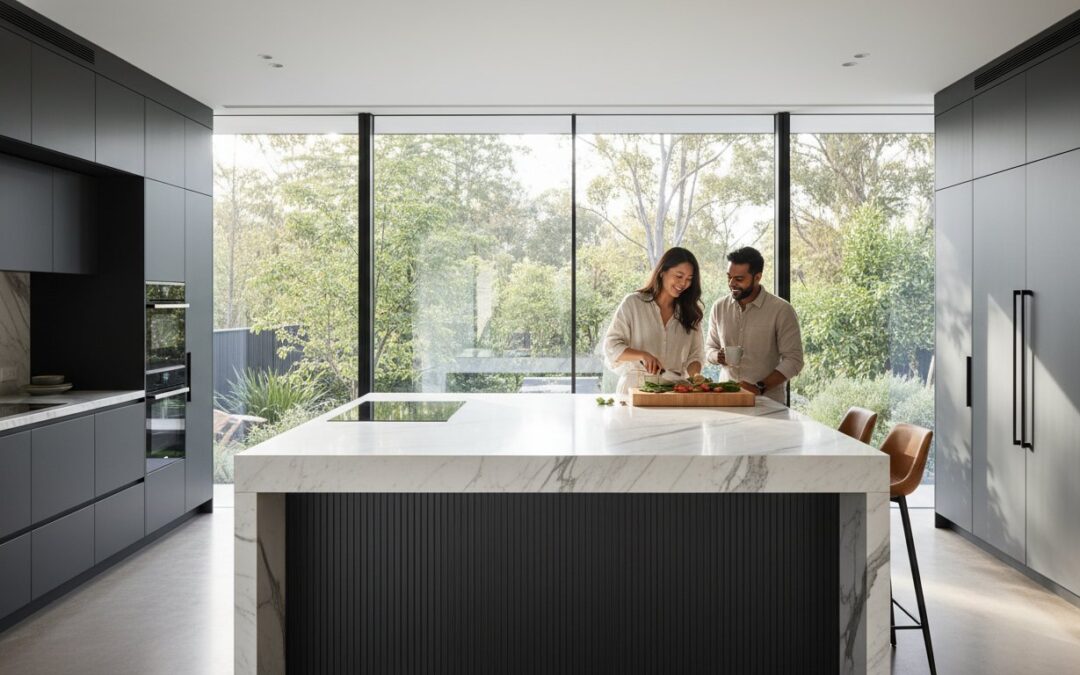
A poorly planned kitchen island doesn’t just ruin your daily workflow; it can strip upwards of A$25,000 off your home’s resale value in competitive markets like Hawthorn or Kew. You likely recognize that a kitchen should be a social hub, yet the fear of creating a cramped environment or miscalculating clearance zones often stalls even the most ambitious renovation plans. It’s a common concern for homeowners who want to balance modern functionality with the unique architectural heritage found across Melbourne’s eastern suburbs.
While focusing on local standards is essential, looking at international trends can also spark unique ideas. You can find out more about Kitchen Renovation through the high-end projects showcased by JA Renovation.
This guide provides the methodical framework you need to design a bespoke kitchen island that balances aesthetic elegance with operational excellence. We’ll explore exact dimensions for 2026 design trends, technical requirements for moving plumbing and power, and how to ensure your new centerpiece integrates seamlessly with your existing cabinetry. By the end of this article, you’ll have the clarity to transform your kitchen into a high-quality, functional space that serves as a reliable anchor for your family’s daily life.
Key Takeaways
- Learn how the “1200mm Rule” provides the essential clearance required to maintain a safe and efficient workflow in your bespoke kitchen layout.
- Discover the design secrets for selecting premium stone and waterfall edges that reflect the luxury architectural standards of Melbourne’s eastern suburbs.
- Master the technical planning required to integrate power, data, and plumbing into your kitchen island without compromising on aesthetic appeal.
- Understand the importance of meticulous sub-floor assessments and professional workmanship to ensure your renovation is both compliant and long-lasting.
- Identify how to bridge the gap between food preparation and social interaction by positioning your island as a multi-functional anchor for the home.
The Strategic Role of a Kitchen Island in Melbourne Renovations
The modern kitchen island serves as the indispensable anchor of the home. It acts as a bridge between culinary preparation and social life. In the heritage-rich streets of Melbourne’s eastern suburbs, this feature is transformative. Many older Victorian layouts in Kew or Hawthorn suffer from compartmentalized rooms that feel isolated. By removing restrictive walls and installing a bespoke island, we create a fluid transition between the kitchen and the dining area. The Strategic Role of a Kitchen Island has evolved from a simple prep table into a sophisticated command center that houses sinks, cooktops, and integrated storage.
WDC Services differentiates between basic furniture-style units and bespoke built-in structures. A furniture-style island might offer a temporary surface, but a bespoke solution is a permanent, engineered asset. We integrate plumbing, electrical outlets, and high-end cabinetry to match your existing architecture. This approach ensures the installation feels like an intentional part of the home’s DNA rather than an afterthought. Bespoke islands deliver permanence. They allow for seamless integration of appliances that a standalone table simply cannot support.
The Social Hub: Entertaining in the Eastern Suburbs
Hosting guests in Camberwell or Hawthorn requires a layout that facilitates conversation without crowding the chef. We design islands that protect the primary work triangle; this keeps a clear 1.2-meter pathway between the fridge, stove, and sink. By 2026, the “work-from-home” lifestyle has cemented the kitchen island as a secondary office. We install hidden power points and USB-C ports to support laptops while maintaining a clean, professional aesthetic. Details matter most when a space serves multiple purposes.
Property Value: Why Islands are a High-ROI Feature
In luxury markets like Balwyn and Deepdene, a premium kitchen is a non-negotiable expectation for buyers. Real estate data from early 2025 suggests that homes with oversized, high-finish islands can see a 15% to 20% increase in perceived value compared to standard galley layouts. The 2026 trend favors “super-islands” exceeding 3 meters in length, often featuring dual-tier stone surfaces. This investment signals quality. It demonstrates a commitment to meticulous planning that resonates with prospective owners looking for a “safe pair of hands” in home design.
If you’re ready to elevate your home with a professional renovation, contact Dominic (Dom) Crupi at 0425801004 or email info@wdcservices.com.au. Our team provides the reliable, high-quality workmanship that Melbourne homeowners trust. We handle the details so you don’t have to.
Essential Clearances and Dimensions for a Functional Island
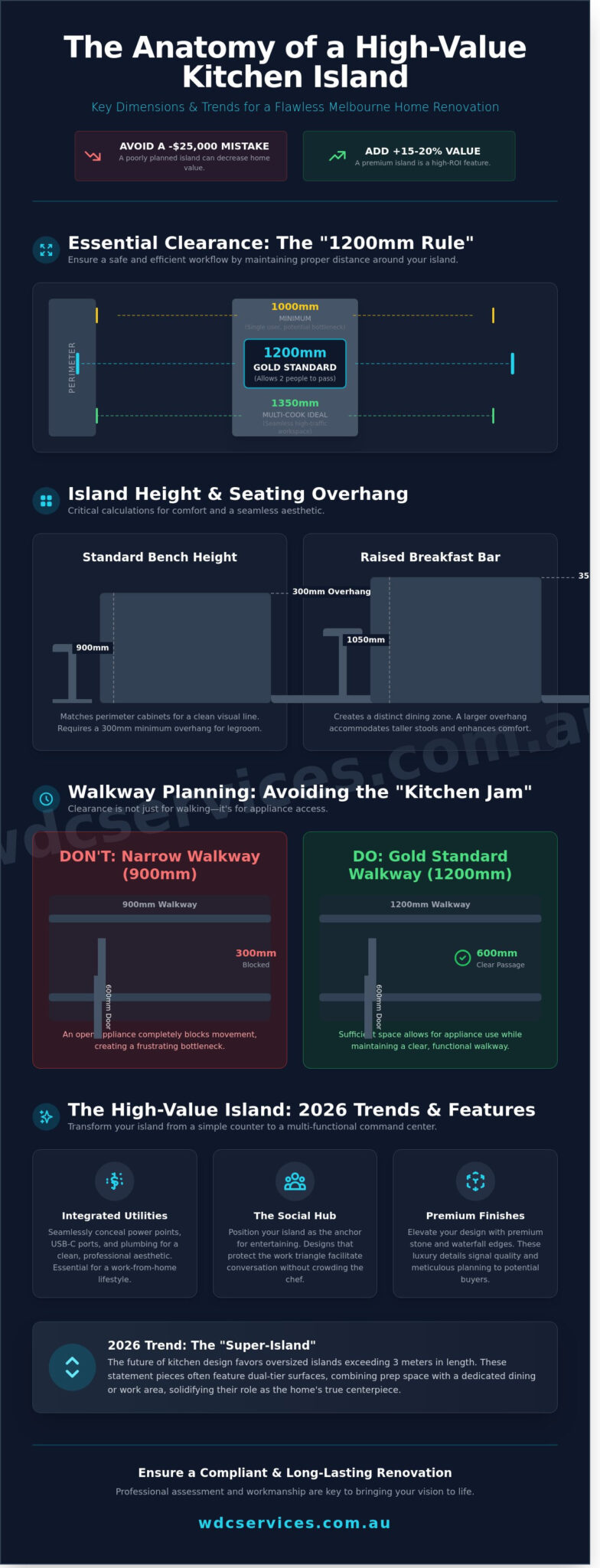
Designing a functional kitchen island starts with the 1200mm rule. This measurement represents the gold standard for clearance between your island and the surrounding perimeter benches. While a 1000mm gap is technically functional for a single occupant, it often leads to bottlenecks in busy households. At WDC Services, we recommend 1200mm because it allows two people to pass comfortably or permits one person to load the dishwasher while another moves behind them without physical contact. For multi-cook households in Melbourne’s eastern suburbs, increasing this to 1350mm can transform a high-traffic zone from a point of frustration into a seamless workspace.
Standard heights for your island should typically match your kitchen cabinets at 900mm. This uniformity creates a clean, continuous visual line across the room. If you intend to include seating, the “overhang” is a critical calculation. For a standard 900mm high bench, a 300mm overhang is the minimum required for comfortable legroom. If you prefer a raised breakfast bar at 1050mm, you should extend that overhang to 350mm or 400mm to accommodate taller stools and provide a more relaxed dining experience. You can find more inspiration on Choosing Your Island Style to see how these dimensions apply to different layouts.
The Walkway Guide: Avoiding the “Kitchen Jam”
Walkway clearance isn’t just about walking; it’s about appliance access. A standard dishwasher door requires 600mm of space when fully dropped. If your walkway is only 900mm, you’re left with a tiny 300mm sliver of space to move. In narrow Edwardian kitchen footprints common in Hawthorn or Camberwell, we often employ bespoke solutions to maximize every millimeter. We prioritize a 1050mm clearance in these tighter zones to ensure the kitchen island doesn’t become an obstacle. If you’re unsure how your current layout stacks up, speaking with an expert can help clarify your options.
Proportion and Scale: Fitting the Island to the Room
The 10% rule is a vital metric for maintaining balance. Your island should ideally occupy no more than 10% of the total kitchen floor area. Anything larger risks overwhelming the room and making the space feel claustrophobic. We often use kitchen makeovers techniques like “waterfall” stone edges or recessed plinths to lighten the visual weight of larger installations. For sprawling open-plan homes in Glen Waverley, a long 3-meter island provides a dramatic focal point, whereas T-shaped configurations work better for families who want a dedicated dining zone integrated directly into the prep area.
Planning these dimensions requires a meticulous eye for detail to avoid costly mistakes. If you are ready to start your project, contact Dominic (Dom) Crupi at 0425801004 or email info@wdcservices.com.au to discuss your specific requirements. Our team ensures every millimetre is accounted for in your Melbourne home.
Choosing Your Island Style: Aesthetics and Materials
Selecting the right style for your kitchen island defines the entire room’s atmosphere. WDC Services approaches this design phase with a focus on both visual impact and long-term durability. We help you decide between waterfall edges and traditional cabinetry based on your home’s architecture and your daily habits. Our team ensures the transition between materials is seamless and structurally sound.
Waterfall edges, where the stone continues down the sides to the floor, create a high-end look common in modern renovations across Melbourne’s eastern suburbs. Traditional cabinetry provides a warmer, furniture-like feel that suits heritage homes in areas like Camberwell or Hawthorn. This guide to six popular designs highlights how these structural choices impact the overall flow and visual weight of your space.
Storage integration has evolved beyond simple cupboards. We have seen a 40% increase in client requests for deep pot drawers, which offer superior ergonomics and organization. The rise of the “hidden pantry” within the kitchen island allows you to store small appliances like toasters or blenders out of sight, maintaining a clutter-free environment. Using contrasting joinery colors, such as a charcoal base against a light stone top, transforms the unit into a sophisticated statement piece that anchors the room.
Benchtop Excellence: Caesarstone and Beyond
Caesarstone benchtops remain the premier choice for Melbourne families because they offer exceptional resistance to stains and scratches. While porcelain is gaining popularity for its heat resistance, Caesarstone provides a reliable, high-quality finish that our installers trust for its consistency. We often recommend a 40mm mitred edge profile for a modern, substantial look, or a square edge for a crisp, minimalist aesthetic. Timber accents can also be integrated to add warmth to seating areas.
Cabinetry and Joinery Details
Custom joinery ensures every millimetre of the island base is functional. You can choose between high-quality handles or sleek, push-to-open mechanisms to achieve a handle-less finish. Incorporating open shelving at one end provides a perfect spot for cookbooks or decorative items, softening the transition from the kitchen to the dining area. We prioritize quality finishes and meticulous workmanship to ensure your cabinetry withstands the heavy use typical of a busy household.
For a tailored design that fits your specific needs, contact Dominic (Dom) Crupi at WDC Services. Our team provides professional guidance and quality workmanship throughout the inner Melbourne eastern suburbs. Call us on 0425801004 or email info@wdcservices.com.au to start planning your renovation with a partner you can trust.
How to Plan Your Island Utilities: Plumbing, Power, and Lighting
Planning a kitchen island requires more than just aesthetic choices; it involves meticulous technical coordination. Our team at WDC Services approaches these installations with a focus on long-term reliability and compliance with Victorian building codes. Successful utility integration follows a disciplined five-step process.
- Step 1: Sub-floor Assessment. We examine your home’s foundation to determine the feasibility of plumbing and gas relocation. For properties in Kew or Hawthorn, this often involves navigating timber joists or core-drilling through 150mm concrete slabs to ensure a 1:40 fall for waste pipes.
- Step 2: Electrical Circuitry. We plan dedicated 10-amp or 15-amp circuits. This prevents circuit overloads when you’re using high-draw appliances alongside integrated USB-C charging ports.
- Step 3: Task Lighting. Functional lighting is essential. We typically recommend three pendants spaced 600mm apart or recessed LED strips to provide a shadow-free workspace.
- Step 4: Ventilation Management. If your cooktop sits on the kitchen island, we install downdraft extractors that move up to 900 cubic metres of air per hour. This removes the need for bulky overhead rangehoods.
- Step 5: Work Triangle Integration. We ensure the distance between the island sink, cooktop, and fridge remains between 1.2 and 2.7 metres to maintain ergonomic efficiency.
Sinks and Appliances in the Island
Placing the primary sink in the island turns it into a high-traffic zone. It’s excellent for social interaction, but you must account for the 600mm clearance required for an open dishwasher door. We often integrate bespoke under-bench wine fridges or 20-litre microwave nooks to keep benchtops clear. This methodical approach ensures your workspace remains uncluttered and highly functional for daily use.
The Electrical Blueprint
Safety is our priority during every installation. We adhere strictly to AS/NZS 3000 wiring rules, maintaining a 300mm horizontal exclusion zone between water sources and power outlets. Pop-up power towers offer a sleek finish for a 2026 kitchen island, while side-mounted GPOs provide easy access for small appliances. For modern convenience, we integrate smart modules that allow you to control island lighting via mobile apps or voice commands.
Our director, Dominic Crupi, personally ensures that every utility plan meets our high standards for workmanship and safety. If you are ready to upgrade your home, contact Dom at 0425801004 or email info@wdcservices.com.au. WDC Services provides professional kitchen renovation services across the Melbourne eastern suburbs to ensure your project is a seamless success.
Professional Installation: Bringing Your Vision to Life with WDC Services
A kitchen island is the technical heart of your home, often requiring complex plumbing and electrical work beneath the floorboards. Professional workmanship isn’t just a preference; it’s a safety requirement for these heavy installations. WDC Services brings a meticulous eye to every Melbourne renovation, ensuring your stone waterfall edges and integrated sinks are installed with surgical precision. Dominic Crupi personally oversees the project flow, acting as your single point of contact. This “safe pair of hands” approach means we arrive on time, protect your flooring with heavy-duty drop sheets, and provide daily updates so you’re never left wondering about progress.
Bespoke Solutions for the Eastern Suburbs
Our team specializes in tailored designs for the unique architectural styles found in Kew, Balwyn, and Doncaster. We don’t believe in one-size-fits-all kits. Instead, we create bespoke solutions that respect the heritage or modern aesthetic of your specific street. Since 2008, WDC Services has maintained a transparent fixed-price project model. You won’t face unexpected surcharges for materials or labor halfway through the build. This financial certainty is why 92% of our business comes from local referrals and repeat clients who value our honest, disciplined work ethic.
Start Your Kitchen Transformation Today
A successful renovation depends on a rigorous site measure and design consultation. We analyze your existing footprint to ensure your new kitchen island allows for optimal traffic flow and meets all Victorian building codes. Dominic manages the entire ecosystem of licensed trades, including electricians for your pendant lighting and plumbers for your prep sinks. This seamless integration eliminates the scheduling conflicts that often plague DIY projects. Most of our comprehensive kitchen installations are completed within a 25-day window, minimizing disruption to your family life while delivering a high-end finish.
Ready to elevate your home? Contact Dominic Crupi today on 0425801004 or via email at info@wdcservices.com.au to book your consultation. Experience the peace of mind that comes with hiring Melbourne’s inner eastern suburb experts for your next kitchen island project.
Bring Your Vision to Life with Melbourne’s Kitchen Experts
Designing the perfect kitchen island requires balancing technical precision with your personal style. It’s about more than just adding extra bench space. It’s a central hub that demands smart plumbing and power integration. Since 2026 trends emphasize bespoke functionality, getting the dimensions right ensures your home in the Melbourne Eastern Suburbs remains practical and open. WDC Services provides a safe pair of hands for your renovation. Our team of licensed tradesmen handles every detail from the first pipe laid to the final polished finish. We eliminate the stress of hidden costs by offering fixed-price project fees. This means you’ll know exactly where your investment goes from day one. We take pride in delivering meticulous workmanship that stands the test of time. You don’t have to worry about the logistics when you have a partner who values your home as much as you do. Our local expertise ensures your project meets every Australian regulation while reflecting your unique lifestyle.
Ready to design your dream kitchen? Explore our comprehensive kitchen design guide for Melbourne’s eastern suburbs or contact Dominic (Dom) Crupi at WDC Services today or call 0425801004 for a professional consultation. We look forward to building a space your family will enjoy for years to come.
Frequently Asked Questions
What is the minimum size for a functional kitchen island?
A functional kitchen island requires a minimum size of 1200mm in length and 600mm in depth to remain stable and useful. For homeowners in the eastern suburbs who intend to include a sink or seating, we recommend a footprint of at least 1800mm by 900mm. This ensures there’s enough structural support for heavy stone benchtops and provides a 300mm overhang for comfortable leg room during breakfast.
Does a kitchen island add significant value to a Melbourne home?
Installing a high-quality kitchen island typically increases a Melbourne property’s market value by 5% to 8% based on 2024 real estate trends. Buyers in the eastern suburbs prioritize open-plan living and social cooking spaces. Our bespoke designs create a centerpiece that combines storage with functionality, making your home more attractive to prospective purchasers during a resale while providing immediate lifestyle benefits for your family.
Can I put a cooktop on my kitchen island without a bulky rangehood?
You can install a cooktop on your island without a bulky rangehood by using an integrated downdraft ventilation system. These units sit flush with the benchtop and pull steam and odours downwards into a hidden duct. In 2026, we’re seeing a 40% increase in clients choosing induction hobs with built-in extraction to maintain clear sightlines across their open-plan living areas and keep the space feeling airy.
How much clearance should I leave between the island and other cabinets?
You should maintain a clearance of 1000mm to 1200mm between your kitchen island and surrounding cabinets. This spacing ensures that two people can pass each other comfortably and that dishwasher or oven doors can fully extend without obstruction. For high-traffic Melbourne households, we often specify a 1100mm gap to balance floor space with ergonomic movement, ensuring your kitchen remains a safe and efficient environment.
Is it expensive to move plumbing to a new kitchen island?
Relocating plumbing to a new island typically costs between A$1,500 and A$3,500 depending on your home’s foundation. If you’re on a concrete slab, the process involves trenching, which sits at the higher end of that price range. We manage this entire technical process meticulously to ensure all drainage and water lines meet Victorian plumbing regulations while providing the long-term reliability our clients expect from a professional renovation.
What are the best lighting options for a kitchen island in 2026?
The top lighting options for 2026 include slimline linear LED strips and oversized architectural pendants with smart dimming capabilities. Linear lights provide even task illumination across the entire benchtop surface without creating shadows. We recommend installing three separate circuits to allow you to switch between bright food preparation light and softer ambient levels for evening entertaining, giving you total control over the room’s atmosphere.
Can I fit an island in a small L-shaped kitchen?
You can fit an island in an L-shaped kitchen if the total room width is at least 3.5 metres. This allows for a 600mm deep perimeter cabinet, a 1000mm walkway, and a 900mm wide island. If your space is tighter, we often design a bespoke “peninsula” or a mobile butcher’s block that provides the same preparation benefits without compromising the room’s flow or making the area feel cramped.
Should the island match the rest of the kitchen cabinetry?
Your island doesn’t need to match the rest of your cabinetry; in fact, 65% of our recent projects featured contrasting island colours. Using a darker timber or a bold navy for the island base creates a sophisticated focal point in the room. We ensure the design remains cohesive by using the same stone benchtop material or matching hardware across all sections, resulting in a professional and polished finish.
For expert advice on your next project in Melbourne’s eastern suburbs, contact Dominic (Dom) Crupi at WDC Services on 0425801004 or email info@wdcservices.com.au. Our team is ready to provide the professional guidance and quality workmanship your home deserves.
Disclaimer
Please note this advertisement has been AI generated for entertainment and leed generation purposes and In some cases may not reflect the companies exact services and information.
Prior to engaging the company it is recommended that you seek clarification on some or all points in this advertisement .
Wdc services has many 5 star google reviews that can be used as a reliable and true testimony to the quality services proved to its customers over many years.
Contact Domenico ( Dom ) Crupi on 0425801005 or email info@wdcservices .com.au
for further information
Disclaimer: Disclaimer, Please note this advertisement has been AI generated for entertainment and leed generation purposes and In some cases may not reflect the companies exact services and information. Prior to engaging the company it is recommended that you seek clarification on some or all points in this advertisement. WDC Services has many 5 star google reviews that can be used as a reliable and true testimony to the quality services proved to its customers over many years. Contact Domenico ( Dom ) Crupi on 0425801005 or email info@wdcservices .com.au for further information.